

Target Cities: Kokura and Nagasaki
Kokura: Military Arsenal of Southern Japan
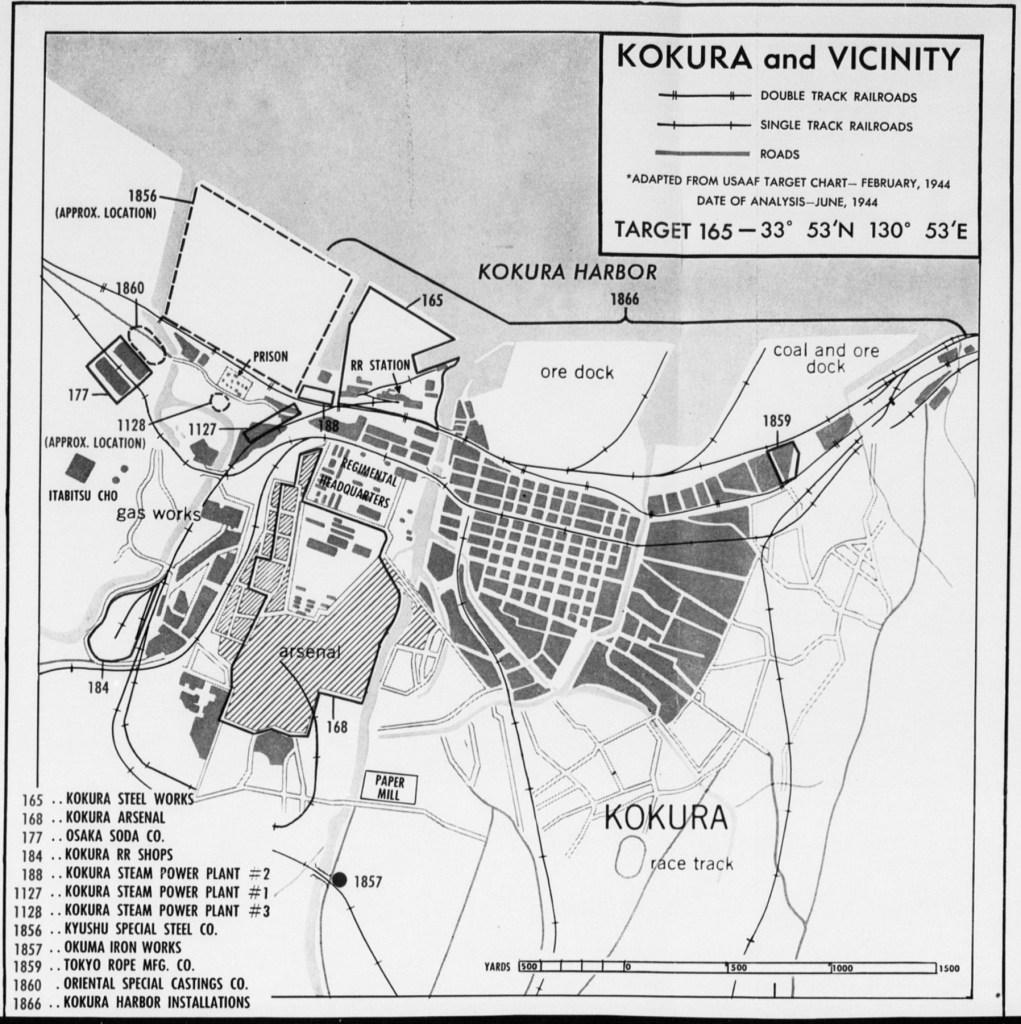
Kokura is an industrial city located on the northernmost point of Kyushu Island and ideally situated on the western bend of the Shimonoseki Strait (Shimonoseki Kaikyo in Japanese, also called the Kanmon Strait). During the Pacific Campaign, Kokura was identified as Target Area No. 90.34 by the Allied Joint Target Group. As the shortest route from Korea and the Yellow Sea to the island of Shikoku and the east coast of Honshu, the cities along the Shimonoseki Strait naturally developed as ideal locations for Japanese industry. In the 1930’s and the early years of the Second World War, the area grew to see the heaviest concentration of shipping in the Far East. In addition to Kokura, the cities in this area included Tobata, Wakamatsu, Shimonoseki, Moji, and Yahata (called Yawata by Allied Intelligence, sometimes confused with Yawata City in Kyoto Prefecture).
Kokura’s industrial center was not a large target, estimated to be only 1.5 square miles (3.9 square kilometers) in size by Allied Intelligence. However, inside this small footprint were twelve individually marked targets, foremost among them being the Kokura Arsenal, referred to as Target No. 168, which, in addition to its industrial purpose of manufacturing weapons and equipment vital to Japan’s war effort, also housed a garrison consisting of one Imperial Japanese Army regiment. Allied intelligence reports marked Kokura Arsenal as the largest producer of artillery guns and shells, military vehicles, and small arms ammunition in southern Japan. Particularly concerning for the Allies were unconfirmed reports that peacetime chemical production plants in Kokura were being outfitted with the capability to load poison gas artillery shells and store chlorine, phosgene, and mustard gas.
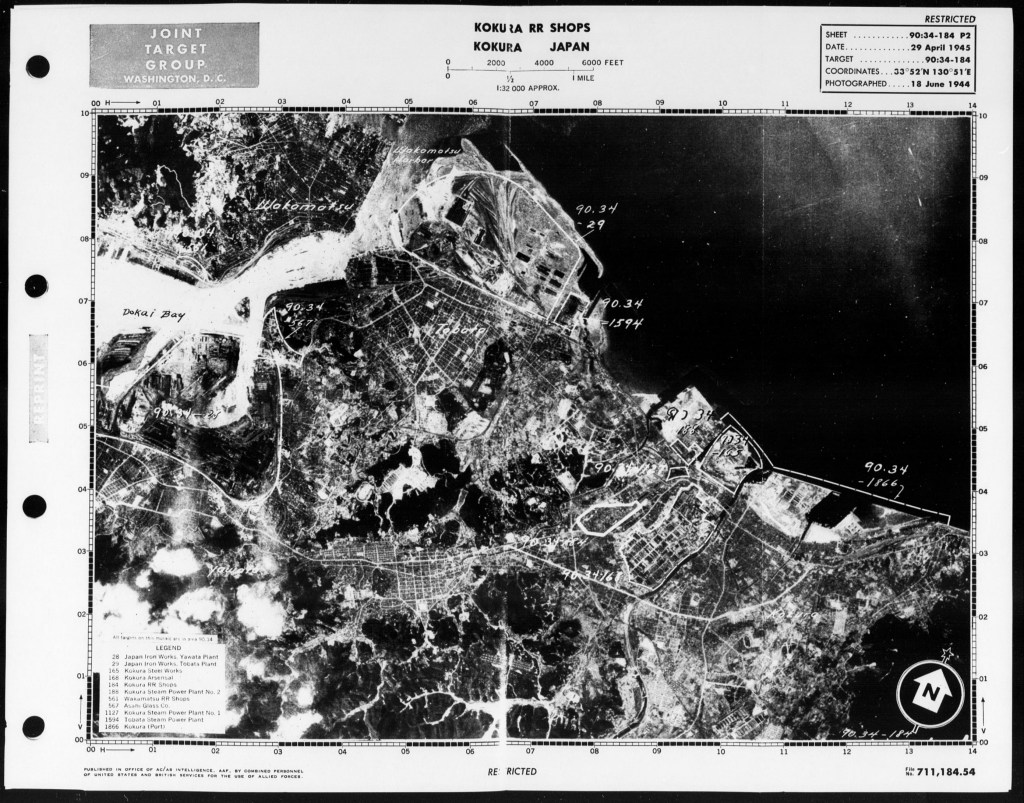
Allied Intelligence map produced by the Joint Target Group showing the Kokura Railroad Shops in Kokura, Japan. From the National Archives Catalog, NAID 778122858. 
Allied Intelligence map produced by the Joint Target Group showing the Kokura Aresenal in Kokura, Japan. From the National Archives Catalog, NAID 778122858. 
Allied Intelligence map produced by the Joint Target Group showing the Kokura Steel Works in Kokura, Japan. From the National Archives Catalog, NAID 778122858. 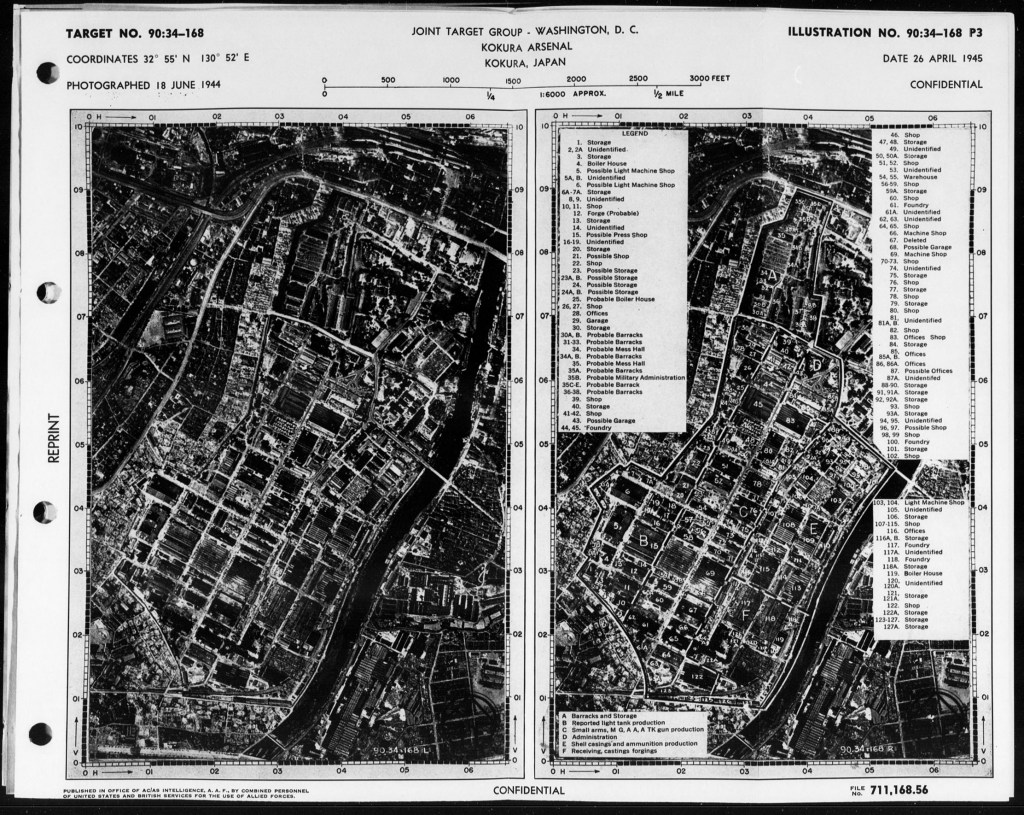
Allied Intelligence map produced by the Joint Target Group showing the identified buildings comprising the Kokura Arsenal in Kokura, Japan. From the National Archives Catalog, NAID 778122858.
| Target Number | Target Name | Air Target Index Comments |
| Target No. 165 | Kokura Steel Works | Integrated iron and steel plant with large capacity for shapes, bars, wire rod. Probably working at very small percentage of capacity. |
| Target No. 168 | Kokura Arsenal | Important producer of artillery, vehicles, guns, shells, and other armament. One of largest in Japan. Small storage area. |
| Target No. 177 | Osaka Soda Company | Sizable producer of caustic soda, chlorine and hydrochloric acid. |
| Target No. 184 | Kokura Railroad Shops | Large [railroad] repair shops. Also large producer of freight cars. |
| Target No. 188 | Kokura Steam Power Plant No. 2 | Installed capacity 78,000 kw. Ranks second among 5 plants supplying 70% of power to N Kyushu heavy industry zone. |
| Target No. 1127 | Kokura Steam Power Plant No. 1 | 40,000 kw capacity; smallest of 5 generating stations supplying 70% of electric power to N Kyushu industrial zone. |
| Target No. 1128 | Kokura Steam Power Plant No. 3 | 50,000 kw capacity. |
| Target No. 1856 | Kyushu Special Steel Company | Small producer of high speed steel, steel for aircraft, semi-finished auto and aircraft parts, precision tools, cutters, reamers. |
After the Tokyo Firebombings in early 1945, military materials manufacturing facilities moved from the Tokyo Arsenal down to the Kokura Arsenal. Also in the industrial district were three power plants in Kokura that produced a total of 173,000 kilowatts, of which 90% was used by the surrounding production plants and industries. Additional resources being refined and manufactured in the Shimonoseki Area included pig iron, rolled steel, coke and by-products, aluminum, other non-ferrous metals, coal, and machining equipment.
The Air Objective Folders by Target Area: Japan: Shimonosecki [sic] described the local climate: “Ideal weather for high-level bombing in this area is rare and difficult to forecast without adequate knowledge of existing conditions. Only 36 clear days, on the average, occur during the entire year, but there is an additional unknown number of days with scattered low or middle clouds (sky coverage, 2 to 3 tenths) during which conditions are relatively favorable. Furthermore, when sky coverage consists entirely of high clouds, even though the sky be almost or completely covered, conditions are relatively favorable for high-level bombing.”
Today, Kokura is no longer an independent city. It became two wards, north Kokura and south Kokura, of the conglomerate city of Kitakyushu (literally “North Kyushu” City in Japanese) along with Yahata, Tobata, Moji, and Wakamatsu, which included all of the portions of northern Kyushu along the southern coast of the Shimonoseki Strait.
Nagasaki: Japan’s Historic International Maritime Capital
Nagasaki is a port city on the west side of the island of Kyushu in southern Japan and is the capital city of the prefecture with the same name. Facing the Korean peninsula to the northwest, mainland China to the west, and Taiwan to the southwest, Nagasaki City is in an ideal location for trade, transportation, and industry. Its harbor in Nagasaki Bay is surrounded on all sides by peninsulas and islands that protect ships from the storms and typhoons common in the East China and Philippine Seas.
The city itself is generally divided into two primary river valleys, the Urakami Valley, which contains Nagasaki’s core industries, and the Nakashima Valley, which leads down into the eastern part of the city. Due to the mountainous terrain peaked by Mounts Inasayama, Hokazan, and Konpira, there are many smaller valleys that hug the tributary waterways that eventually empty into the two main rivers or Nagasaki Bay. The mountains and hills surrounding Nagasaki also keep the city’s populace confined to the valleys, leading to many fingers of built up areas that reach up into the forested highlands. In order to make the most use of the limited lowland terrain, the people of Nagasaki created artificial islands and reclaimed land around Nagasaki Bay, altering the waterside areas to build shipyards, wharves, and dry docks to support the ever-busy maritime industry. Even with these extra man-made spaces, the city is densely packed. Prior to World War II, an aerial view of Nagasaki would show irregularly shaped blocks of chōme (city districts) capped with the roofs of wooden or tiled buildings, each at a height different than that of its neighbors.
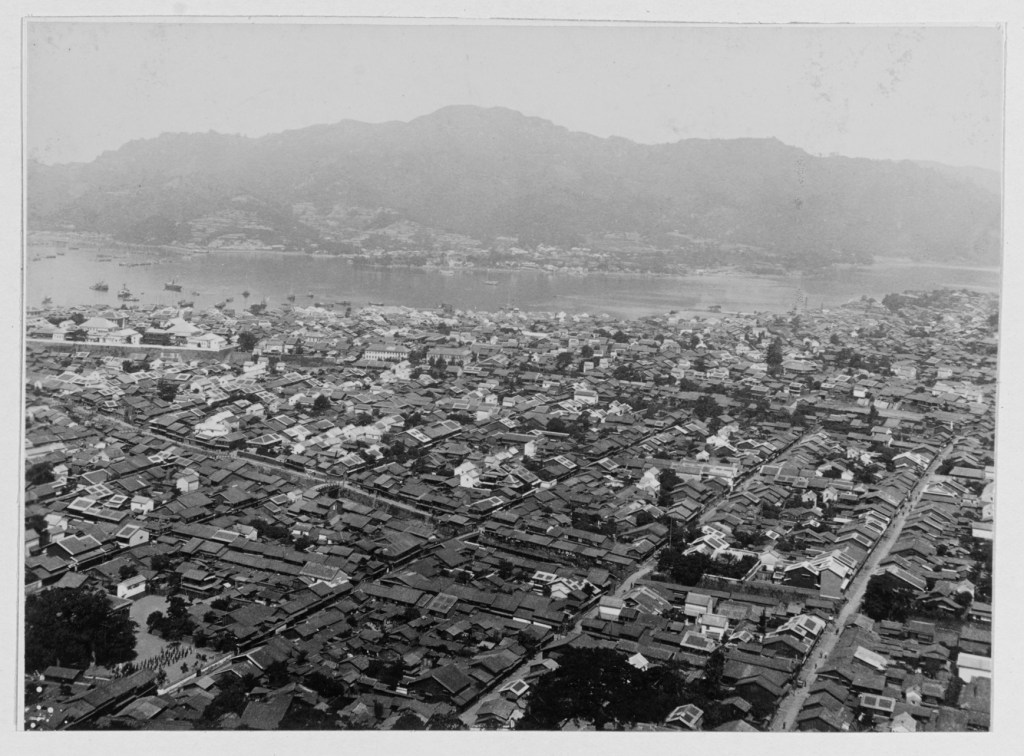
During the European Age of Discovery, Nagasaki served as one of the very few outlets in Japan where foreign trade was allowed. Dutch, Chinese, and Portuguese traders were able to establish contained districts that facilitated the flow of goods, peoples, and ideas to and from Japan and the wider world. Along with the merchants came Christian missionaries who were allowed to preach and proselytize as permitted by the Japanese officials who controlled the area at the time. However, the times when missionary work was permitted were occasionally punctuated with periods of persecution and expulsion of the European and converted local populations. Despite this, Nagasaki grew to house one of the largest Catholic congregations in Japan. By World War II, Nagasaki’s cityscape of low wooden buildings was dotted with the masonry of churches and cathedrals built in western architectural style.
According to the Army Pathology Institute’s study, “The metropolitan area of Nagasaki is officially reported as approximately 35 square miles [90 square kilometers] in extent, but the built up portion was crowded into an area of about 5.5 square miles [14.2 square kilometers]. Of this, 15% was occupied by industrial installations. In the congested remainder there were no wide streets or pleasant parkways. The houses were built so close together that there was little space for yards or gardens. Here lived a population of about 200,000, so that the general population density in the residential section can be estimated as about 56 per acre.”

The Institute continues:
“The residential buildings were of frame construction, usually in the typical Japanese style with flimsy panels, frequently containing glazed sections, and thin walls. Such structures invariably had over-heavy roofs supported by slender joists. Many of the buildings consisted of only one story and [Japanese-type] buildings higher than two stories were not common. Few of these buildings had full cellars, but the threat of air raids had led to the construction of covered trenches inside the houses. These shelters were usually arranged so that the sole entrance was indoors. Most of the Japanese-style buildings had roofs covered by ornate rounded tiles, embedded in thick mud or plaster… The schools and many of the public buildings were of modern heavy, reinforced-concrete, earthquake-proof construction. One such group of buildings housed the Hospital of the Nagasaki Medical College. These fine modern structures were located on the eastern side of the Urakami Valley, approximately midway between the steel works and the ordnance plants. There were only a few western style brick buildings with load-bearing walls in Nagasaki. Several of these were large Roman Catholic churches, and also the buildings of the Medical College.”
The Joint Target Group explains the significance of Nagasaki as a Japanese military and industrial target in its Pre-Attack Assessment, dated 5 March 1945:
“The Nagasaki area derives its industrial importance chiefly from the extensive shipbuilding and ship repair facilities of the Mitsubishi Dockyard (Target 90:36-543) and Kawanami Industry Co. Shipyard (Target 90:36-860). In addition, there are small-boat yards engaged in the construction of small wooden vessels. The Akunoura Engine Works (Target 90:36-542) a producer of large ship engines, and the Hayashi Commercial Co. Engine Works (Target 90:36-828) are functionally integrated with ship construction and repair installations of the area. These facilities are estimated to represent some 10 percent of marine engine capacity, 13 percent of shipbuilding capacity, and 6 percent of ship repair capacity for Japan Proper; and to employ some 60,000 workers (67 percent of total industrial employment in Nagasaki). The large shipways and graving docks permit the construction and repair of the largest merchant and naval vessels.”
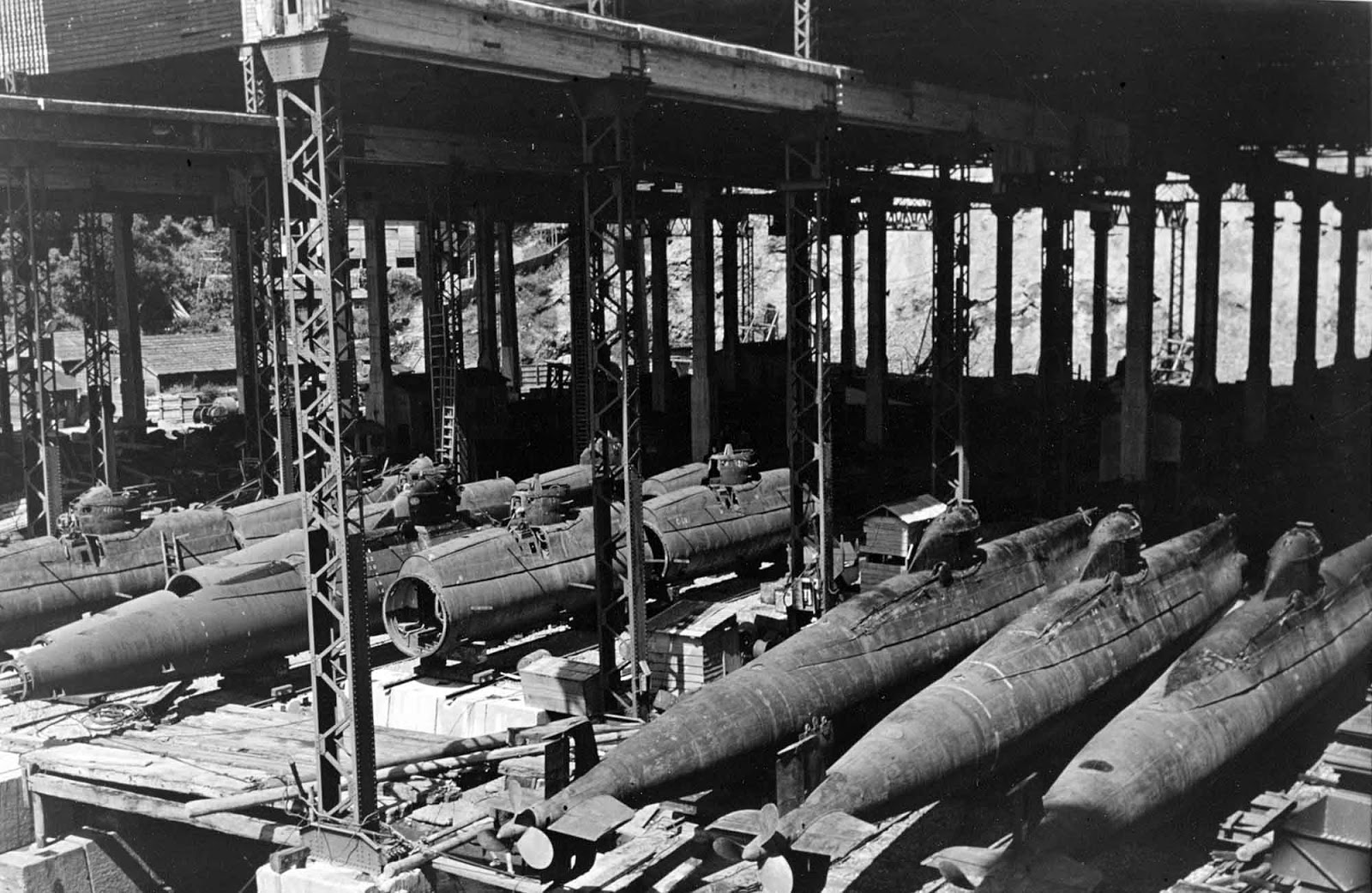
“Japanese Type D (Koryu) Midget Submarines in an assembly shed at the Mitsubishi shipyard, Nagasaki, Japan, 17 September 1945. This shop contained approximately fifteen nearly complete boats, and assemblies for many more. Photographed by Lieutenant M.P. Ewing. Official U.S. Navy Photograph, now in the collections of the National Archives.” From the NHHC, 80-G-K-6490. 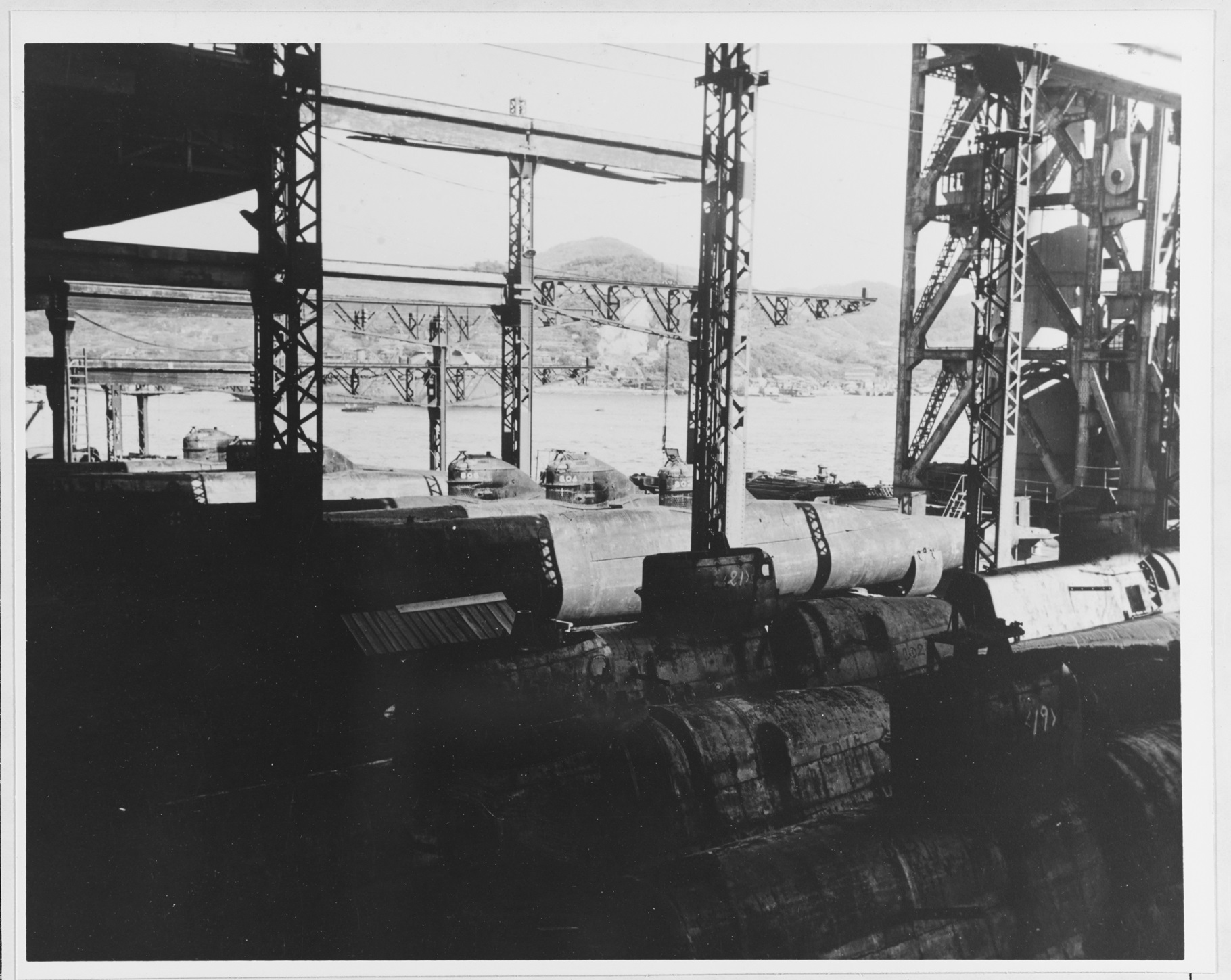
“Japanese Type D (Koryu) Midget Submarines in an assembly shed at the Mitsubishi shipyard, Nagasaki, Japan, circa September 1945. Collection of Admiral Harry W. Hill, USN, 1968.” From the NHHC, NH 65836. 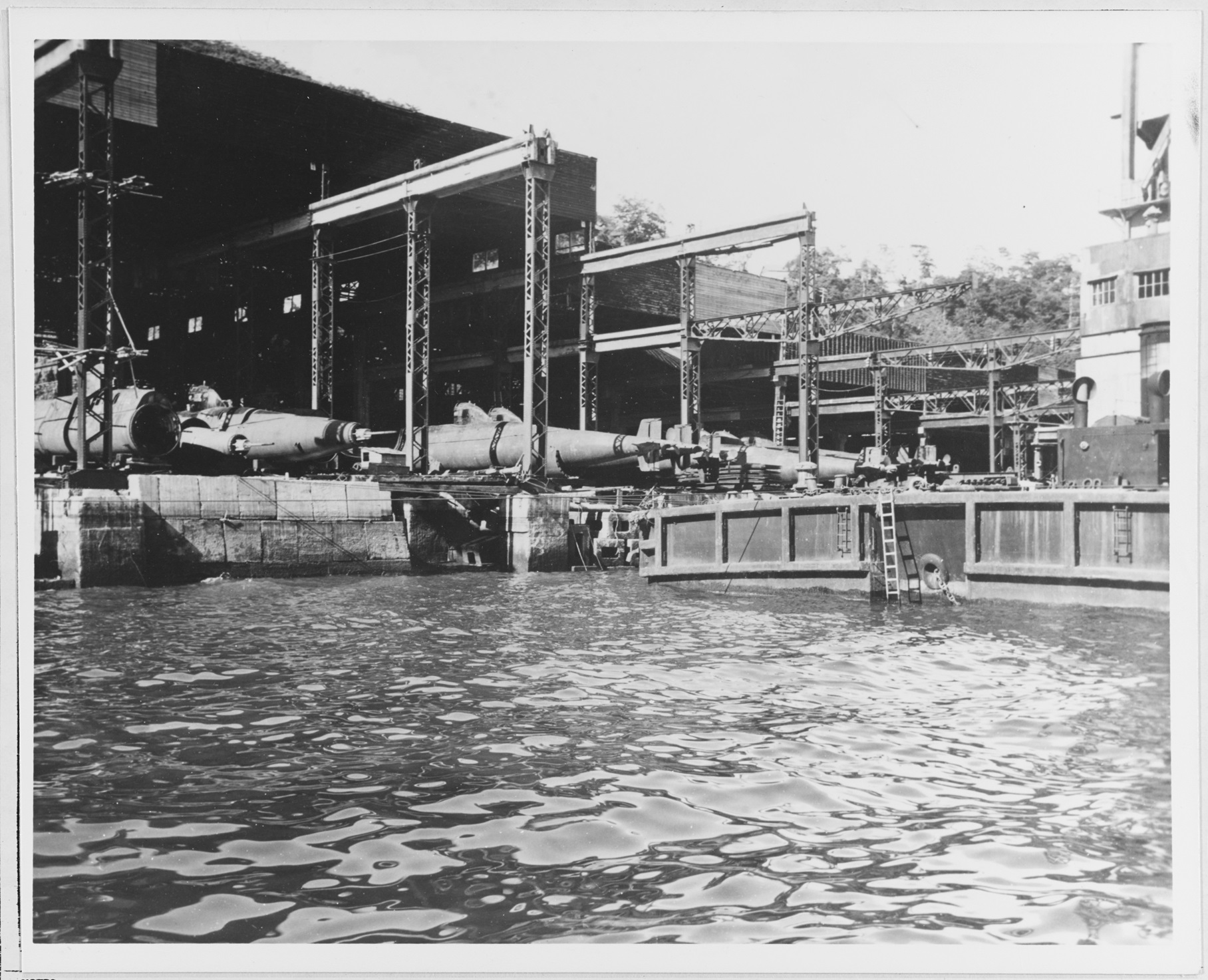
“Japanese Type D (Koryu) Midget Submarines in an assembly shed at the Mitsubishi shipyard, Nagasaki, Japan, circa September 1945. Collection of Admiral Harry W. Hill, USN, 1968.” From the NHHC, NH 65826.
As Japan began its rapid military modernization program, it required industries and infrastructure to facilitate building, repairing, and supplying the vessels of the Imperial Japanese Navy. By the start of the First Sino-Japanese War (1894-1895), the Mitsubishi Heavy Industries group had established itself as one of the largest military suppliers in Japan. By the start of the Second Sino-Japanese War (1937-1945), Mitsubishi had acres of metalworks, steel mills, lumber yards, dockyards, shipyards, and ordnance facilities in and around Nagasaki. Allied intelligence estimated that the Tategami Shipyard (Target No. 544) alone produced 10-12% of Japan’s naval and merchant marine vessels launched from 1936-1938. The following Japanese warships (with ship class and years active or cancelled) were built by Nagasaki shipyards in the early/mid-20th century and saw action in World War II:
- Destroyer Sawakaze, Minekaze-class, 1920-1945
- Destroyer Yakaze, Minekaze-class, 1920-1945
- Destroyer Hakaze, Minekaze-class, 1920-1943
- Destroyer Akikaze, Minekaze-class, 1921-1944
- Destroyer Yukaze, Minekaze-class, 1921-1945
- Destroyer Kamikaze, Kamikaze-class, 1922-1945
- Destroyer Asekaze, Kamikaze-class, 1923-1944
- Destroyer Teruzuki, Akizuki-class, 1942
- Destroyer Suzutsuki, Akizuki-class, 1942-1945
- Destroyer Niizuki, Akizuki-class, 1943
- Destroyer Wakatsuki, Akizuki-class, 1943-1944
- Destroyer Shimotsuki, Akizuki-class, 1944
- Light Cruiser Tama, Kuma-class, 1921-1944
- Light Cruiser Kiso, Kuma-class, 1921-1944
- Light Cruiser Natori, Nagara-class, 1921-1944
- Light Cruiser Sendai, Sendai-class, 1924-1943
- Light Cruiser Noshiro, Agano-class, 1943-1944
- Heavy Cruiser Furutaka, Furutaka-class, 1926-1942
- Heavy Cruiser Aoba, Aoba-class, 1927-1945
- Heavy Cruiser Haguro, Myoko-class, 1929-1945
- Heavy Cruiser Chokai, Takao-class, 1932-1944
- Heavy Cruiser Mikuma, Mogami-class, 1935-1944
- Heavy Cruiser Tone, Tone-class, 1938-1945
- Heavy Cruiser Chikuma, Tone-class, 1939-1944
- Battlecruiser Kirishima, Kongo-class, 1915-1942
- Battleship Hyuga, Ise-class, 1918-1945
- Battleship Musashi, Yamato-class, 1942-1944
- Escort Carrier Taiyo, Taiyo-class, 1941-1944
- Escort Carrier Chuyo, Taiyo-class, 1942-1943
- Escort Carrier Unyo, Taiyo-class, 1942-1944
- Escort Carrier Kaiyo, Kaiyo-class, 1943-1945
- Light Aircraft Carrier Junyo, Hiyo-class, 1941-1946
- Aircraft Carrier Amagi, Unryu-class, 1944-1945
- Aircraft Carrier Kurama/Kaimon, Unryu-class, cancelled 1943
- Aircraft Carrier Ship No. 5010, Unryu-class, cancelled 1943
- Aircraft Carrier Kasagi, Unryu-class, cancelled 1945

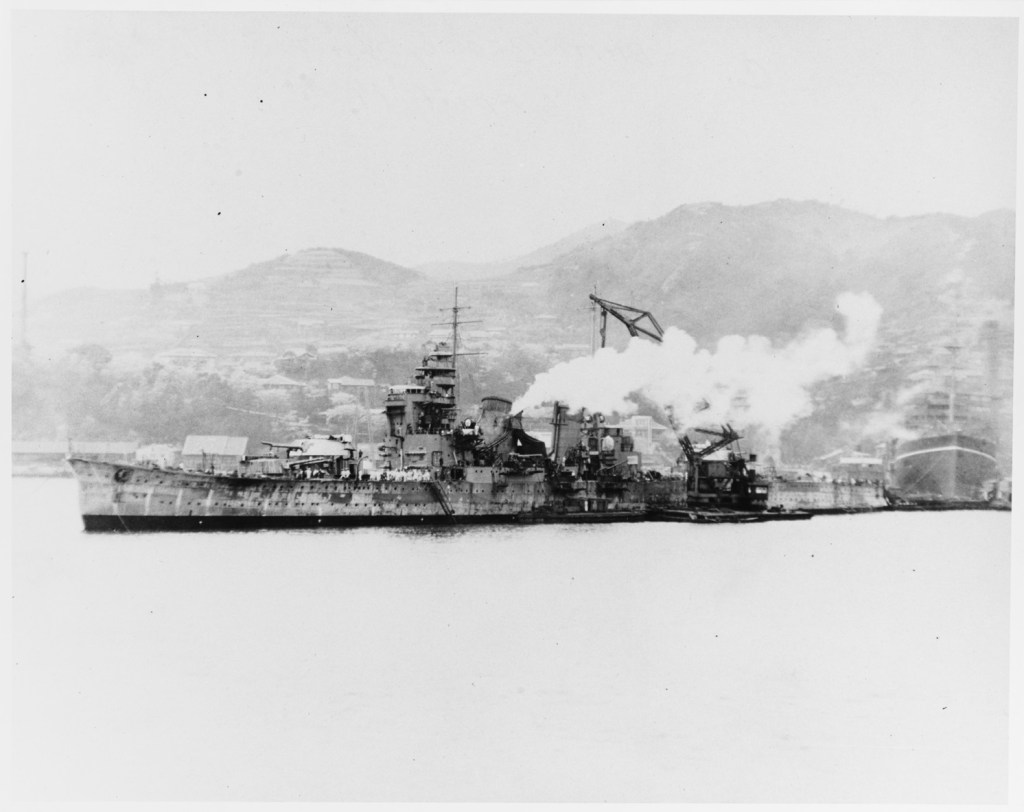
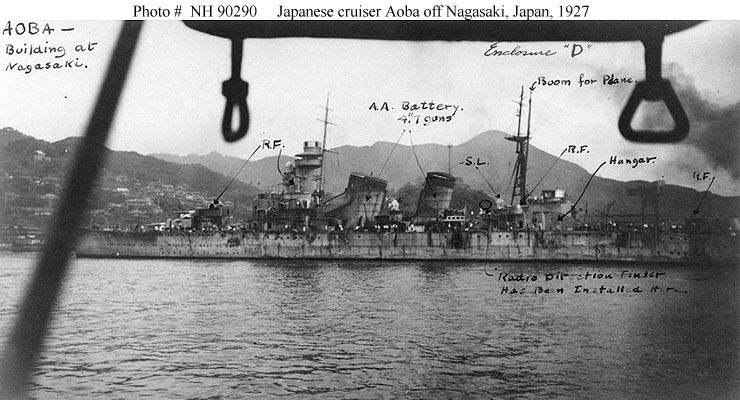
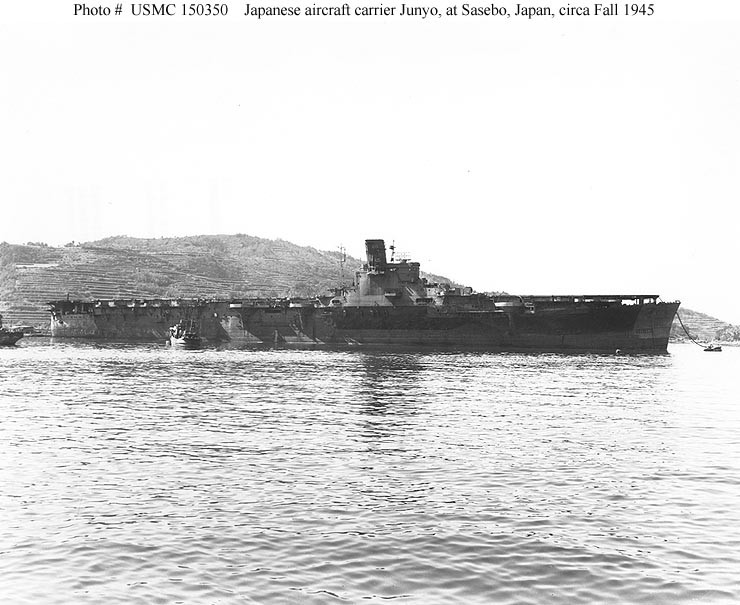
The Nagasaki Shipyards were also tasked to build two auxiliary support ships, 22 escort ships, and 81 motorized torpedo boats between 1941-1944. There were even more vessels built specifically for “special attack forces.” These included six hundred suicide motorboats, one hundred manual torpedoes, dozens of midget submarines, and other hastily constructed vessels, all of which were intended for one-way missions when the Allies began the invasion of Mainland Japan. You can view a more complete list of Japanese shipbuilding plans in the Japanese Naval Shipbuilding Bulletin 142-145, 4 June 1945.

Joint Target Group reconnaissance photo showing the Tategami Shipyard (Target No. 90:36-544) and the Mitsubishi Dockyard (Target No. 90:36-543). From the National Archives Catalog, NAID 77812959. 
Joint Target Group reconnaissance photo showing the Akunoura Engine Works (Target No. 90:36-542) in southern Nagasaki. From the National Archives Catalog, NAID 77812959. 
Joint Target Group reconnaissance photo showing the Mitsubishi Electric Manufacturing Company (Target No. 90:36-829). From the National Archives Catalog, NAID 77812959. 
Joint Target Group reconnaissance photo showing the Mitsubishi Steel and Arms Works (Target No. 90:36-546). To the north is the Mitsubishi-Urakami Ordnance Plant (Target No. 90:36-2022). From the National Archives Catalog, NAID 77812959.
| Target Number | Target Name | Air Target Index Comments |
| Target No. 542 | Akunoura Engine Works | One of leading marine engine works, producing diesel engines, steam turbines, boilers and forgings. Integrated with [Mitsubishi Dockyard] and [Tategami Shipyard]. |
| Target No. 543 | Mitsubishi Dockyard | Complete ship repair dockyard. Has 3 concrete dry-docks and several large shops. Possibly camouflaged. Integrated with [Akunoura Engine Works] and [Tategami Shipyard]. |
| Target No. 544 | Tategami Shipyard | One of Japan’s principal shipbuilding yards. Has built all types of merchant vessels and naval craft up to 40,000 tons. Has 6 building slips and usual shops and facilities. Integrated with [Akunoura Engine Works] and [Mitsubishi Dockyard]. |
| Target No. 545 | Kozaki Point Oil Storage Depot | Major storage area. Six groups of tanks. Probable underground storage. |
| Target No. 546 | Mitsubishi Steel and Arms Works | One of six leading ordnance plants, reportedly producing torpedoes and other naval munitions. Also has closely integrated steel furnaces, steel rolling mill and arms works. |
| Target No. 828 | Hayashi Engine Works | Makes heavy marine engines, probably for Kawanami Industry Co. Shipyard (90:36-860). |
| Target No. 829 | Mitsubishi Electric Manufacturing Company | Manufacturer of heavy electrical equipment, including equipment for ships, such as large generators, motors, etc. |
| Target No. 832 | Megami Point Oil Storage Depot | Three tanks and coal storage S of Point, 2 tanks N of Point. Explosives magazine reported in hillside to E. |
| Target No. 860 | Kawanami Industry Shipyard | Builds and repairs medium and small ships. 6 partially covered ways, 2 drydocks, shops, etc. |
| Target No. 1842 | Nagasaki-Dejima Wharves and Railroad Yard | Extensive warehouse, oil storage, shops area. |
| Target No. 2022 | Mitsubishi-Urakami Ordnance Plant | New plant, a major arsenal, torpedoes. |
| Target No. 3441 | Doinokubi Oil Storage Depot | Approximately 80,000 barrels storage capacity. |

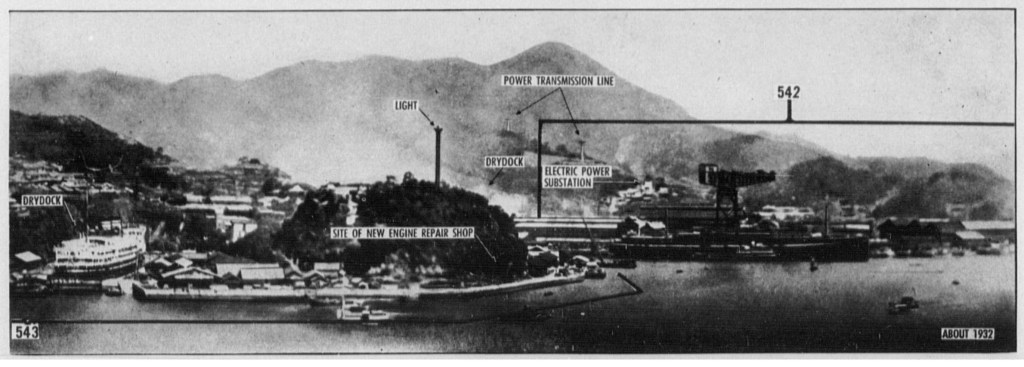

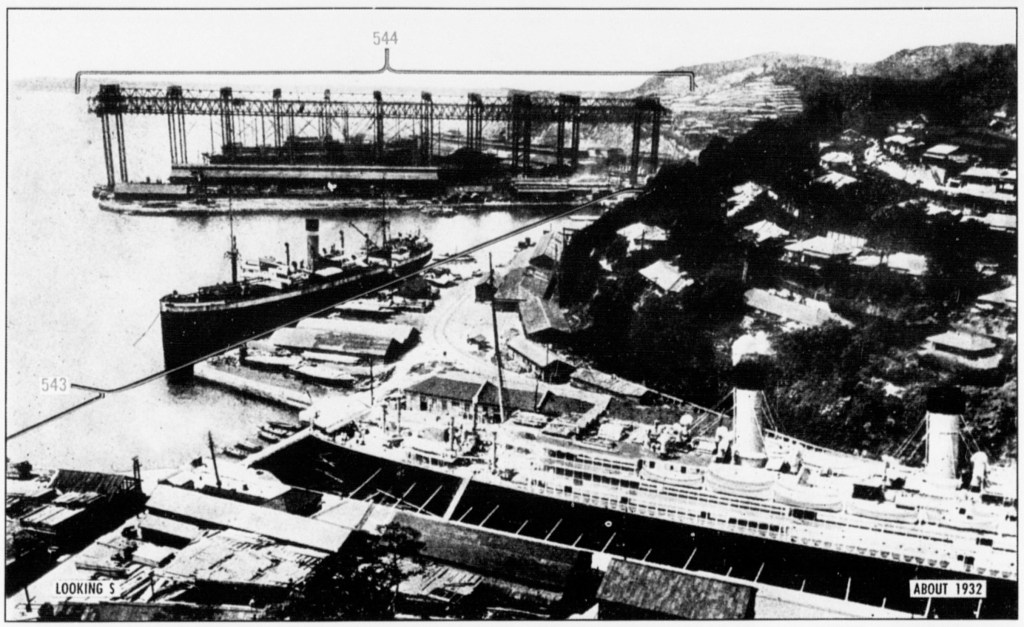
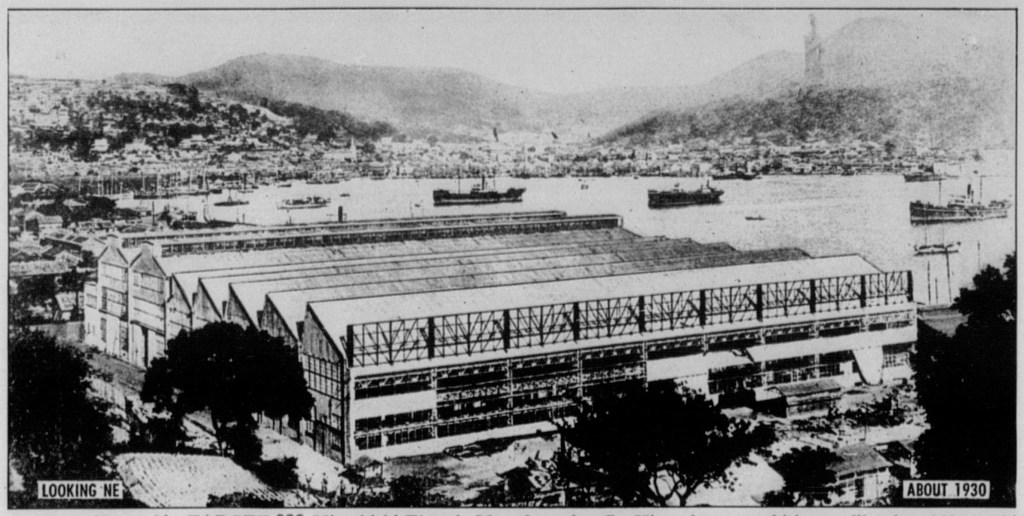

These industries, of which Mitsubishi was only one, became an important part of the Japanese wartime supply effort and were instrumental in building the cargo vessels that would follow in the wake of Japan’s imperial expansion and its establishment of the Greater East Asia Co-Prosperity Sphere. Ships from the Nagasaki dockyards carried men and materiel out to the Japanese colonies scattered across East Asia and the Pacific. Ships returning to mainland Japan carried metal ores, natural rubber, crude oil, and foodstuffs, all of which were domestically scarce resources that Japan needed to import from abroad to fuel its ongoing military conquests, especially after the United States began a series of trade embargoes in 1938.
Japan cited the increasingly harsh American trade restrictions as one of its casus belli when it attacked Pearl Harbor on 7 December 1941. Coincidentally, the Type 91 Mod. 2 shallow-water torpedoes carried by Japanese B5N “Kate” bombers during the attack on Pearl Harbor were manufactured at the Mitsubishi-Urakami Ordnance Works (Target No. 2022) in northern Nagasaki.