The Dead, the Dying, and the Nagasaki Hibakusha
Casualty Factors and Statistics
The casualty estimates for both atomic bombings are imprecise and vary widely. In Nagasaki, Manhattan Project personnel gave a 1946 estimate of 39,000 dead and 25,000 injured, with 64,000 total casualties, or 33%, of a population estimated to have been at 195,000 prior to the bombing. Another survey conducted in 1947 by the US Strategic Bombing Survey (USSBS) gave an estimate of 45,000 dead and 50,000 to 60,000 injured, a casualty rate of approximately 48-54% over the entire Nagasaki population.
The uncertainty of the casualty statistics was compounded by several variables. Due to military and civilian population movements or evacuations, rural-to-urban commuting, populations of Korean and Chinese imported forced laborers, as well as other chance circumstances, the Japanese government did not have an accurate estimate for the population immediately prior to the bombings. An official ground survey of the damage inflicted upon the people of Nagasaki was not started until 17 September, six weeks after Fat Man was dropped.
| Source | Pre-Bombing Population | Dead/Missing | Injured | Total |
| Nagasaki Prefecture (31 August 1945) | N/A | 21,172 | 40,993 | 62,665* |
| Nagasaki Prefecture (23 October 1945) | N/A | 25,677 | 112,370 | 138,805* |
| Preliminary Report – Atomic Bomb Investigation (27 November 1945) | 270,000 | 40,000 | 50,000 | 90,000 |
| US Naval Technical Mission to Japan (15 December 1945) | 260,000+ | 45,000 | 45,000 | 90,000 |
| Manhattan Engineering District (1946) | 195,000 | 39,000 | 25,000 | 64,000 |
| US Strategic Bombing Survey (1947) | 195,000 | 45,000 | 50,000 – 60,000 | 95,000 – 105,000 |
| M. Masuyama, Tokyo Imperial University and Atomic Bomb Casualty Commission (1947)** | N/A | 29,398- 37,507 | 23,469 – 26,709 | 52,867 – 64,216 |
| Japan Economic Stabilization Board (1949) | 195,000 | 23,753 | 55,000 | 78,753 |
| Nagasaki City Atomic Bomb Records Preservation Committee (1950) | 240,000 | 73,884 | 74,909 | 148,793 |
| Army Institute of Pathology (1951) | 195,290 | 39,214 | 91,786*** | 131,000 |
| OSW (Japan) and USNR (1966) | 195,000 | 36,000 | 40,000 | 76,000 |
| Nagasaki Prefecture (1977) | 270,000 | 73,000 | 75,000 | 148,000 |
| Radiation Effects Research Foundation (2023) | 250,000-270,000 | 60,000-80,000 | N/A | N/A |
*Includes uncategorized casualties. **Does not include military casualties, cases where cause of death is uncertain, or otherwise uncertified cases. ***Injured count inferred.
Prior to the atomic bombings, Nagasaki was targeted by five conventional air raids. These raids were conducted by a total of 136 planes, which dropped 270 tons of high explosives, 53 tons of incendiary devices, and 20 tons of fragmentation bombs. Although Nagasaki had been on the list of non-targeted cities by the end of July, a relatively minor air raid occurred on 1 August 1945. This raid was in no way comparable to the area bombings seen in other Japanese cities. Damage was limited to only a few areas: the Nagasaki shipyard, the Mitsubishi Steel and Arms Works, and the Nagasaki Medical School. The US Strategic Bombing Survey estimated that 276 residential buildings and 21 industrial buildings were badly damaged or destroyed. Correctly interpreting this bombing as a sign of things to come, many school children were organized into patriotic working parties and sent to rural areas outside of the city. However, all too many student working parties were maintaining cave shelters, clearing firebreaks in the city, or working in production facilities on 9 August.
As speculated in “The Manhattan Project History,” Book I, Volume 4, there may have been 40,000 civilians brought into Hiroshima the week of 6 August to receive instructions on the evacuation of unnecessary persons from the city, prompted by the leaflet-dropping campaigns undertaken by the US Army Air Force in the latter months of the war. On the other hand, the same instructions may have been given to the residents of Nagasaki the week prior, resulting in more people leaving the city for the countryside. Additionally, the Nagasaki District Police had issued 29,313 permits for civilians to leave the city.
It is important to note, however, that there is no concrete evidence that special leaflets warning Japanese citizens about the atomic bomb were dropped until after the Hiroshima bombing. Surviving leaflets primarily show images of B-29 formations dropping conventional ordnance and the declared list of target cities did not include Hiroshima or Nagasaki. Any evacuation instructions were more likely to have been given with firebombing, in particular the firebombing raids on Tokyo, in mind.
The repeated lack of response to or consequence from reconnaissance missions dulled the sense of urgency of getting to an air raid shelter. In the middle of the night on 8 August, a wave of bombers flying over Kyushu had triggered air raid alarms, waking everyone in Nagasaki and putting the night-shift fire brigades on alert. However, these bombers were not targeting Nagasaki. They were likely flying from the airfields on Okinawa to drop their incendiary ordnance on the industrial centers in the Shimonoseki Strait, primarily the city of Yahata. Although this was just another false alarm to the sleep-deprived peoples of Nagasaki, the bombing of Yahata would prove to be another step in the butterfly effect that would result in the destruction of the city the following morning. Sometime after the Enola Gay, serving as the weather plane scouting Kokura, announced that the skies over the city were clear, a change in the wind direction moved the smoke from the smoldering remains of Yahata to Kokura. Steel mill and foundry workers had also lit oil drums on fire as soon as they heard the raid alarm, helping to conceal it from Captain Beahan aboard Bockscar and forcing Commander Ashworth to divert to Nagasaki as Fat Man’s secondary target.
On the morning of 9 August, the weather reconnaissance plane sent to Nagasaki ahead of Bockscar had triggered two sirens, one for a raid alert and another for a raid alarm five minutes later (raid alert/alarm can be compared with a tornado watch/warning). As Bockscar began its approach, another raid alarm (without a preceding raid alert) sounded. With the expectation of another non-event that would only result in wasting time and energy, relatively few Nagasaki residents made their way to the shelters. The 1951 Army Pathology Institute study estimated that only around 2,000 people were in underground shelters at the time of the explosion.

Victims of the Atomic Bomb
The casualties included Japanese and non-Japanese: Allied prisoners of war, Chinese and Korean slave laborers, and Nagasaki residents, both civilian and military, though overwhelmingly civilian, all killed by the atomic bomb. If not killed instantly, many would die in the following days and weeks. Almost all of the deaths in Nagasaki occurred within thirty days after the bombing. Surveyor teams would generally place causes of death or injury in three categories: radiation poisoning, thermal burns, and mechanical damage. “Mechanical” refers to injuries caused by flying glass, building collapse, or by other means, and include fractures, lacerations, contusions, etc.
Those who were outside or otherwise exposed and subjected to the intense radiation received flash burns beyond four kilometers away from the explosion. The degree of burns suffered depended on factors such as proximity to the blast, the clothes that they were wearing, and whether anything was in the way to act as a shield. Victims less than 500 meters who were in the open were instantly carbonized. Like the thermal-shocked inhabitants of Pompeii in 79 AD, only human-shaped remains were left, some still in the position that they were in at detonation.
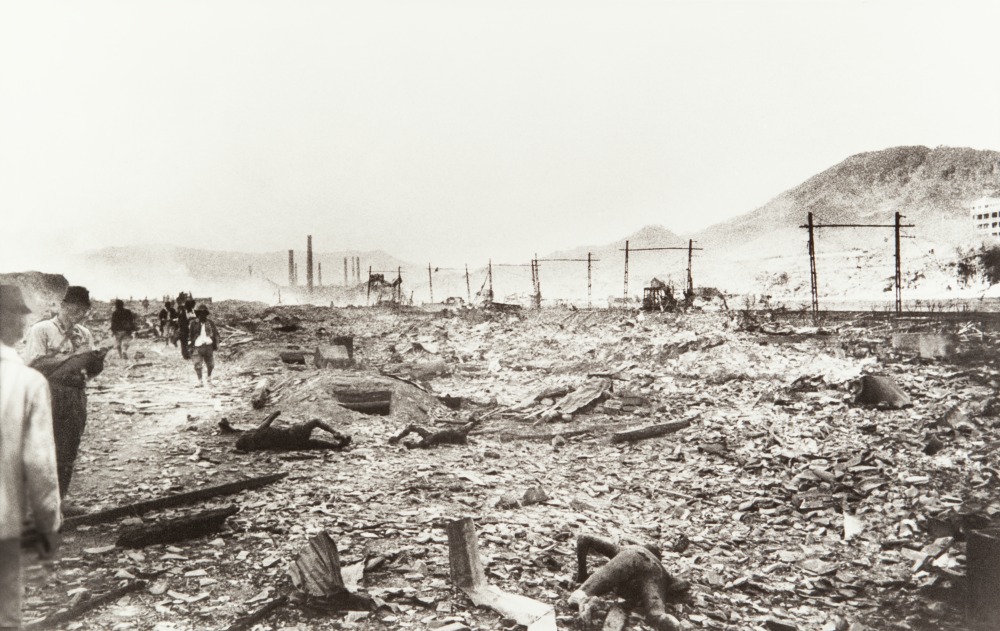
Charred and contorted bodies line the road running parallel to the railroad, 10 August 1945. Photograph by Yamahata Yosuke. From the Museum of Photograph Art. 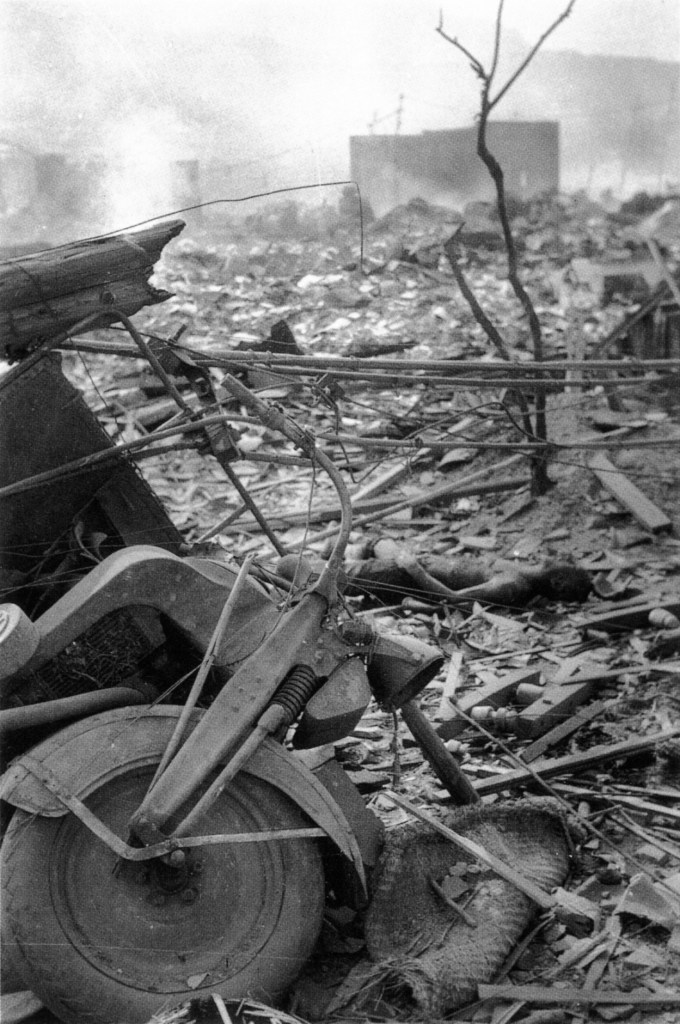
A blackened body lies among the ruins of Nagasaki near Iwakawa-machi, 10 August 1945. Photograph by Yamahata Yosuke. From Wikimedia. 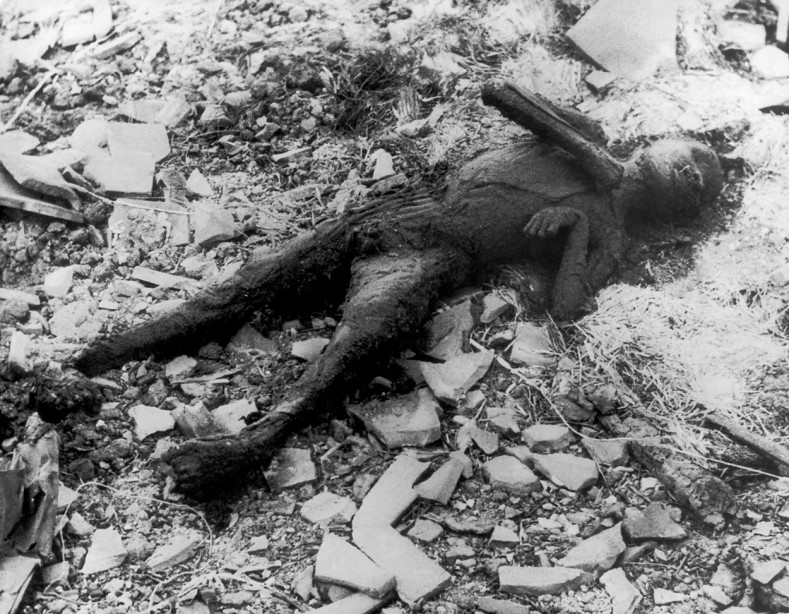
A young boy lies charred amidst the ruins of Nagasaki. His body has been blackened beyond recognition, 10 August 1945. Photograph by Yamahata Yosuke. From Wikimedia. 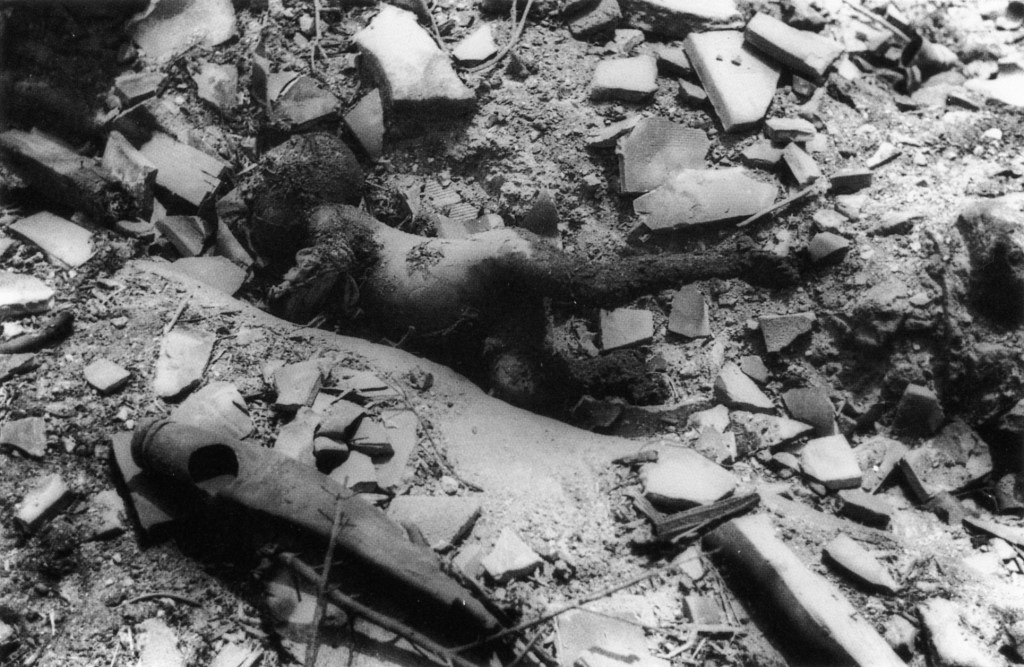
The charred body of an infant killed by the atomic bomb, 10 August 1945. Photograph by Yamahata Yosuke. From Wikimedia.
Although Fat Man discharged an extremely large amount of radiation, the duration of the thermal radiation was incredibly short, just a few thousandths of a second. While this is enough time to char wood, melt tiled surfaces, or burn skin, there is not enough time for that heat to defuse or penetrate further than the surface layer. This is seen in the well defined lines of the shadows of telephone poles, building walls, and people that were clearly visible after the explosion. Past a certain distance, around 2,300 meters, material as thin as a paper screen could offer protection from the thermal radiation. Examples of this exist in the flash burn patterns that formed on skin that was partially protected only by thin cloth from a shirt, monpe, or kimono.
The US Strategic Bombing Survey notes this phenomenon in its Preliminary Report:
“The light and radiant heat rays accompanying the flash traveled in a straight line and any opaque object, even a single leaf of a vine, shielded objects lying behind it. The duration of the flash was only a fraction of a second, but it was sufficiently intense to cause third degree burns to exposed human skin up to a distance of a mile. Clothing ignited, though it could be quickly beaten out, telephone poles charred, thatch-roofed houses caught fire. Black or or other dark-colored surfaces of combustible material absorbed the heat and immediately charred or burst into flames; white or light-colored surfaces reflected a substantial portion of the rays and were not consumed.”
The dazed survivors began extricating themselves and their family, friends, and neighbors from the wreckage of what had been their homes or place of work. They then began a general movement towards air raid caves and shelters located in the hills overlooking the Urakami Valley. In addition to being the only high ground visible among the wreckage, fires that had started among the many wooden buildings soon began to spread.
Initially, it was believed that the heat from the bomb started all of the fires. The US Strategic Bombing Survey determined that almost half of the fires were started indirectly. The many small fires in the residential areas reported by eyewitnesses were likely caused by domestic sources, such as coal fires in kitchens that began to spread when the wooden structures collapsed. Fires in the industrial areas were started by electrical short-circuiting, smelting and refining processes, and gas leaks seeping from pipes damaged in the blast. Buildings with access to gas utilities were supplied from either the Kyushu Gas Works south of the hypocenter or the Urakami Gas Works located to the north.
Helplessness, for both themselves and others, was a common facet of eyewitness accounts. As those who could walk made their way to wherever they thought would be safe, the critically and fatally wounded still able to talk cried out for mizu, for water. Voices emanating from under collapsed buildings begged for help from anyone who could hear them. In too many cases, there was simply nothing the survivors could do but keep moving and looking for their family, friends, and neighbors. Behind them, fires started making their way through the city, house by house and block by block. The city’s streets, with their congested houses, shops, and other buildings, continued to smolder for days.
The following are accounts of witnesses being interviewed for the Army Pathology Institute’s Atomic Bombing Study and focus primarily on medical aspects of their experience:
Lt. Masao Shiotsuki, Imperial Japanese Navy Surgeon, Omura Naval Hospital
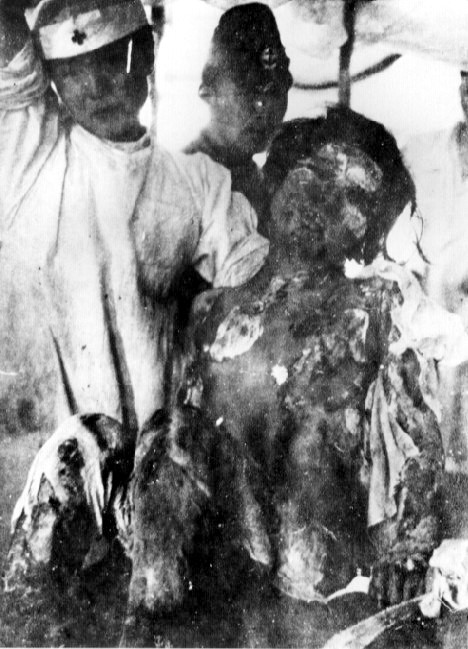
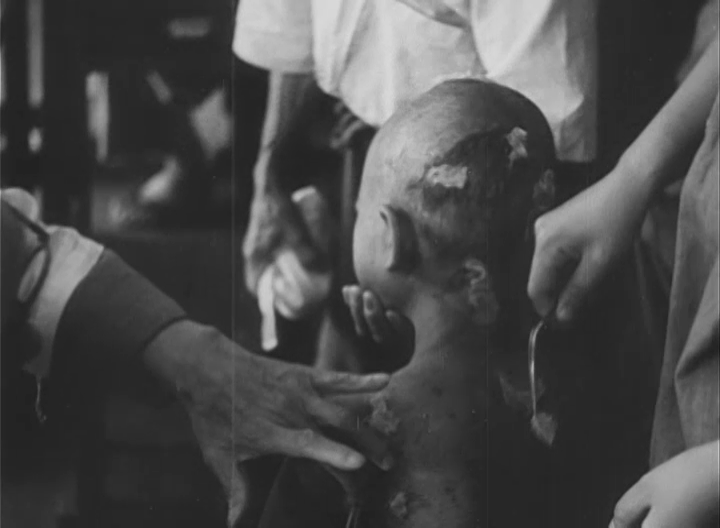
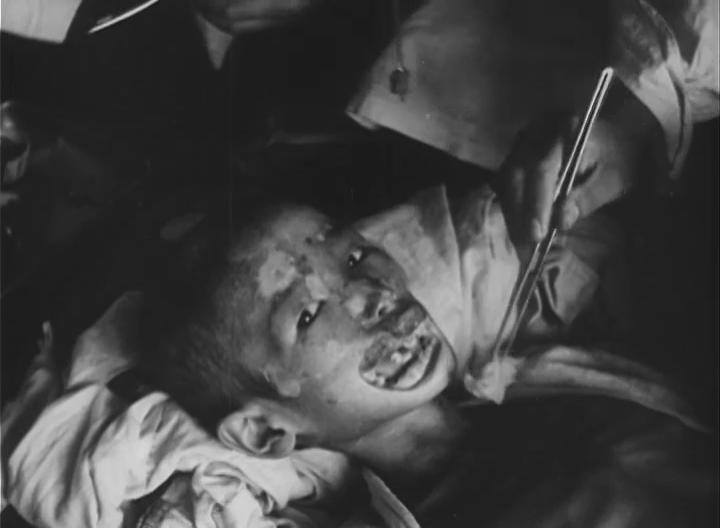
About 600 wounded patients were sent to the Omura Naval Hospital between 2000, 9 August and about 0100, 10 August. These were transported to Omura Railroad station by train, and from there to the hospital by trucks. The appearance of the patients on that night was horrifying. Their hair was burned, their clothes torn to pieces and stained by blood, and the naked parts were all burned and inflamed. Their wounds were contaminated by filth. Many among them had numerous pieces of glass and wood projecting from the skins of the face and back. Many were in such a state that they were with difficulty recognized as human beings.
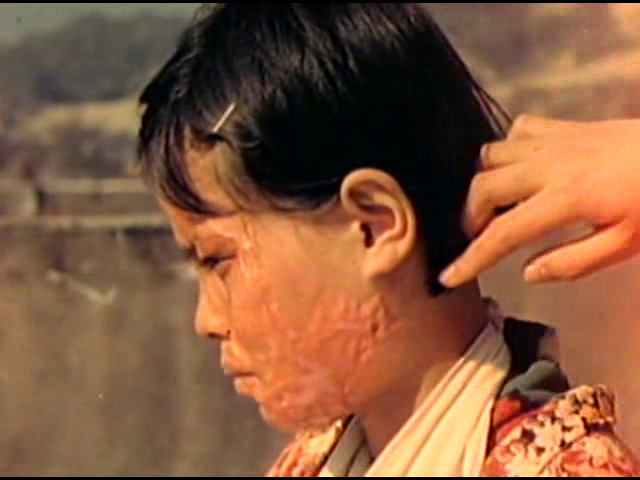
Left: A female student, age 14, at a military aid station. Terribly burned in the explosion, she likely died within a few days of this photograph being taken. Photograph by Masao Shiotsuki. From Wikimedia.
As can be imagined, it was an appalling scene of confusion. Nearly ten hours had passed since the injuries had been received, and in spite of their severe injuries, the majority of the patients were quiet as though in a collapsed state. Many were covered with black blobs, which we at first thought to be coagulated blood from their wounds, mixed with smoke from the train. Later, however we learned that after the explosion there had been a “Black rain” throughout the city. The patients were given routine burn treatment and we finished about 1500, 10 August.
Aiko Tagawa, age 20, baggage worker at Urakami Railroad Station
On the morning of the bomb explosion, I was working in the baggage room, a one-story building with wood walls, glass windows, and standard tile roof. The all-clear signal had sounded about half an hour previously. Suddenly the room was lighted up very intensely, and the whole building crashed down. I was cut by broken glass on the right elbow, right hip, and thigh. The baggage master was killed by falling debris where he sat. I felt no heat, nor was I burned. The room became dark with dust, dirt, and soot. I walked and ran north along the railroad tracks as far as the end of the Mitsubishi Steel Works, then turned west to cross the bridge over the river and escape into the hills. By this time, I saw many fires all around. The bridge was down, so I waded across the river.
I do not recall seeing any dead people along the route. At the river, many were jumping into the water to get relief from burns. Most of them wore clothing that was torn into shreds; I did not see any clothes burning, nor do I know whether the clothes had been burning previously.
Toward evening, my father found me and brought me to our home in Michino. At that time, I saw dead people in the streets. I think they died from burns, but I cannot say for sure. Their bodies, including their faces, were swollen. Some of the faces were black from soot. Their eyes were not prominent.
My wounds suppurated, and healing is very slow, not being healed yet (three months later). My hair began to fall out two weeks after the explosion and I was completely bald until recently, when the hair began to grow in again. I had no neuroma nor petechiae at any time, no loss of weight, no loss of strength, and no obvious anemia.
My menses began at the age of twelve, were very regular, every 30 days, until the explosion. My last period was August 1 to 6; then I had scant flow for one day on November 1st. I have no headaches.
Toragoro Ueno, age 44, mechanic at the Mitsubishi Steel Works
I worked at the Mitsubishi Steel Works. Early in the morning, about 0930 or before 1000, an air raid alarm had been sounded and we, a group of steel workers headed by myself, put on our steel helmets and went to the air raid shelter up on a wooded hillside west of the plant. About a quarter of eleven, I saw the all-clear flag on the pole at the plant, and our group began to walk back through the woods along the path about two feet wide with trees lining both sides. I was ahead, wearing a steel helmet over a wool liner, white cotton shirt with short sleeves and no markings, full-length cotton trousers, pale green in color, and leather shoes.
The path led slightly north of east directly in line with the bomb center and about 1,600 meters away. My first experience was noting an intense light, the color of which I cannot recall, and then I heard a loud noise. I quickly threw myself on the ground and then felt a terrific blast which blew off my helmet. I lay there for about two or three minutes fully conscious. A yellowish dust and smoke was thick all around. I noted burning pieces of dry leaves and paper and clothing in the road, but no fires in the woods. Several minutes later, I saw flames among the houses down in the open part of town.
At the time of the flash, I felt no heat on the face or body, but in a short time my skin showed burns and blisters – in fact, the reaction was immediate. I ran toward the factory, and on coming by the stream, I saw many people jumping into the water to relieve burns. Near the Fuchi School, I saw many people with clothing so scorched that it fell to shreds. I do not recall seeing any dead people [around] me.
After 20 or 30 minutes, the dust cleared up to be followed in another 20 or 30 minutes by smoke coming from burning houses.

I ran to my home nearby and found the house collapsed in ruins. There were small fires of flaming wood in several spots. Some black and khaki colored clothes hanging on bamboo poles were burning, although not near any fire to be ignited by it.
I had no epilation of any part of the body (I wore a steel helmet). I saw no purpuric spots, but I did have definite petechial hemorrhages, rice-size from about the 5th to 12th of September, on the forearms, hips, buttocks, and sides of thighs. They disappeared gradually. At the same time, I had conjunctivitis and edema of the left eye. For several weeks I had difficulty in hearing with the left ear, but recovery is not complete. I was pale and had severe malaise for many weeks but am recovering.
Kikuo Fukahori, age 47, workman at the Kawanami Koyagi-jima Shipyard
While working in Koyagijima which was six to seven kilometers from the bombed area, he heard a loud noise. His first thought was that the explosion was right over his workshop. Getting out of the shop, he noticed the sky over the Mitsubishi Shipyards as red and bright as a sunset. As there were hills between his place and the bomb, he could see only the sky and no smoke on the low surface.
Taking the 2 o’clock boat, he got off and started to climb the hills in order to get back to his house in Okamachi (that was near the bomb center). As he reached the top, he found it difficult to get down to is home because of the fires which had started. He saw the church, which was ablaze, hiding the area from him, because of the black smoke from it.
At about 5pm he came down to the place where his home had stood but found nothing but ashes. He then went to the cave in the prison hill, near the main street, to try and find his family. That day he found none of his family. But on the following morning he found… bones which were the remains of his 21 year old daughter and four other children on the ground where his house had stood. He imagined they had been pinned under the fallen house and burned.
On the morning of 11 August, he went to the cave again to see if his wife was there. Upon arriving he saw five bodies at the mouth of the cave, which were naked and browned, and looking as if they were drowned. Their eyes and tongues were out, and his wife’s body was one of them. As he looked about six feet deeper into the cave, he noted some more bodies which appeared much like the ones at the mouth, except that they were not as black.
Later, he heard from a woman who survived in the cave that she experienced a sensation of a strong gust of wind, followed by the odor of smoke, but she did not know of the explosion.
Taeko Fukahori, age 16, schoolgirl attached to a working party
This girl was working with about 60 other men and women in a cave pumping the water out when the bomb exploded. She was about 60 feet inside this cave which was situated near the hill by the prison and about 100 or 150 meters from the bomb center. Around this hill many cave trenches had been built, and she was in the one nearest to the main street on the north side of the hill, facing west. The clothes she was wearing at the time were a blue short-sleeved shirt with red and white dots and blue trousers.
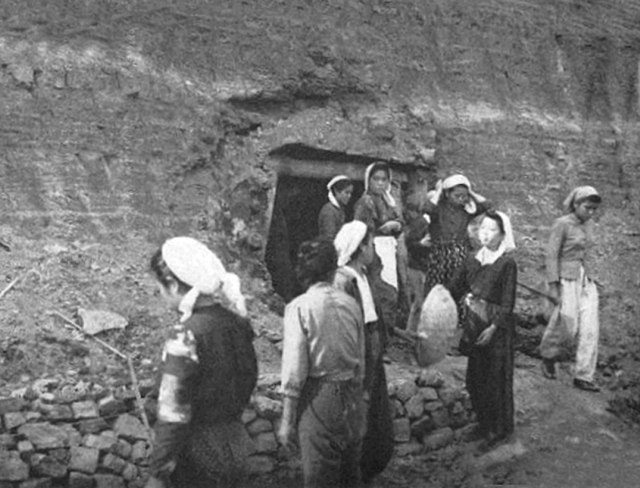
When the bomb exploded, she felt the blast and was knocked down but not unconscious, apparently dazed. The electric light was blown out and the cave became dark, and as she ran out of the cave, she did not see the locations or the conditions of the others in it, but she did hear some cries for help and thought the people were alive.
It was about five minutes after she got out of the cave that she noticed burns on her shoulders, hip, and legs. Later, she was told by another survivor that the others in the cave were mostly wounded on their legs. She took shelter under a bridge where she saw many people suffering from burns.
Her wounds became infected later and took six weeks to heal, but she did not show any other symptoms of injury or malaise. She had her menstrual period on 12 August, normally, but missed it in September and October.
Fusa Kawauchi, age 49
She was sitting sideways in a cave about forty to fifty feet from the entrance with the right side of her face toward the entrance, yet she was burned on the left side of the face, and the outer aspect of her left arm showed 3rd degree burns. She claims her clothing was torn into shreds and the skin peeled off her left arm. Her clothing did not burn, nor was there a fire to cause flame burns. She did not see a flash of light. Her first strange experience was hearing a rushing noise of air in the cave, as though machinery were working. She was crouching; holding onto a hose emptying water from the inside of the cave; she held on tighter and does not recall whether there was enough pressure of suction to force her one way or the other. She kept her eyes closed for several minutes, or so it seemed to her. Upon opening her eyes, she looked at the girl working opposite to her at that time, and she was also conscious. They remarked that each other’s face was covered with black, sooty material. They saw fire outside the cave and made their way out. On the way out, they passed several prone bodies in the cave, most of them moaning and crying for help.
Once outside, this woman made her way to a cave higher on the hillside to avoid the fires of the houses toward the main road. The fires were very intense. The other girl was led to the highway by a young man who did not work in the cave and [was] unknown to them. He [had] come from higher on the hill. Later on, two or three other women joined her in the cave higher up on the hillside. On the way to this cave, she passed several dead or dying people in the rubble of collapsed houses, some of which were on fire. She thinks this was about ten minutes after the explosion.
Of about 20 people in the cave, men, women, and children, some being there before and some arriving after her entrance, most of them died of burns in the two days she remained; all died without food or water during that time. On the second day her daughter found her and took her to safety.
The faces and bodies of the burned individuals in the cave were quite markedly swollen.
She wore a black silk shirt and mompe at the time of the explosion. This was torn, not burned.
Takatashi Hasegawa, age 44
Location when the bomb exploded – in a two story concrete building on the second floor facing the bomb center, about 4.5 meters away from a window, the glass of which had been blown away.
The bomb explosion threw me on my abdomen. I could not see momentarily, although I remained fully conscious. On the return of visibility, I walked to my home in a valley on the other side of a hill nearby. I was bleeding from a cut over the right eye which was difficult to control. On going to bed, I began to feel pain from cuts over the back, the left arm, and right side of the head. Six days later I was examined by Dr. Shirabe, who said I had an incised wound of glabella about one cubic millimeter long, laceration of the right mastoid process, scalp, left forearm, multiple small incised wounds of the back, subluxation of the right first [metatarsal-phalangeal] joint, general malaise, weakness from shock, and contusions.
I soon began to lose weight, which became quite marked in about a week. My skin became pale, dry, dark, and wrinkled. My eyes were sunken, my cheek bones prominent. Perspiration practically ceased, even on the hottest days, except on exertion. Appetite remained good for a time. Aside from dryness of the mouth on awaking, there was no change in the mucous membranes. At times I had a miserable feeling like a “hang-over.” There was mild constipation. There were no changes in the special sense.
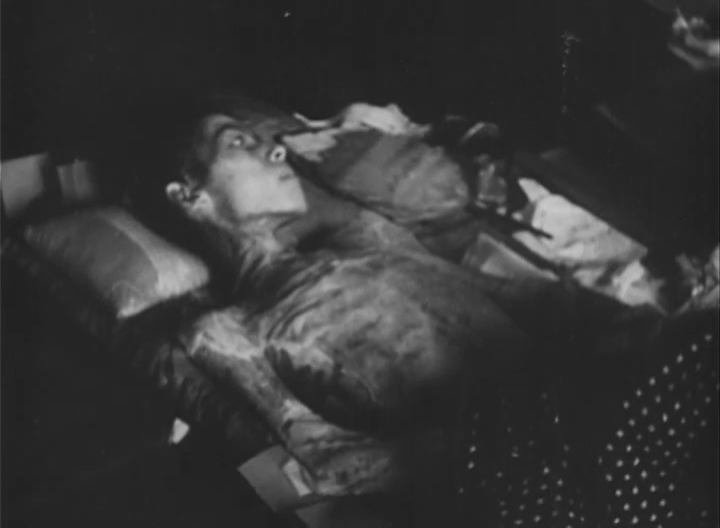
Two days after receiving my wounds, they became purulent (infected and discharging pus), and my temperature, rose to 39.2 degrees Celsius (102.5°F). It soon returned to normal. Three weeks later, I had a chill with fever of 38.3 degrees Celsius (100.9°F), the temperature remaining slightly above 37 degrees Celsius (98.6°F) for about two weeks. During all that time I felt cold and miserable. A high-pitched ringing noise affected the left ear, but hearing was not disturbed. Eyesight was good. My appetite became bad, I had insomnia. My skin became even drier and rougher. My throat was sore, although the tonsils did not swell.
Small, purplish spots appeared on the limbs and chest. The stools were either too dry or watery, and at times bloody. Urine seemed normal. All these symptoms disappeared about seven weeks after injury, and now, thirteen weeks later, my health is rapidly returning to normal.
Dr. Tatsuya Koga, age 25, medical doctor, Nagasaki Medical Hospital
At the time of the bomb explosion, I was in the isolation ward of Nagasaki Medical Hospital which was about 700 to 800 meters southeast of the bomb center. The building is made of concrete, two stories high. I was at the north end of the hall. On the east side of the floor is that hall; on the north, west, and south are sickrooms. I was, therefore, sheltered from the bomb by the walls of the building and of the rooms. I wore a white, long-sleeved shirt, white sport trousers, putties, and a white gown overall.
As I was walking through the hall, I heard what sounded like a dive bomber. I was about to make for a shelter when I was thrown to the floor, striking my head. I did not see a flash, nor do I recall hearing the noise of the explosion. The concussion caused unconsciousness for probably a minute. When I opened my eyes with return of consciousness, everything appeared black before me. Believing I had become blind and unable to escape, I sat still for several minutes. But then the dust and black smoke began to clear, and I was able to see the surroundings. I could not smell the smoke, nor did it affect my eyes.
Blood from a wound in my scalp was dropping down my cheeks onto my gown and trousers. The backs of my hands were scratched. The hall was filled waist-high with broken glass and plaster. I ran down the broken staircase out of the building and saw that the nurses’ dormitory, a two-floored wooden structure, was completely destroyed. I now realized an atomic bomb had exploded. With four other doctors and with some nurses and patients, we took shelter on the hillside at the back of the hospital. On leaving the grounds, about fifteen minutes after the explosion, we noticed that all the houses in sight had been destroyed and that smoke was rising from some spots. I applied iodine to my scalp wound and dressed it with a compression bandage.
About 3 in the afternoon, I felt nauseated and vomited bile three times. The mucosa of the left eye became hyperemic, edematous, and painful, as though a foreign particle was present. My mouth was dry. An overwhelming lethargy came over me, and I lay down in the field. At 6pm, I awoke and walked to the center of town, which was now nothing but a ruin from the fire. I drank water several times but vomited all immediately.
Dr. Kohei Koyano, medical doctor, Nagasaki Medical School
I was in good health at the time the atomic bomb was dropped at Nagasaki. I can distinctly remember that the weather was fine, too. At 8 o’clock in the morning, I started for the college and on the way I heard the warning signal. Later came the air raid alarm, at which time I had been making my rounds of the hospital patients. I stopped making my rounds and waited in my office. At about 11 o’clock, the all-clear signal was given and I went into the surgical outpatient consulting room, in the front part of the main building and there began polyclinic work.
The building I was in was a three story concrete structure with a basement. On each floor was a hall through the center of the building, almost from east to west. On either side of the hallways were rooms for various hospital and educational purposes. My consulting room was on the south side. Under these conditions, the room I was in at the time of the explosion was sheltered from radiant energy by the roof, ceiling, and floor above; and from the south side by the three walls which divided the room from the hall and the other room. There was a table a little to the west from the center of the room, and a consulting table a little east from the center. I was sitting between these two tables with the south windows behind me and facing north.
Around me were a few students, doctors, nurses, and patients. For some time after the bombing, I could not find out what happened to these people, but later I was assured that all of them survived without serious injuries.
I had been quite absorbed in my work and had not noticed any sound of a plane. At about 1130 that morning I felt a strange flash like a magnesium flash from the windows behind me, and about the same time with an ear-rendering noise the whole place turned to darkness. The earth from the walls, window glass, and instruments were broken to bits and poured around me like a shower while a hot wind with a strange smell (like exploded firecrackers) attached itself and made me choke for a while. This must have been for about 10 seconds, I was not sure, but I was quite conscious at the time. In a little while I saw a dim, round light before my eyes which gradually broadened. “If you have ever been on a train with no top on it, and suddenly rushed into a tunnel, you would have felt the hot smoke from the engine all over you in the dark, and as the train neared the exit of the tunnel, you would then see first the dim light which would gradually grow wider and stronger.” It could be explained something like that, even to the broadening of the light.
I had heard that there were unnumbered cases of patients with burns in Hiroshima, a couple of days previously, and I just thought of covering myself, head and all, with the white calico gown I was wearing. Doing so, I quickly crouched on the floor. Just as soon as it cleared from the darkness to twilight, I stepped out to the hall, but found that I could hardly walk on it. So I went out into the yard through the window. Then for the first time I noticed I was bleeding from my forehead and bruised about the left elbow. As these injuries did not disturb my bodily motion, I left them as they were and tried to look around. There stood a pillar of brown smoke and the sun in the sky looked bloody because of the smoke, which appeared as if you were looking toward the setting sun in Manchuria through the yellow sands.
There were students and nurses with some strange injuries, like burns on the exposed parts of their bodies. (I had not quite realized this to be an atomic bomb as of yet). Some were wounded and bloody all over and they were all crying for help. The whole scene looked like “Hell” itself. I turned around the main building and came near the location where my office and operating room were, there I saw flames shooting out from the north room where there had been no windows at all since the bombing of 1 August. (During this time, not more than five minutes had elapsed).
I was afraid of being surrounded by the flames which had suddenly enveloped me and I escaped to a hill 500 meters on the east side. Others say that about this time we had a shower, but I do not remember it.
Some of the wounded dropped on the way to the hill. Many knowing I was a surgeon swarmed around me for aid. I saw burns of wide areas on most of them and they cried from thirst. When we came up to the hilltop an assistant with no outward-appearing injury began to vomit and now was unable to walk. (He got better once but died after five weeks). Now we came over the hill to the town and I gave some directions to the people. I climbed to the hilltop again at night to sleep there. The next morning, I went down to the college, knowing that the president was seriously injured, and I had to take up his responsibilities.
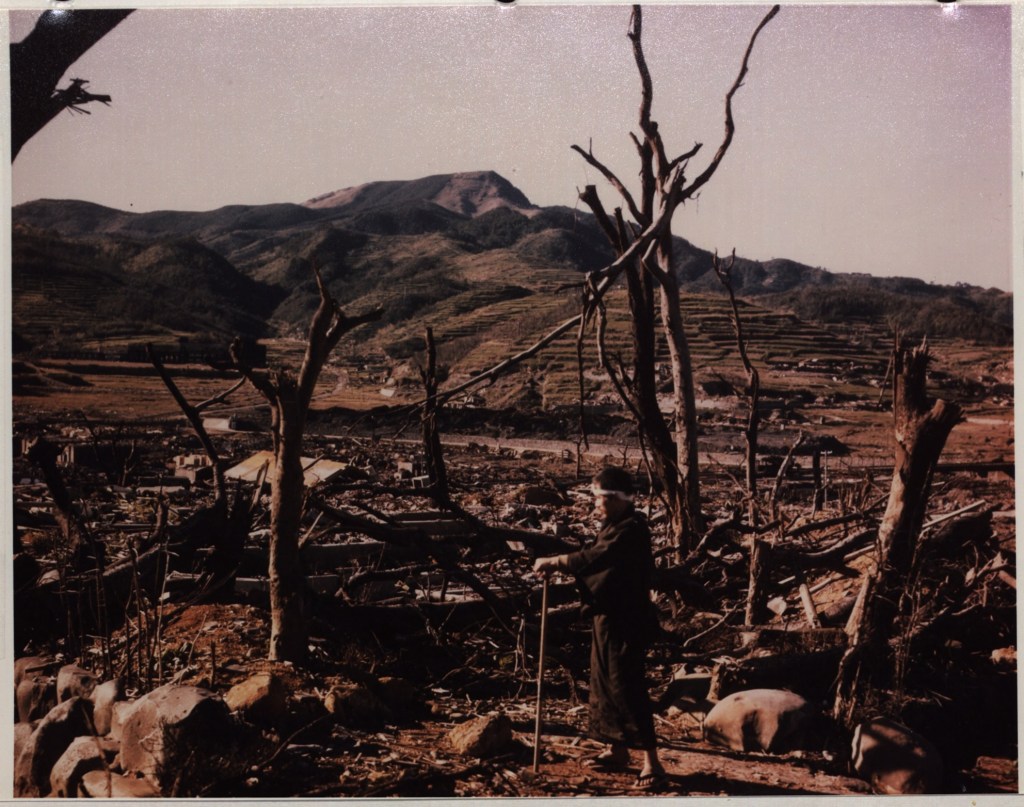
My home was about 0.9 kilometers northwest from the hospital and about 0.5 kilometers from the bomb center. The house had burned and collapsed but the trench underneath it was still in good condition. For a week after the bomb I slept in the trench at night and worked in the college during the day. After a week I moved away to a part of the city about four kilometers from the college and walked everyday back and forth under the midsummer’s sun. My wife had been wounded on her head, chest, and limbs, but had been getting better. But about two weeks after the injury, her temperature went up to 40 degrees Celsius and she became hemorrhagic, and her condition was quite serious. I gave her 250 cubic centimeters of my own blood, but in those days of heavy responsibilities, I did not seem to feel tired. One day at the beginning of September, after walking in the rain to the hospital and back home again, for the first time, I felt quite feverish… My gums became dark purple and there was slight hemorrhage… Actually, I was in bed six days and injected vitamins ABC, liver preparation, and calcium, and ate as many summer oranges as I could get which proved especially effective.
Unnamed Japanese Sailors
Unnamed Japanese Sailor #1: The next morning, 10 August 1945, after the bombing, a number of dead were along the side of the road across from the Nagasaki Station who showed evidence of burns. It was the impression of the narrator that these people had walked from somewhere near the center of the bomb area. Buildings along the road were smoldering but not in actual flame. About 2,000 meters from the bomb center, there were many dead and dying along the road with evidence of burns. Their clothes were scorched. The bodies showed evidence of multiple wounds about the head and extremities and burns of exposed areas. From 2,000 meters toward the center there were many dead and wounded. There were estimates of 300 to 400 dead and dying from 2,000 meters to 900 meters. The number of dead increased as you approached the center. The dead and dying were being moved to caves along the road. A number of dead horses (about 100) were bloated and described as having no hair. As he approached the center from 900 meters, the bodies appeared black, “as though they had been painted black.” A few of those who were black appeared to be alive… The houses at 600 meters looked as though they were blown away rather than burned. The dead were black and swollen and had no clothes. Dead animals were also noted in this area. The horses were described as hairless, bloated, and with abdominal walls ruptured. Going along the road from 500 meters toward the center, there were easily 500 bodies countable. At the foot of the hill the Medical School there were 20 or 30 dead. These bodies were naked and black, and some were swollen and had ruptured abdomens.
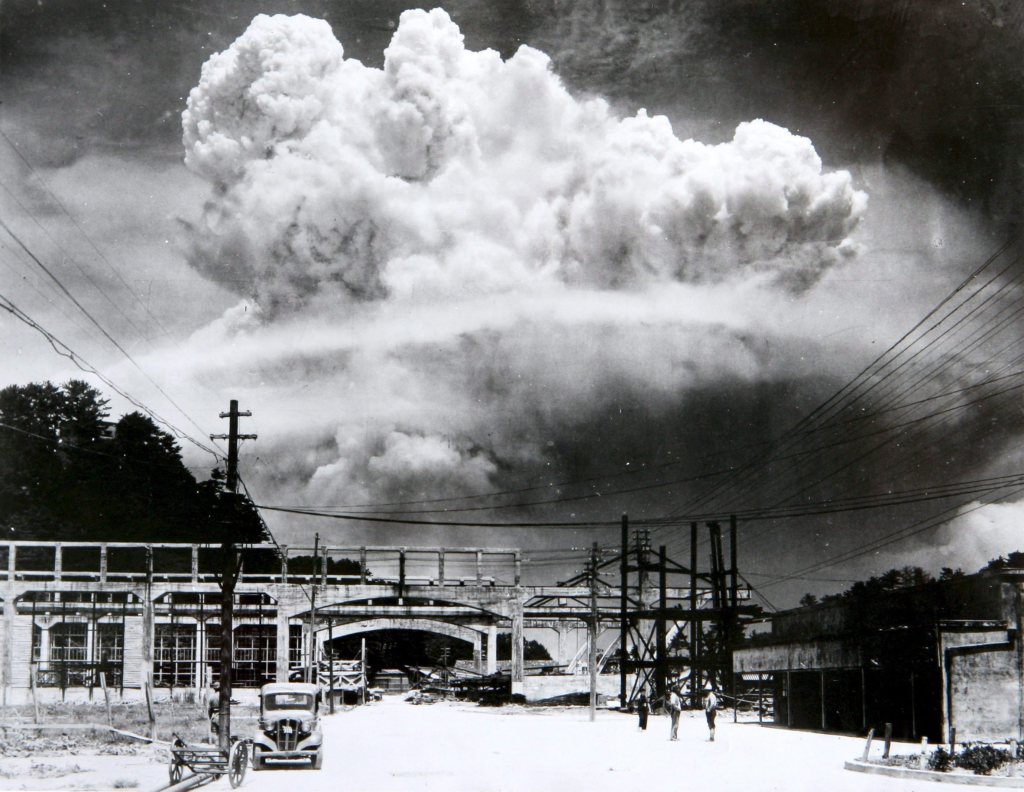
Japanese Sailor #2: A narrator on the ship Tsuruoka Maru saw the explosion through field glasses. He heard a loud explosion and what he thought were four or five explosions afterwards. The smoke after the explosion, which appeared to rise straight up, seemed to be bluish in color at the base and white and mushroom-shaped on top. The narrator noticed several fires in the surrounding forest; also a small boat bringing supplies to the narrator’s ship caught fire and burned soon after the explosion. A black hat of one of the men on the ship was blown from his head by the blast, and when found it was noted that the hat had turned brown… One of the men who wore short sleeves had second degree burns of his arms with huge blister formation. This ship was 9000 meters from the bomb center anchored in the harbor.
Japanese Sailor #3: On 13 August 1945, bodies were being burned in the vicinity of the Nagasaki Station (2,600 meters). At 1,800 meters, bodies were seen being removed from factory sites. The entire area looked deadly brown; nothing was green. There was a strange, horrible odor everywhere. A building at 1,400 meters was still smoking. The hills to the west of the city had many smoking areas. There were a number of bodies along the road from this point, 1,200 meters, on towards the center. The narrator was unable to see these bodies because they had been covered. At 600 meters north of the center, there were about six bodies which were swollen, faces yellow, eyes were entirely out of their sockets, tongues were protruding, and abdomens were ruptured on the left with intestines outside the abdominal wall. A number of blind horses were straying about the area; their eyes appeared to have been burned. The entire area was brown, nothing green was visible.
Captain James F. Van Pelt, Bockscar’s navigator, wrote the following regarding his visit to Nagasaki as part of a post-war survey team:
“There were skulls along the roads. The Japanese people had built air raid shelters (a hole about five or six feet deep with sandbags around it) in front of their houses, where you could look down and see skeletons.”
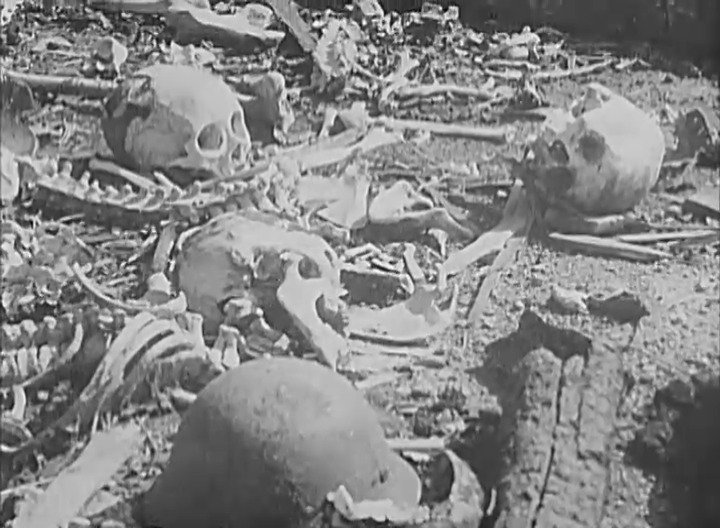
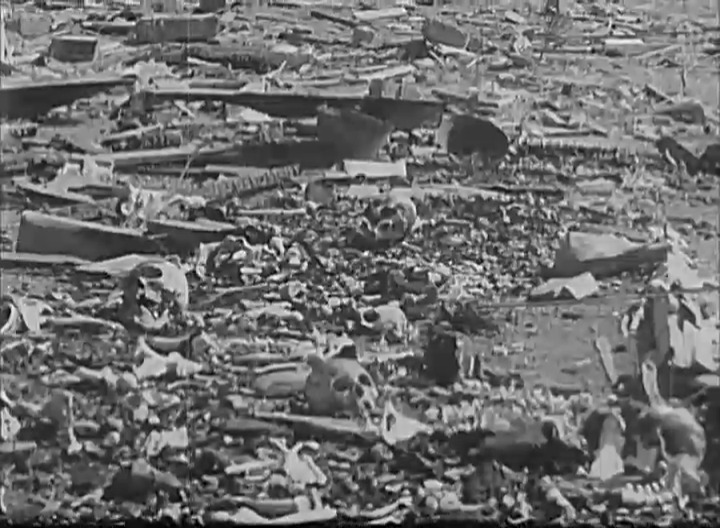
Radiation Sickness and Persons Affected by the Atomic Bomb
Surviving the burn and blast effects of the bomb did not guarantee actual survival. In a situation unique to Hiroshima and Nagasaki, radiation played a large part in killing people who, although subject to burns, cuts, and other injuries, did not appear to be in critical condition. Lieutenant Jakob Vink, a Dutch medical officer who was a prisoner of war in Nagasaki on 9 August, referred to the unknown sickness as “Disease X.” As the cause of the disease was unknown to Nagasaki’s medical personnel, treatment for the many casualties generally focused on the symptoms caused by radiation. Typical methods of care included multi-vitamins, liver extracts, blood transfusions, and blood plasma.
People who were within a kilometer of the hypocenter received severe doses of radiation, if not killed by blast or fire effects, and began to show symptoms of nausea and vomiting as soon as an hour after the bomb. After a latent period lasting around a day, victims would experience bloody diarrhea, nausea, vomiting, fevers, rapid emaciation, and then death. The 1945 Preliminary Report estimated that, among these peoples in the “Most Severe” category, the mortality rate was one hundred percent. Other surveys found that there were people who survived at this close distance. However, the mortality rate for this group was still found to be in excess of ninety percent.
Those survivors determined to have received a “Moderate” dose of radiation were typically located between 1.0 and 1.5 kilometers (0.6 and 0.9 miles) from the hypocenter. As in the “Most Severe” category, symptoms of radiation sickness, such as nausea and vomiting, began to appear only a few hours after exposure. Following a latent period that could last up to a week or more, patients began to show hemorrhagic gingivitis (bleeding gums), which would further progress into necrotic ulcers, petechiae (bleeding spots under the skin), bloody diarrhea, epistaxis (nosebleeds), fever, epilation, and rapid emaciation. Autopsies found that victims had no white blood cells, bone marrow deterioration, and acute inflammation of mucous membranes throughout the body.
Speaking to American news outlets, Dr. Harold Jacobsen from Columbia University was quoted on 10 August 1945 as saying that the areas around the Hiroshima and Nagasaki hypocenters may be radioactive enough to cause lethal radiation poisoning for seventy years. This was a legitimate fear for the survivors still in and around Nagasaki. Radiation effects were almost entirely unknown to the regular population. In addition, speculation from named and unnamed sources were frequent features in newspapers, each of which were vying to be the first to report on the many secrets of the new atomic age. In an attempt to assuage these fears, Dr. J. Robert Oppenheimer stated that “there is every reason to believe there was no appreciable radio activity [sic] on the ground at Hiroshima and what little there was decayed very rapidly.” This was confirmed in both cities by post-war surveys.
Regardless, the unknown tends to be accompanied by fear or even hostility. The survivor’s of both Hiroshima and Nagasaki became known as hibakusha, roughly translated as “persons affected by the (atomic) bomb.” The term is multi-faceted: although the hibakusha are given legal protection, medical care, and financial compensation by the government and sympathy from the community, being identified as a person exposed to radiation can, and often does, result in fear, hostility, and even disgust that stems from the “unknown” factor regarding radiation, atomic energy, and nuclear technology. This factor itself stems from the censorship imposed by the military headquarters that occupied Japan after the surrender. With no one in the media covering, or being allowed to cover, the effects of the atom bomb on the dead and wounded in Hiroshima and Nagasaki, the topic soon became a social taboo.
Part of this line of thinking may have come from the censorship of the Japanese Imperial Government during the war. The public were aware that the government censors downplayed the military disasters in the latter years of the war. Limits on what you could say or how you could say it were familiar concepts for the Japanese. However, if the new censorship regime forbade even the mention of the hibakusha, what did that say about the people exposed to radiation? Public speculation, uninformed though it was, soon spread in hushed tones with the witnessed accounts of the destroyed cities, of people instantly turned into statues of ash, and of the stream of injured victims fleeing the city, their faces and bodies red and swollen with burns and their skin hanging off like rags. Some people were fine for a week, but then began to deteriorate and waste away from a mysterious sickness caused by the bomb.
Questions remained unanswered for years: Was radiation sickness contagious? Does everything that they touch become infected? Are tumors going to grow from parts of the body exposed to radiation? Will their children have genetic defects? Have they all been sterilized? Has their DNA been altered or mutated? Are you willing to risk your family to exposure if you do not know?
To answer questions and combat these fears, organizations such as the Radiation Effects Research Foundation and Hiroshima International Council for Health Care of the Radiation-Exposed have been working for decades to answer these questions by conducting in-depth studies on the pathology of radiation exposure. Lifetime studies on Hiroshima and Nagasaki hibakusha and their descendants have greatly contributed to the medical community’s understanding of the effects of radiation on the human body. Both of these organizations conduct lectures, provide specialized medical training, and publish the results of their extensive research in a publicly available format. Other organizations like the Hibakusha Stories group focus on social and cultural aspects of hibakusha advocacy. The United Nations Office for Disarmament Affairs also has a page dedicated to the hibakusha on their education website.
In the decades after World War II and the use of the atomic bombs, the term hibakusha widened to include just about anyone who has been exposed to man-made atomic activity. This included the crew of Lucky Dragon No. 5, a Japanese fishing boat that was exposed to radiation from the Castle Bravo thermonuclear bomb test in the Marshall Islands. Despite being 86 miles from the test, the crew was exposed to enough radiation to cause the same symptoms experienced by the hibakusha of the atomic bombings almost ten years earlier.
In 2011, the Fukushima Daiichi Accident caused the evacuation of around 160,000 Japanese residents and the establishment of an exclusion zone centered around the nuclear power plant. Evacuees forced from their homes are entitled to aid from the Japanese government and compensation from the Tokyo Electric Corporation, who operated the plant. Similarly to the Hiroshima and Nagasaki hibakusha, however, some choose not to apply for aid or identify themselves out of fear that they will be “outed” as an affected person and be subject to the discrimination that has existed in Japanese society since the end of the war.
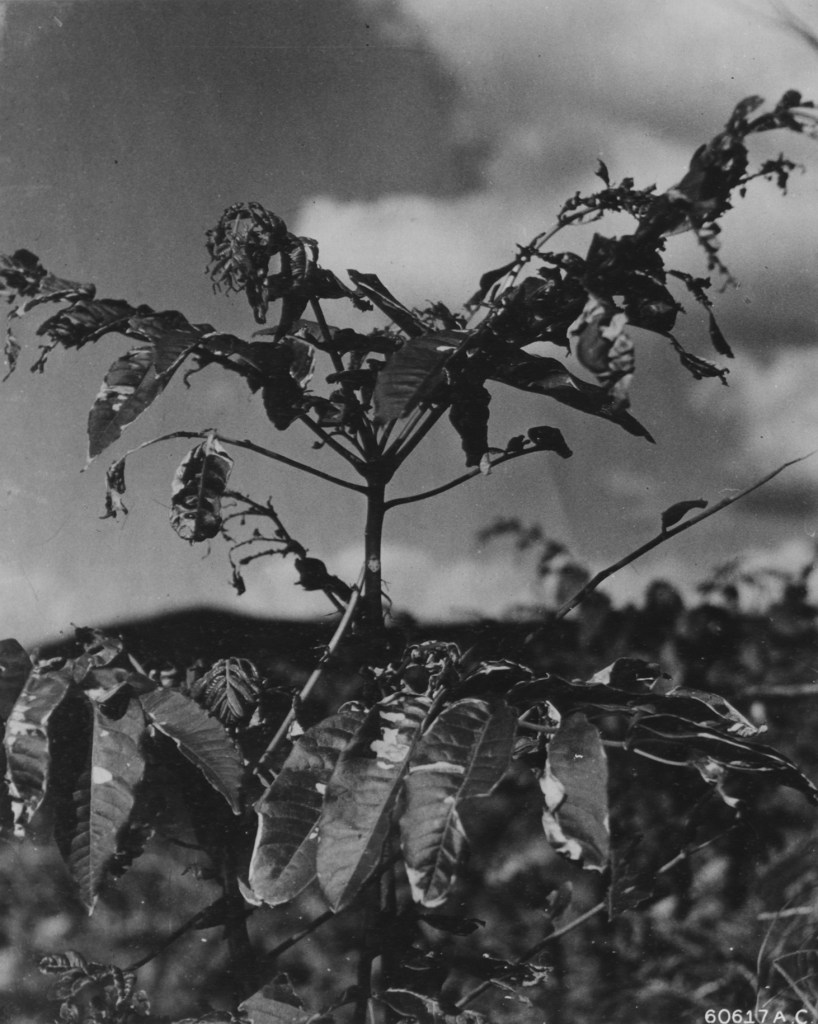
Despite the fears of the two cities turning into an uninhabitable nuclear wasteland, within a few months, new plant growth could be seen in areas that had been subject to the most severe effects of the bombs. Although the heat from the blast flash burned any vegetation in the line of sight of the hypocenter, these burns were largely superficial and the roots and bulbs below ground remained undamaged. Many of these hibakujumoku (Japanese: atomic bombed trees or shrubs) were cataloged and are still alive today.