

Birth of the White Sands Proving Ground
1945
Early in 1945, the Office of the Chief of Ordnance (OCO) contracted with Western Electric’s Bell Telephone Laboratories to develop a supersonic surface-to-air guided missile (SAM) to attack high-speed, high-altitude aircraft. By October 1946, Bell (which had tested the first U.S. jet aircraft three years earlier), with its subcontractors, Douglas Aircraft and Aerojet Engineering, and Aberdeen’s Ballistic Research Laboratory, produced the first successful Nike. Meanwhile, the Navy Bureau of Ordnance, concerned with the potential threat of kamikaze suicide attack, directed the Johns Hopkins University Applied Physics Laboratory (APL, established in 1942) to initiate the Bumblebee guided-missile and antiaircraft program, which led to the 3T missile family: Talos, Terrier, and Tartar.

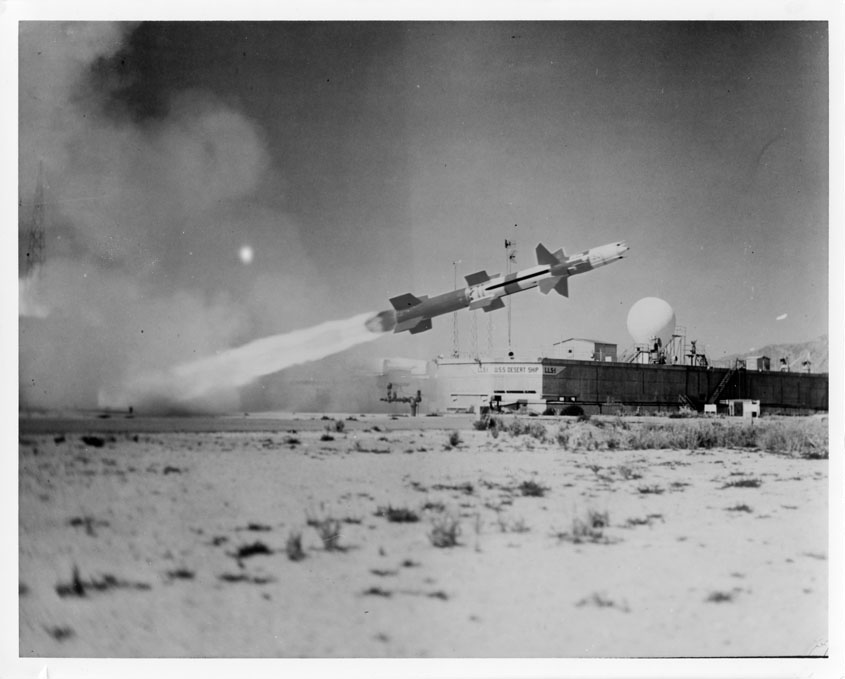
The new WSPG site in the Tularosa Basin incorporated the Alamogordo Bombing Range, ORDCIT, and portions of the Fort Bliss Artillery Range. The site was approved by the Secretary of War on February 20, the day after the last V–2 was fired in Europe. Initially, the northern portion was under the jurisdiction of the Army Air Force (which became the Air Force in 1947); the central portion was under the jurisdiction of the Department of the Army, OCO; and the extreme southern portion, including the Fort Bliss Antiaircraft Firing Range, remained part of Fort Bliss. This split in jurisdiction lasted until Army consolidation in 1950. Beginning on April 1, the first of 17 JPL Private F missiles was fired from Hueco Range on Fort Bliss, Texas. One month later, on May 2, Wernher von Braun and his rocket team fled the advancing Soviet Army and surrendered to American forces at Oberjoch, Germany. They had evacuated their Peenemünde rocket-research site and hidden their research documents in an old mine shaft near Dorten. U.S. Army Ordnance Technical Intelligence Special Mission V–2 captured the V–2 hardware at the underground Mittelwerk factory in Nordhausen, Germany. The 144th Ordnance Company secretly marshaled the Dorten documents, nearly 100 of some 400 Peenemünde personnel, and large quantities of V–2 hardware for transport to the United States.
By May 22, 1945, the first captured V–2 rocket components were being transported to Antwerp for shipment to the new Proving Ground. By June 30, evacuation of Peenemünde personnel to the United States was approved. Actual construction at WSPG began on June 25, with water-well drilling. Camp construction began on June 29, with the re-erection of three barracks buildings (referred to as “CCC buildings” in the 1959 WSMR history) moved from Sandia Air Base near Albuquerque or Camp Luna near Las Vegas, NM. These buildings had been sawn in half and transported to the new site with house-moving wheel sets. A relocated hangar, Dallas-type hutments, a missile-assembly building, and a building for the Fire Department were added. In correspondence to Starkweather, Col. E. W. Bradshaw, one of the three OCO officers who helped choose the WSPG site, recalls that (then) Lt. Col. Harold Turner, the first WSPG Commanding Officer, with the help of C Battery, 69th Antiaircraft Artillery Battalion, selected base camp and launch site locations, erected wood-floor squad tents, established generator and line power, drilled the first wells, and re-erected the three relocated barracks.
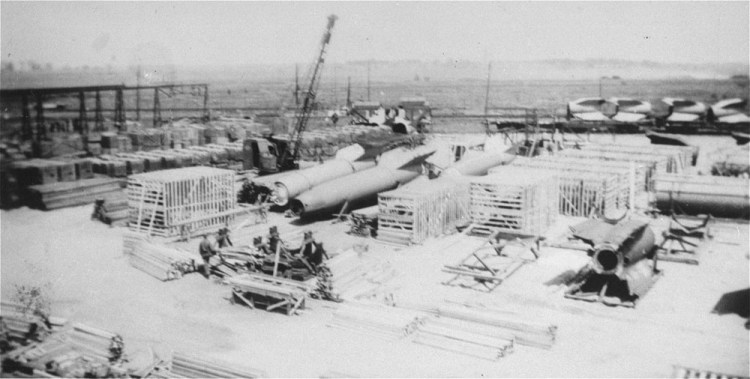
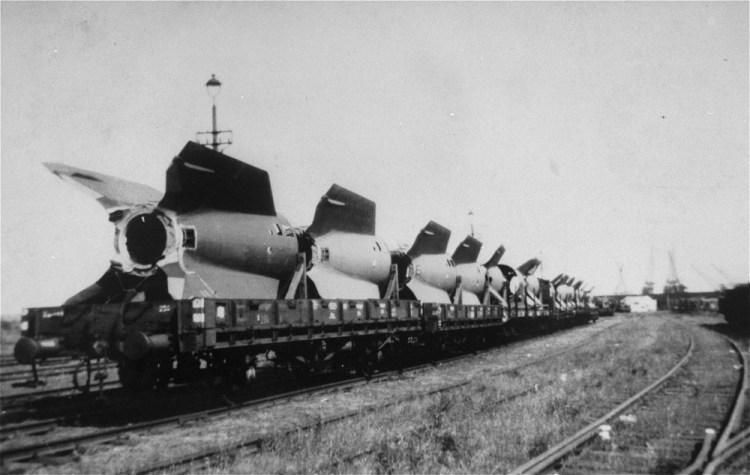
The Proving Ground was officially authorized by ASF Circular 269, July 13, effective July 9, 1945. Construction of the Army blockhouse at Army Launch Area 1 (the first at WSPG, now Launch Complex 33) commenced on July 10. By late July, 300 freight-car loads of V–2 (and probably other) missile parts were enroute to WSPG. Operation Overcast, a program to exploit German civilian scientific personnel, was established on July 19 and assumed responsibility for the captured Peenemünde staff. Meanwhile, the Manhattan Project, operating in secret at Site Y (Los Alamos, NM) under the command of Maj. Gen. Leslie Groves, had successfully designed the world’s first atomic device. Unbeknownst to Col. Turner, WSMR’s first commander, the Commander of the Alamogordo Bombing and Gunnery Range, Col. Roscoe Wilson, had reluctantly transferred control of the 432 square-mile Trinity Site to the Manhattan Project. Construction at Trinity was underway by November 1944, and the Trinity test was ignited July 16, 1945, at 5:29:45 a.m., Mountain War Time. Less than one month later, atomic weapons were first used against Japan, just as the captured German V–2 materiel began to arrive at WSPG.
On August 6, 1945, the first atom bomb was dropped at Hiroshima, Japan, followed by another at Nagasaki on August 9. The following day, C Battery, 69th Antiaircraft Artillery Battalion, was officially assigned to WSPG, and 163 officers and enlisted troops from the 9393rd Technical Service Unit, OCO, arrived, followed later by elements of the 4119th Area Service Unit (formerly 4845th), 8th Service Command, 4th Army. Robert H. Goddard, the father of American rocketry, died the same day.
Having been stationed at Stallion site Jan. 1962 until Sept. 1963, I found this article extremely interesting as well as educational. Thank you authors for a fine job.
Thank you so much! I’m very glad to hear you liked this article. Please stay tuned, as we’ll be adding much more in the future!
-Jenn
Thanks for the History. Been there several times with friends and family.
Thank you for this information. My dad served his duties here and I was able to see what he was involved in. He passed many years ago and I did not get an opportunity to share with him. Thanks Joe Hubbard
in the late 40,s 1946-47 my dad was a paratrooper in training on the east coast in the 101 airborne, preparing for a 2 nd invasion, should the first one have failed. due to a training accident, he was transfered to white sands missle range in about 1946 where he was a mechanic on the V-2 rockets, Unfortunately we have no pictures of my dad while there due to the secrurity concerns, He did recall to me the German scientists who arrived on base, also recalled the V-2 that went off couse and landed in Mexico, and finally he like to tell about the adventures he had chasing down V-2 s for recovery of the debris using a tank as pursuing vehicle.
It would be wonerful to hear from any on who might have known my Dad and worked with him, He passed away in El Paso, over 45 years ago. We miss him so much, and we are so proud of him.
thanks
Tom Warner
Thomas, my Dad was stationed at White Sands proving grounds when in the army. I don’t know if any of his photos would have your Dad. Most of the men were sent to fight in the Battle of the Bulge except for his unit and a couple of others. He was assigned to work on the rockets during his time there.
Army Radar Signal Corp White Sands Test Site. 1950’s. Enlisted right out of high school.