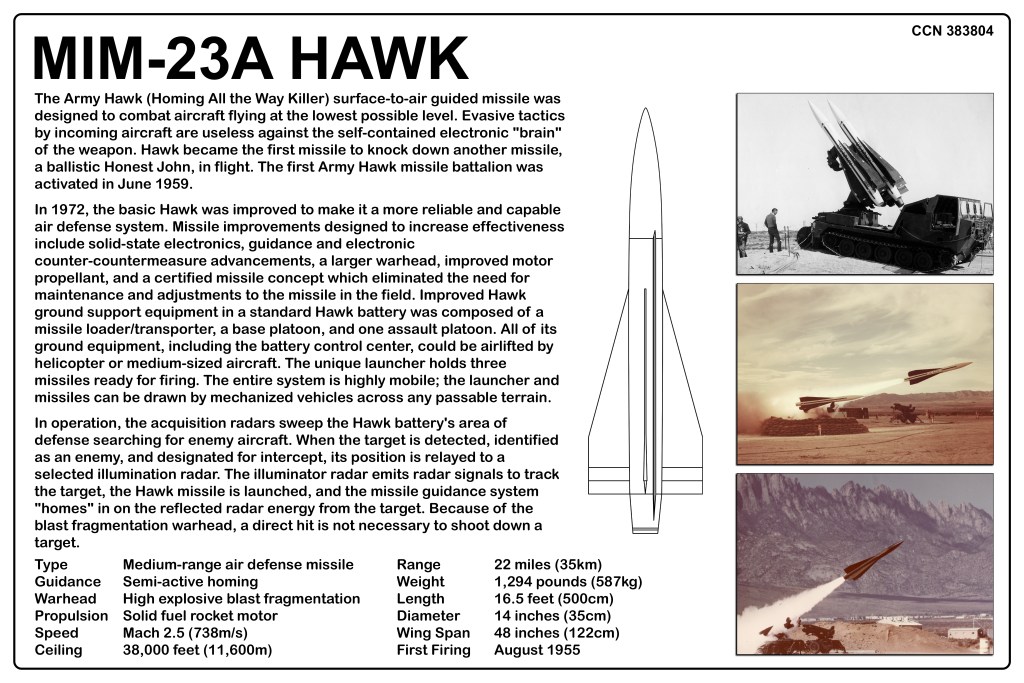
MIM-23 Hawk
| Type: | Medium-range air defense missile |
| Guidance: | Semi-active homing/proportional navigation |
| Warhead: | High explosive blast fragmentation |
| Propellant: | Solid fuel rocket motor |
| Speed: | Mach 2.5 (738m/s) |
| Ceiling: | 38,000 feet (11,600m) |
| Range: | 22 miles (35km) |
| Weight: | 1,294 pounds (587kg) |
| Length: | 16.5 feet (500cm) |
| Diameter: | 14 inches (35cm) |
| Wing Span: | 48 inches (122cm) |
| First firing: | August 1955 |
The Army Hawk (Homing All the Way Killer) surface-to-air guided missile was designed to combat aircraft flying at the lowest possible level. Mobile and with a relatively high rate of fire, Hawk is 16.5 feet long and 14 inches in diameter with four back-swept wings and control surfaces running along the rear two-thirds of the missile.
Guidance is radar homing. Evasive tactics by incoming aircraft are useless against the self-contained electronic “brain” of the weapon. The unique launcher holds three missiles ready for firing. The entire system is highly mobile; the launcher and its missiles can be drawn by mechanized vehicles across any passable terrain. All of its ground equipment, including the battery control center, could be airlifted by helicopter or medium-sized aircraft.
Hawk was tested at White Sands Missile Range in a program which included Marine Corps experimentation for adapting Hawk to the Corps’ specialized tactical requirements. Hawk’s altitude capabilities, despite its original design for low-level operation, have been proven up to six miles against a target missile flying at 1,400 miles per hour. Hawk became the first missile to knock down another missile, a ballistic Honest John, in flight. The prime contractor for Hawk was Raytheon. The propulsion system was manufactured by Aerojet General and Thiokol Chemical.
In addition to being produced in the United States, Hawk was also produced in France, Italy, and 17 other countries. These countries produced the NATO/Hawk variant for their own deployment. Production of this variant began in 1962. The first Army Hawk missile battalion was activated in June 1959.
In 1972, the basic Hawk was improved to make it a more reliable and capable air defense system. New pieces of equipment added were the Information Coordination Central, which provides automatic friendly aircraft identification and automatic missile firing through the use of a computer, and the Improved Platoon Command Post, which provides manual and automatic target processing. Threat performance has increased in speed, maneuverability, terrain following, and countermeasures capability. Missile improvements designed to increase effectiveness include solid-state electronics, guidance and electronic counter-countermeasure advancements, a larger warhead, improved motor propellant, and a certified missile concept which eliminated the need for maintenance and adjustments to the missile in the field.
Improved Hawk ground support equipment in a standard Hawk battery is composed of a missile loader/transporter, a base platoon, and one assault platoon. The base platoon consists of a pulse acquisition radar, a continuous wave acquisition radar, a range-only radar, an information coordination central, a battery control center, plus one high-power illuminator, three launchers, and nine ready missiles. The assault platoon consists of an improved platoon command post, a continuous wave acquisition radar, one high-power illuminator, three launchers, and nine ready missiles. The TRIAD battery incorporates one additional assault platoon to the battery. The TRIAD’s advantages are increased firepower, area coverage, and deployment flexibility.
In operation, the acquisition radars sweep the Hawk battery’s area of defense searching for enemy aircraft. When the target is detected, identified as an enemy, and designated for intercept, its position is relayed to a selected illumination radar. The illuminator radar emits radar signals to track the target, the Hawk missile is launched, and the missile guidance system “homes” in on the reflected radar energy from the target. This sequence of events is performed automatically, but can be overridden and redirected by the fire control officer at any time during the sequence prior to missile launch. Because of the blast fragmentation warhead, a direct hit is not necessary to shoot down a target.