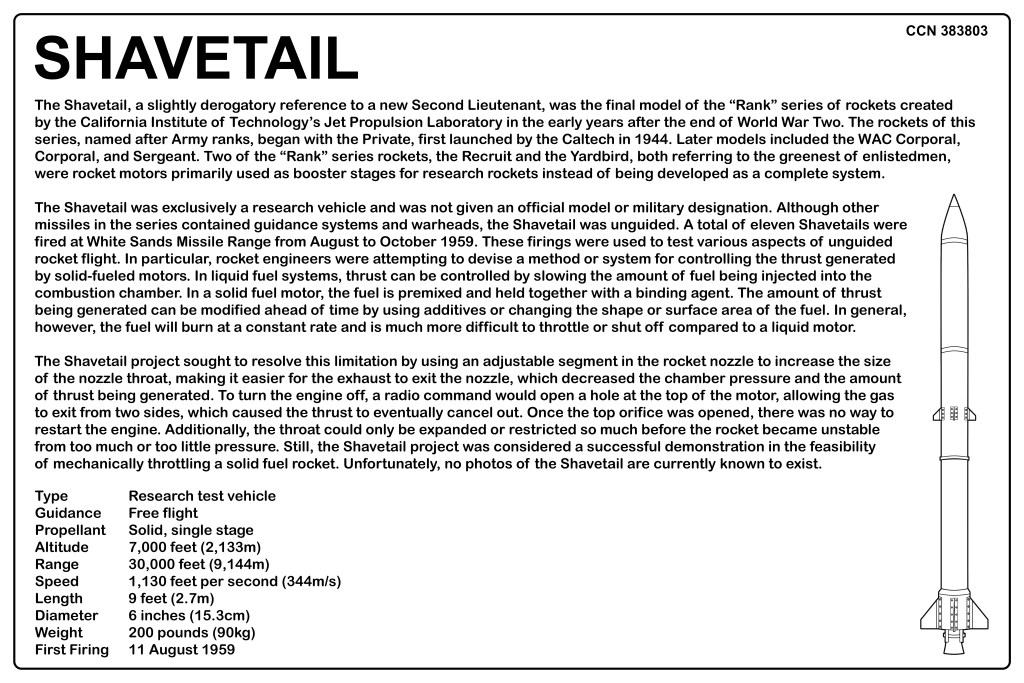
Shavetail
| Type: | Research test vehicle |
| Guidance: | Free flight |
| Propellant: | Solid single stage |
| Altitude: | 7,000 feet (2,133m) |
| Range: | 30,000 feet (9,144m) |
| Speed: | 1,130 feet per second (344m/s) |
| Length: | 9 feet (2.7m) |
| Diameter: | 6 inches (15.3cm) |
| Weight: | 200 pounds (90kg) |
| First Firing: | 11 August 1959 |
The Shavetail, a slightly derogatory reference to a new Second Lieutenant, was the final model of the “Rank” series of rockets created by the California Institute of Technology’s Jet Propulsion Laboratory in the early years after the end of World War Two. The rockets of this series, named after Army ranks, began with the Private, first launched by the Caltech in 1944. Later models included the WAC Corporal, Corporal, and Sergeant. Two of the “Rank” series rockets, the Recruit and the Yardbird, both referring to the greenest of enlistedmen, were rocket motors primarily used as booster stages for research rockets instead of being developed as a complete system.
The Shavetail was exclusively a research vehicle and was not given an official model or military designation. Although other missiles in the series contained guidance systems and warheads, the Shavetail was unguided. A total of eleven Shavetails were fired at White Sands Missile Range from August to October 1959. These firings were used to test various aspects of unguided rocket flight. In particular, rocket engineers were attempting to devise a method or system for controlling the thrust generated by solid-fueled motors. In liquid fuel systems, thrust can be controlled by slowing the amount of fuel being injected into the combustion chamber. In a solid fuel motor, the fuel is premixed and held together with a binding agent. The amount of thrust being generated can be modified ahead of time by using additives or changing the shape or surface area of the fuel. In general, however, the fuel will burn at a constant rate and is much more difficult to throttle or shut off compared to a liquid motor.
The Shavetail project sought to resolve this limitation by using an adjustable segment in the rocket nozzle to increase the size of the nozzle throat, making it easier for the exhaust to exit the nozzle, which decreased the chamber pressure and the amount of thrust being generated. To turn the engine off, a radio command would open a hole at the top of the motor, allowing the gas to exit from two sides, which caused the thrust to eventually cancel out. Once the top orifice was opened, there was no way to restart the engine. Additionally, the throat could only be expanded or restricted so much before the rocket became unstable from too much or too little pressure. Still, the Shavetail project was considered a successful demonstration in the feasibility of mechanically throttling a solid fuel rocket. Unfortunately, no photos of the Shavetail are currently known to exist.
Although “Shavetail” is not an actual military rank, the term was slang for 2nd Lieutenants, the most junior grade officer in the US Army. According to Merriam-Webster, the word originated in the mid-1800s and came from the practice of shaving the tails of new mules that had not been broken in yet. The term carried a derogatory connotation and likely fell out of use as the number of people engaged in equine husbandry lessened over time. Today, 2nd Lieutenants are sometimes referred to as “Butterbars,” because their gold rank insignia looks like a bar of butter.