MIM-104 Patriot
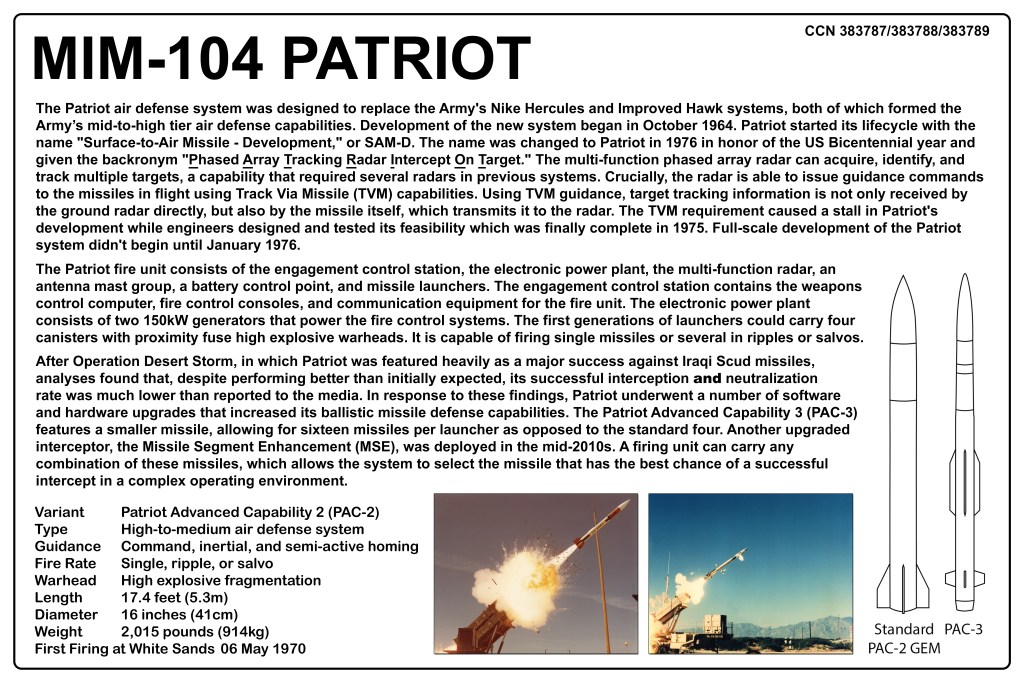
| Type: | High-to-medium air defense (HIMAD) system |
| Launch Rate: | Single, ripple, salvo |
| Propulsion: | Single stage using solid propellant |
| Guidance: | Command, inertial, active, and semi-active homing |
| First firing at White Sands: | 06 May 1970 |
| Variants: | Standard | Patriot Advanced Capability 2 (PAC-2) | Patriot Advanced Capability (PAC-3) |
| Number of interceptors per launcher: | 4 | 4 | 16 |
| Warhead: | Fragmentation | Fragmentation | None |
| Length: | 17.4 feet (5.3m) | 17.4 feet (5.3m) | 15.2 feet (4.6m) |
| Diameter: | 16 inches (41cm) | 16 inches (41cm) | 10 inches (25cm) |
| Weight: | 2,015 pounds (913kg) | 2,000 pounds (907kg) | 736 pounds (333kg) |
The Patriot air defense system was designed to replace the Army’s Nike Hercules and Improved Hawk systems. Originally, it was designed for defense against high-performance, air-breathing targets. Development of the new air defense system began in October 1964.
Patriot started its lifecycle with the name “Surface-to-Air Missile – Development,” or SAM-D. The name was changed to Patriot in 1976 in honor of the US Bicentennial year. Patriot was given the backronym “Phased Array Tracking Radar Intercept On Target.”
The system can simultaneously acquire, identify, track, and destroy multiple air-supported targets. The multi-function phased array radar can perform all of the functions required of several radars in previous systems. Crucially, the radar is able to issue guidance commands to the missiles in flight using Track Via Missile (TVM) capabilities. Using TVM guidance, target tracking information is not received by the ground radar directly, but by the missile, which transmits it to the ground control station. Because the missile is always closer to the target than the ground radar, this method enhances accuracy and the ability to discriminate decoys from the actual warhead. These functions are performed simultaneously by the weapons control computer.
The TVM requirement caused a stall in Patriot’s development while project engineers designed and tested the feasibility of this unproven technology, which was finally complete in 1975. Full-scale development of the Patriot system didn’t begin until January 1976.
The Patriot fire unit consists of the engagement control station, the electronic power plant, the multi-function phased array radar, an antenna mast group, a battery control point, and missile launchers. The engagement control station contains the weapons control computer, fire control consoles, and communication equipment for the fire unit. The electronic power plant consists of two 150kW generators that power most of the fire control systems.
The standard variant launchers each carry four single-stage missile rounds in launching-shipping canisters. The launcher is trainable in azimuth and elevation and is capable of firing single missiles or several in close-sequence salvos. The missiles are divided into nose, guidance, warhead, motor, and control sections. These sections are assembled in the factory and are sealed into the canister as a certified round. The certified round requires no on-site maintenance, being loaded onto the launcher as it is received from rear area supply.
Patriot uses a dual-mode guidance technique consisting of a combination of command and semi-active homing techniques.
The battalion-level information coordination central can coordinate firings within the battalion and serve as a communication center with outside systems. The ICC has a computer for processing and coordinating data between the radars and passes on fire-control information and rules of engagement.
Special features of the Patriot system include the built-in test equipment, fault-isolation capability, and redundant circuitry, all of which operate during normal Patriot operations to prolong time online for the system. During offline time, the Patriot system has a maintenance concept which can direct personnel to individual defective modules for replacement.
Following Operation Desert Storm, in which Patriot was featured heavily and touted as a major success, work began on a new missile model specifically for defense against ballistic missiles. The Patriot Advanced Capability 3 (PAC-3) features a smaller missile, allowing for sixteen missiles per launcher as opposed to the standard four. Another advanced missile, the Missile Segment Enhancer (MSE), was fielded to units in the mid-2010s. The MSE is intended to bridge the distance between the peak altitude of the PAC-3 and the lowest optimal altitude of the Terminal High Altitude Area Defense (THAAD) system. One Patriot launcher can carry any combination of these missiles, which allows the system to select the missile that has the best chance of a successful intercept in a complex operating environment.