

MGM-31 Pershing I and MGM-31C Pershing II
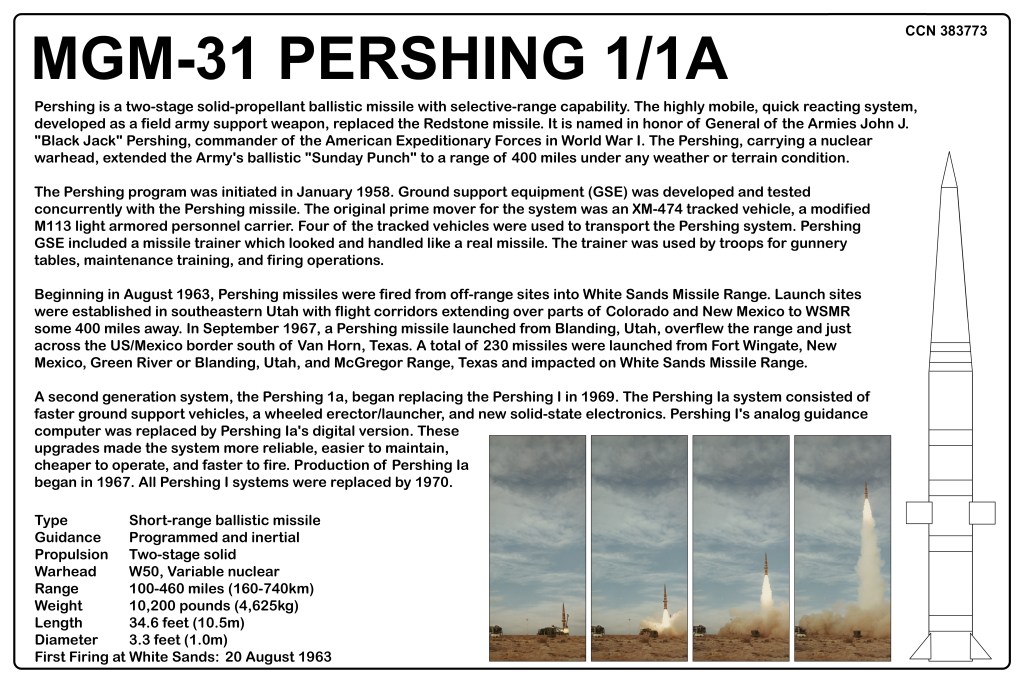
| Pershing 1/1a | Pershing II | |
| Type: | Short-range ballistic missile | Medium-range ballistic missile |
| Guidance: | Programmed and inertial | Inertial, terminal area-correlation |
| Propulsion: | Two-stage solid | Two-stage solid |
| Warhead: | W-50, variable nuclear | W-85, Variable nuclear |
| Range: | 100-460 miles (160-740km) | 1,100 miles (1,770km) |
| Weight: | 10,200 pounds (4,625kg) | 15,840 pounds (7,180kg) |
| Length: | 34.6 feet (10.5m) | 34.9 feet (10.6m) |
| Diameter: | 3.3 feet (1.0m) | 3.3 feet (1.0m) |
| First Firing: | 20 August 1963 | 18 November 1977 |
Pershing I
Pershing is a two-stage solid-propellant ballistic missile with selective-range capability. The highly mobile, quick reacting system, developed as a field army support weapon, replaced the Redstone missile. It is named in honor of General of the Armies John J. “Black Jack” Pershing, commander of the American Expeditionary Forces in World War I. The Pershing, carrying a nuclear warhead, extended the Army’s ballistic “Sunday Punch” to a range of 400 miles under any weather or terrain condition.
The Pershing program was initiated in January 1958. Martin Company, Orlando Division, which had gained experience in guided missile techniques in the Matador/Mace program, was awarded the prime contract in March 1958. Ground support equipment (GSE) was developed and tested concurrently with the Pershing missile. The original prime mover for the system was an XM-474 tracked vehicle, a modified M113 light armored personnel carrier. Four of the tracked vehicles were used to transport the Pershing system. Pershing GSE included a missile trainer which looked and handled like a real missile. The trainer was used by troops for firing operations and maintenance training. Circuits in the system permitted instructors to simulate troubles and faults similar to those that might occur in the live missile.
The Pershing inertial guidance system, developed by the Missile Command Guidance Control Laboratory, was designed to be immune to contemporary electronic counter-measures. It retained control of the missile until cut-off and separation of the second stage. Topping the Pershing was a needle-nose reentry vehicle. The warhead section traveled on a ballistic course and reentered the atmosphere at high velocity. The warhead section was covered with a material that allowed it to withstand reentry heating.
Beginning in August 1963, Pershing missiles were fired from off-range sites into White Sands Missile Range. Launch sites were established in southeastern Utah with flight corridors extending over parts of Colorado and New Mexico to WSMR some 400 miles away. In September 1967, a Pershing missile launched from Blanding, Utah, overflew the range and landed south of the border in an isolated area of Chihuahua, Mexico. A total of 230 missiles were launched from Fort Wingate, New Mexico, Green River or Blanding, Utah, and McGregor Range, Texas and impacted on White Sands Missile Range.
US Army units would participate in live fire exercises and certifications at White Sands. Additionally, troops and units from the 7th US Army and the Federal Republic of Germany’s Air Force were brought from Europe for practice firings at WSMR and the Green River Launch Complex in Utah.
Pershing 1a
A second generation system, the Pershing 1a began replacing the Pershing I in 1969. The Pershing Ia system consisted of faster ground support vehicles, a wheeled erector/launcher, and new solid-state electronics. Pershing I’s analog guidance computer was replaced by Pershing Ia’s digital version. These upgrades made the system more flexible, reliable, easier to maintain, cheaper to operate, and faster to fire.
The biggest outward change was a shift from tracked vehicles to wheels for all ground support equipment, including the improved erector-launcher. The switch to this new equipment was accomplished through a unique logistics plan known as “SWAP.” Battalion-size “packages” of P1-A equipment were formed at Cape Canaveral, Florida, then shipped intact to Pershing units in the field. New equipment was then substituted for the old without affecting the readiness posture of the unit.
Production of the Pershing Ia began in 1967. By 1970, it had replaced all original Pershing I systems in active service.
In 1976, further improvements of the Pershing Ia system were fielded with the sequential launch adapter (SLA) and the automatic reference system (ARS). The SLA allowed a Pershing Ia platoon to fire its three missiles in quick succession, and the ARS, essentially a ground-based inertial unit, eliminated the need to survey the launch site before firing.
A total of about 750 Pershing I/Ia missiles were built, with 108 missiles being deployed to Europe.
Pershing II
Pershing II was a two-stage improved version of Pershing Ia. It utilized a maneuverable reentry vehicle and radar area-correlation guidance. By comparing the on-coming target with stored images, accuracy was greatly improved. The warhead destroyed the target by airburst or earth penetration and could penetrate the ground to a depth of 100 feet before exploding.
Pershing II had a new propulsion sections and modified Pershing Ia ground support equipment. Pershing II was still a manpower-intensive system, requiring 3,800 men for 108 missiles on launchers.
The Deputy Secretary of Defense authorized the Army to proceed with the advanced development of the Pershing II on 07 March 1974. The first Pershing II missile firing at White Sands Missile Range took place in 1977.
The increased range and pinpoint accuracy of the Pershing II were major factors that influenced the Soviet Union’s decision to pursue the Treaty on Intermediate Range Nuclear Forces, in which the US and USSR agreed to eliminate all medium and intermediate-range nuclear armed ballistic missiles. The INF Treaty was signed on 08 December 1987 and ratified by the US Senate on 27 May 1988.
In accordance with the INF Treaty, all of the US Army’s tactical Pershing II missile stages, launchers, trainers, and reentry vehicles had to be eliminated by 31 May 1988. The destruction of the last Pershing IIs occurred in May 1991. Representatives from the Soviet Inspection Team and the US On-Site Inspection Agency were present to witness the elimination process.
Both the US and the USSR were allowed to keep inert missiles for use on display in museums and similar facilities. One of the Pershing II missiles and launchers are on display at the White Sands Missile Range Museum Missile Park.
