MQM-107 Streaker
| Variant: | MQM-107 Standard |
| Type: | Subsonic target drone |
| Guidance: | Auto flight, remote control |
| Propellant: | JATO booster, liquid turbojet |
| Altitude: | 40,000 feet (12,200m) |
| Speed: | 575 miles per hour (925km/h) |
| Length: | 202 inches (513cm) |
| Wingspan: | 118.5 inches (300cm) |
| Weight: | 1,067 pounds (484kg) |
| First firing: | June 1973 |
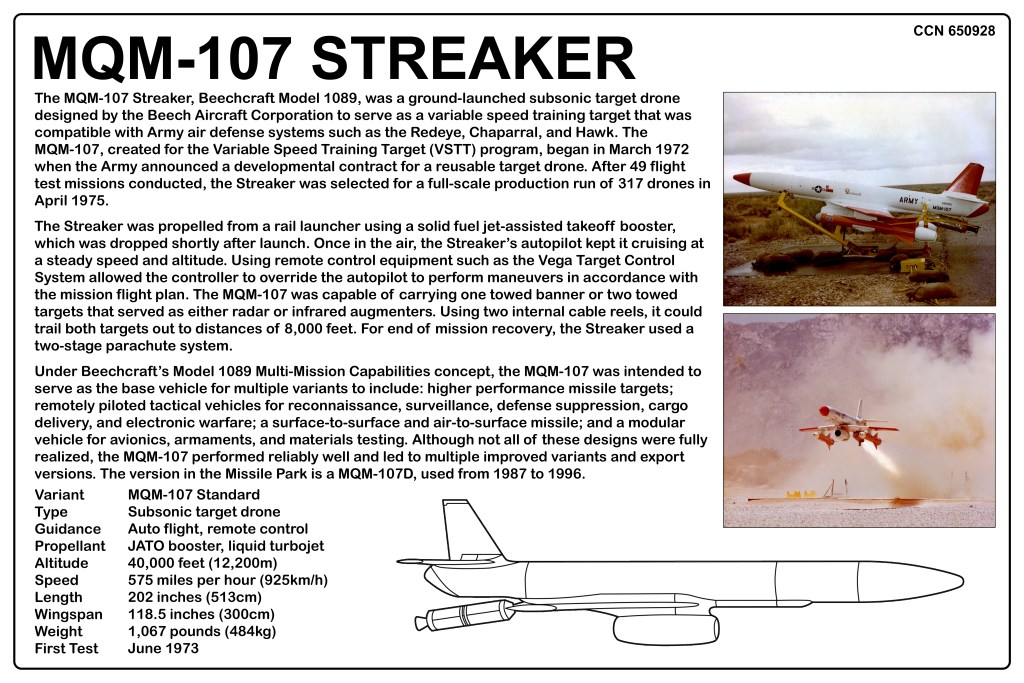
The MQM-107 Streaker, Beechcraft Model 1089, was a ground-launched subsonic target drone designed by the Beech Aircraft Corporation to serve as a variable speed training target that was compatible with Army air defense systems such as the Redeye, Chaparral, and Hawk. The MQM-107, created for the Variable Speed Training Target (VSTT) program, began in March 1972 when the Army announced a developmental contract for a reusable target drone. After 49 flight test missions conducted, the Streaker was selected for a full-scale production run of 317 drones in April 1975.
The Streaker was propelled from a rail launcher using a solid fuel jet-assisted takeoff booster, which was dropped shortly after launch. Once in the air, the Streaker’s autopilot kept it cruising at a steady speed and altitude. Using remote control equipment such as the Vega Target Control System allowed the controller to override the autopilot to perform maneuvers in accordance with the mission flight plan. The MQM-107 was capable of carrying one towed banner or two towed targets that served as either radar or infrared augmenters. Using two internal cable reels, it could trail both targets out to distances of 8,000 feet. For end of mission recovery, the Streaker used a two-stage parachute system.
Under Beechcraft’s Model 1089 Multi-Mission Capabilities concept, the MQM-107 was intended to serve as the base vehicle for multiple variants to include: higher performance missile targets; remotely piloted tactical vehicles for reconnaissance, surveillance, defense suppression, cargo delivery, and electronic warfare; a surface-to-surface and air-to-surface missile; and a modular vehicle for avionics, armaments, and materials testing. Although not all of these designs were fully realized, the MQM-107 performed reliably well and led to multiple improved variants and export versions. The version in the Missile Park is a MQM-107D, used from 1987 to 1996.