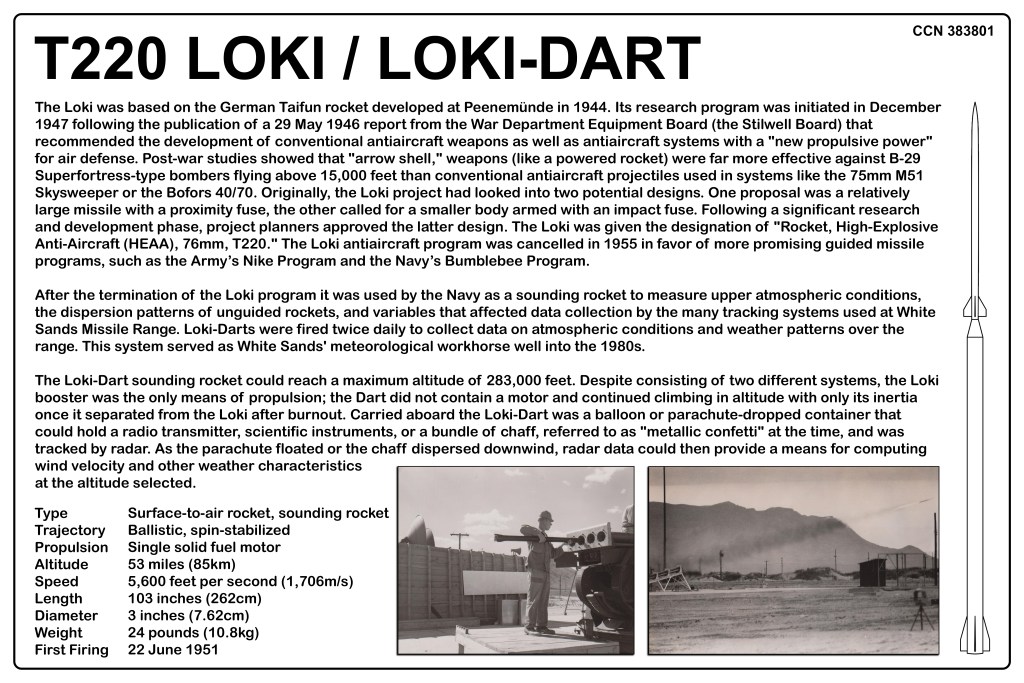
T220 Loki/Loki-Dart
| Type: | Surface-to-air rocket, sounding rocket |
| Guidance: | Free flight, spin-stabilized |
| Propulsion: | Single solid-fuel motor |
| Altitude: | 53 miles (85km) |
| Speed: | 5,600 feet per second (1,706m/s) |
| Length: | 103 inches (262cm) |
| Diameter: | 3 inches (7.62cm) |
| Weight: | 24 pounds (10.8kg) |
| First firing: | 22 June 1951 |
Loki-Dart was named after the Norse god who carried a dart of mistletoe as a weapon. At just over 8.5 feet in length, it is light enough to be hand-carried. The Loki could be attached to a wide number of booster motors or used as a booster itself, depending on mission requirements. The missile on display in the White Sands Missile Range Museum’s Missile Park consists of a Loki booster with a Dart mounted on its nose.
The Loki was based on the German Taifun rocket developed at Peenemünde in 1944. Its research program was initiated in December 1947 following the publication of a 29 May 1946 report from the War Department Equipment Board (the Stilwell Board) that recommended the development of conventional antiaircraft weapons as well as antiaircraft systems with a “new propulsive power” for air defense. Post-war studies showed that “arrow shell,” weapons (like a powered rocket) were far more effective against B-29 Superfortress-type bombers flying above 15,000 feet than conventional antiaircraft projectiles used in systems like the 75mm M51 Skysweeper or the Bofors 40/70.
Originally, the Loki project had looked into two potential designs. One proposal was a relatively large missile with a proximity fuse, the other called for a smaller body armed with an impact fuse. Following a significant research and development phase, project planners approved the latter design. The Loki was given the designation of “Rocket, High-Explosive Anti-Aircraft (HEAA), 76mm, T220.”

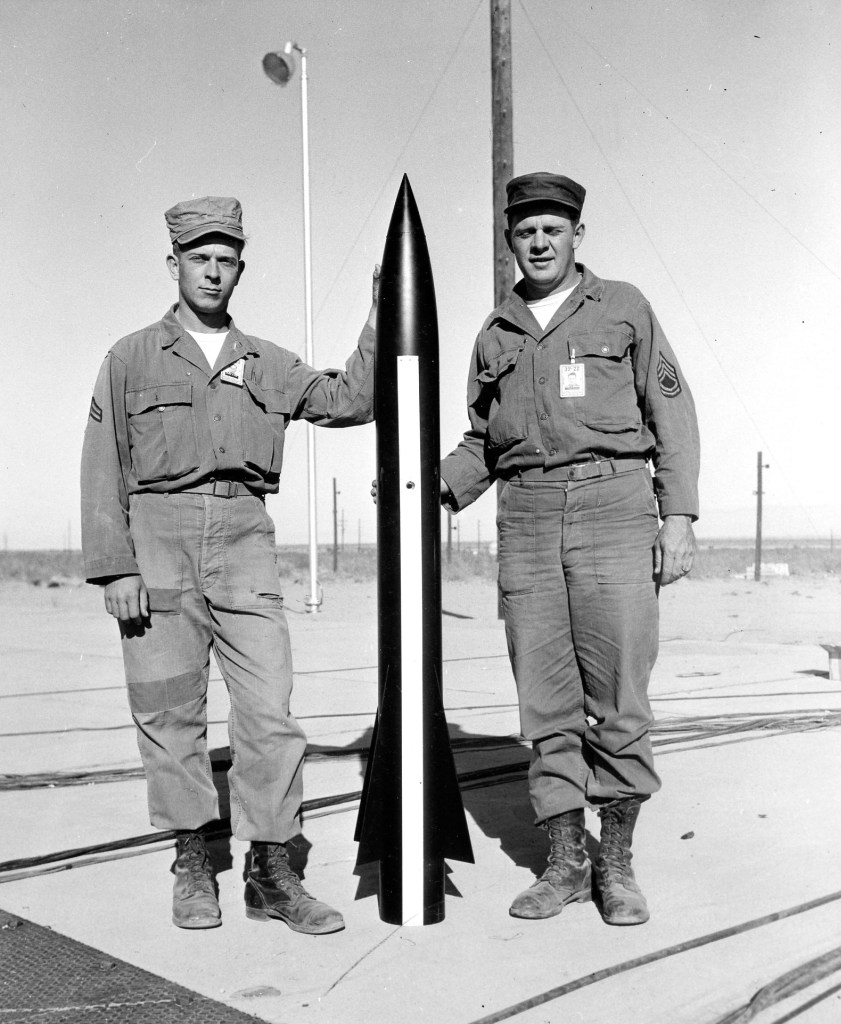
Loki was made of three main parts: the motor, warhead, and fuse. It had no in-flight guidance system and was intended to be fired from the T128 multiple-tube launcher in a barrage pattern calculated by a modified M-33 Fire Control System. Due to its impact fuse, it required a direct hit on its target to detonate. After impact, there was a short delay before detonation to allow Loki to penetrate into the cabin or structure of its target, maximizing the potential destructive power of the two pounds of explosives carried in its warhead. If Loki missed its target, it had a self-destruct device that would activate after thirty seconds.
Like the Loki missile itself, there were multiple prototypes of Ground Support Equipment (GSE) proposed for the complete Loki system. In July 1950, the Ballistic Research Laboratories released a report proposing a launcher firing 81 rockets per salvo. However, this launcher was proposed before project planners had finalized the dimensions of Loki and was based on a 35mm Loki rocket, less than half the diameter of the version chosen for production. After the adoption of the 76mm Loki, it became necessary to scale down the number of rockets launched per salvo.
Work on building the T128 Launcher began in 1952 with the Bendix Aviation Corporation receiving a contract to deliver a system capable of launching multiple Lokis at a time. The first launcher built was a four-tube system, designated as the “ballistic launcher,” with each tube carrying one Loki. While practical for small-scale Loki tests, the fully operational Loki system would require many more missiles per salvo. With this in mind, work began on a 46-tube missile magazine for use with solid propellant Lokis and a 64-tube missile magazine for use with liquid propellant versions. Following the decision to focus exclusively on solid propellants, work ceased on the 64-tube launcher, which had, by that point, only progressed to the development of a one-tenths scale model.
The first test firings of the Loki were at the White Sands Proving Ground’s Army Launch Area 1, known today as Launch Complex 33, in June 1951. By the end of the year, the Jet Propulsion Laboratory had fired 34 Loki missiles. Some 3,544 rounds were fired at White Sands before the antiaircraft phase of the Loki program was completed in September 1955.
The Loki-Dart Sounding Rocket
After the termination of the Loki antiaircraft program, it was used by the Navy as a sounding rocket to measure upper atmospheric conditions, the dispersion patterns of unguided rockets, and variables that affected data collection by the many tracking systems used at White Sands Missile Range. Loki-Darts were fired twice daily to collect data on atmospheric conditions and weather patterns over the range. Loki-Dart served as White Sands’ meteorological workhorse well into the 1980s.
The Loki-Dart sounding rocket could reach a maximum altitude of 283,000 feet. Despite consisting of two different systems, the Loki booster was the only means of propulsion; the Dart did not contain a motor and continued climbing in altitude with only its inertia once it separated from the Loki after burnout. Carried aboard the Loki-Dart was a balloon or parachute-dropped container that could hold a radio transmitter, scientific instruments, or a bundle of chaff, referred to as “metallic confetti” at the time, and was tracked by radar. As the parachute floated or the chaff dispersed, radar data could then provide a means for computing wind velocity and other weather characteristics at the altitude selected.