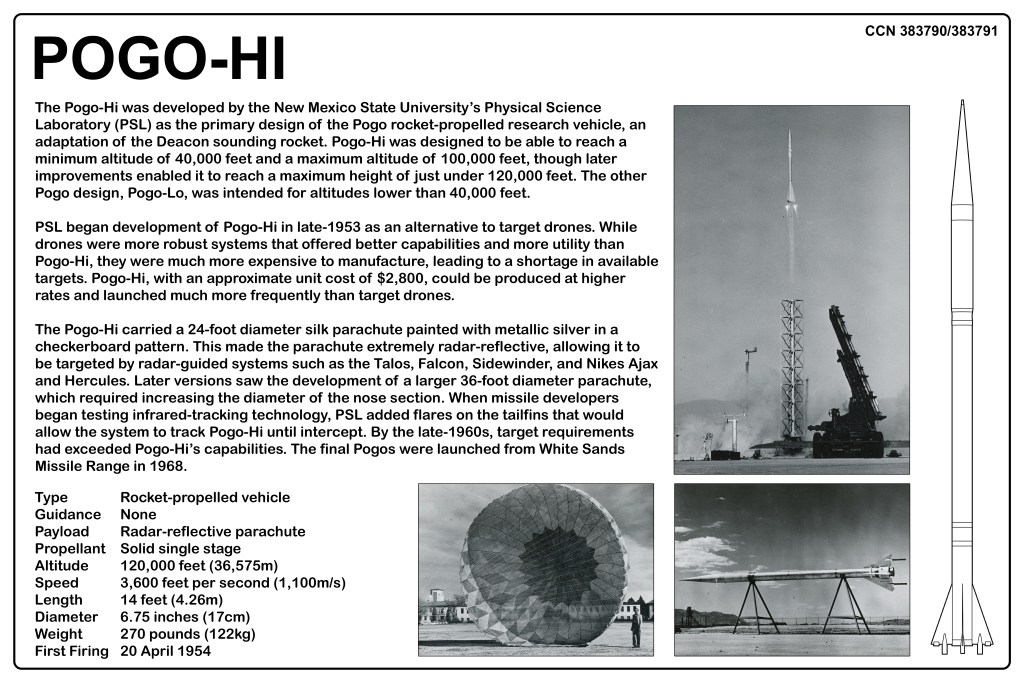
Pogo-Hi
| Type: | Rocket-propelled vehicle |
| Guidance: | None |
| Payload: | Radar-reflective parachute |
| Propellant: | Solid single stage |
| Altitude: | 120,000 feet (36,575m) |
| Speed: | 3,600 feet per second (1,100m/s) |
| Length: | 14 feet (4.26m) |
| Diameter: | 6.75 inches (17cm) |
| Weight: | 270 pounds (122kg) |
| First firing: | 20 April 1954 |
The Pogo-Hi was developed by the New Mexico State University’s Physical Science Laboratory (PSL) as the primary design of the Pogo rocket-propelled research vehicle, an adaptation of the Deacon sounding rocket. Pogo-Hi was designed to be able to reach a minimum altitude of 40,000 feet and a maximum altitude of 100,000 feet, though later improvements enabled it to reach a maximum height of just under 120,000 feet. The other Pogo design, Pogo-Lo, was intended for altitudes lower than 40,000 feet.
PSL began development of Pogo-Hi in late-1953 as an alternative to target drones. While drones were more robust systems that offered better capabilities and more utility than Pogo-Hi, they were much more expensive to manufacture, leading to a shortage in available targets. Pogo-Hi, with an approximate unit cost of $2,800, could be produced at higher rates and launched much more frequently than target drones.
The Pogo-Hi carried a 24-foot diameter silk parachute painted with metallic silver in a checkerboard pattern. This made the parachute extremely radar-reflective, allowing it to be targeted by radar-guided systems such as the Talos, Falcon, Sidewinder, and Nikes Ajax and Hercules. Later versions saw the development of a larger 36-foot diameter parachute, which required increasing the diameter of the nose section. When missile developers began testing infrared-tracking technology, PSL added flares on the tailfins that would allow the system to track Pogo-Hi until intercept. By the late-1960s, target requirements had exceeded Pogo-Hi’s capabilities. The final Pogos were launched from White Sands Missile Range in 1968.