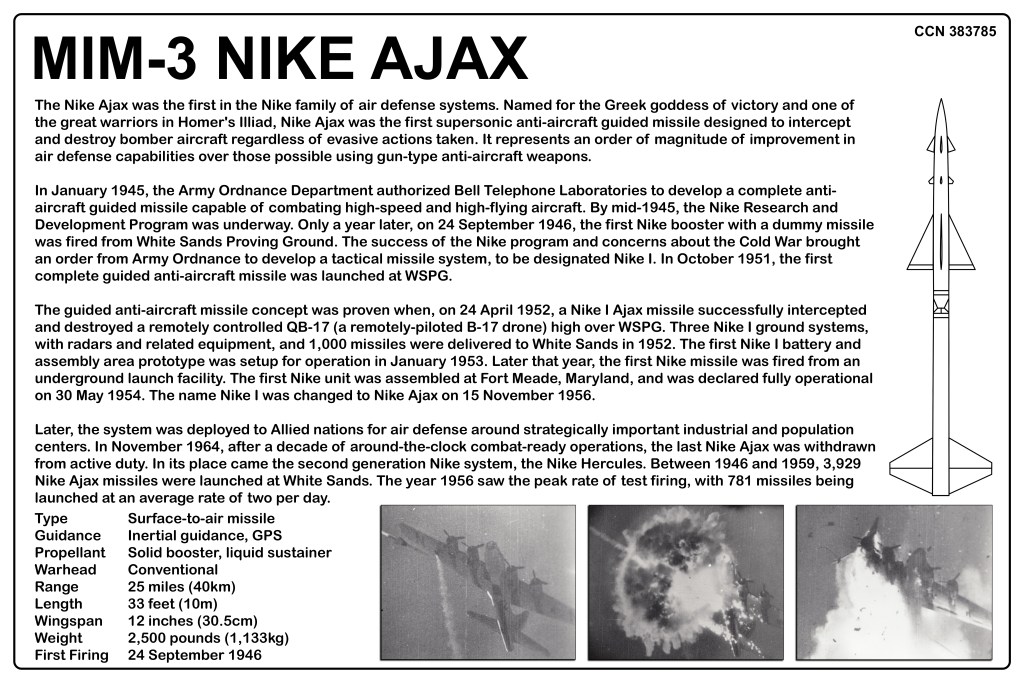
MIM-3 Nike Ajax
| Type: | Surface-to-air missile |
| Guidance: | Inertial guidance, GPS |
| Propellant: | Solid booster, liquid sustainer |
| Warhead: | Conventional |
| Range: | 25 miles (40km) |
| Length: | 33 feet (10m) |
| Diameter: | 12 inches (30.5cm) |
| Weight: | 2,500 pounds (1,133kg) |
| First firing: | 24 September 1946 |
The Nike Ajax was the first in the Nike family of air defense systems. Ajax achieved a number of firsts, many of them before the system was fielded to US Army units. Named for the Greek goddess of victory and one of the great warriors in Homer’s Illiad, Nike Ajax was the first supersonic anti-aircraft guided missile designed to intercept and destroy bomber aircraft regardless of evasive actions taken. It represents an order of magnitude of improvement in air defense capabilities over those possible using gun-type anti-aircraft weapons. As the first in the Nike family, Ajax is the grandfather of all Army guided missiles. Descendants of Ajax are the Nike Hercules, Nike Zeus, and more than a dozen other variants used for research and sounding purposes.
Nike Ajax was a two-stage, liquid-fueled missile with a solid-propellant booster. The sustainer motor uses nitric acid and JP-4 jet fuel to produce 2,600 pounds of thrust for 30 seconds. It delivered high explosive warheads to a radar-determined intercept point with the target aircraft.
In January 1945, before the end of World War II, the Army Ordnance Department authorized Bell Telephone Laboratories to develop a complete anti-aircraft guided missile capable of combating high-speed and high-flying aircraft. By mid-1945, the Nike Research and Development program was underway. Only a year later, on 24 September 1946, the first Nike booster with a dummy missile was fired from Army Launch Area 1 (ALA-1), known today as Launch Complex 33 (LC-33). Following this first launch, an additional 9 unguided rounds were fired from ALA-1, with the last being fired on 28 January 1947.
For three years, various components were test-fired and procedures were refined despite delays caused by funding problems in the aftermath of World War II. The success of the Nike program, plus the growing concern as the Cold War began to mature, brought an order from Army Ordnance to develop a tactical missile system, to be designated Nike I. In October 1951, the first complete guided anti-aircraft missile was launched at White Sands Proving Ground (WSPG).
The guided anti-aircraft missile concept was proven when, on 24 April 1952, a Nike I Ajax missile successfully intercepted and destroyed a remotely controlled QB-17 (a remotely-piloted B-17 drone) high over WSPG. A three-man tracking crew photographed the moment of intercept. Their photo won the 1955 Ernie Pyle Award for Outstanding Contribution towards Nation Security by a Still Photograph. This award is on display at the WSMR Museum along with video of the intercept.
Three Nike I ground systems, including radars and related equipment, and 1,000 missiles were delivered to White Sands in 1952. The first Nike I battery and assembly area prototype was setup for operation in January 1953. Later that year, the first Nike missile was fired from an underground launch facility.
The first Nike unit was assembled at Fort Meade, Maryland, and was declared fully operational on 30 May 1954.
The name Nike I was changed to Nike Ajax on 15 November 1956.
During the mid-1950s, Nike systems were installed along the eastern seaboard. Troop training on the Nike system was conducted by the Army Air Defense School at WSPG. Later, the system was deployed to Allied nations for air defense around strategically important industrial and population centers.
In November 1964, after a decade of around-the-clock combat-ready operations, the last Nike Ajax was withdrawn from active duty. In its place came the second generation Nike system, the Nike Hercules.
Between 1946 and 1959, 3,929 Nike Ajax missiles were launched at White Sands. The year 1956 saw the peak rate of test firing, with 781 Nike Ajax missiles being launched at an average rate of two per day.