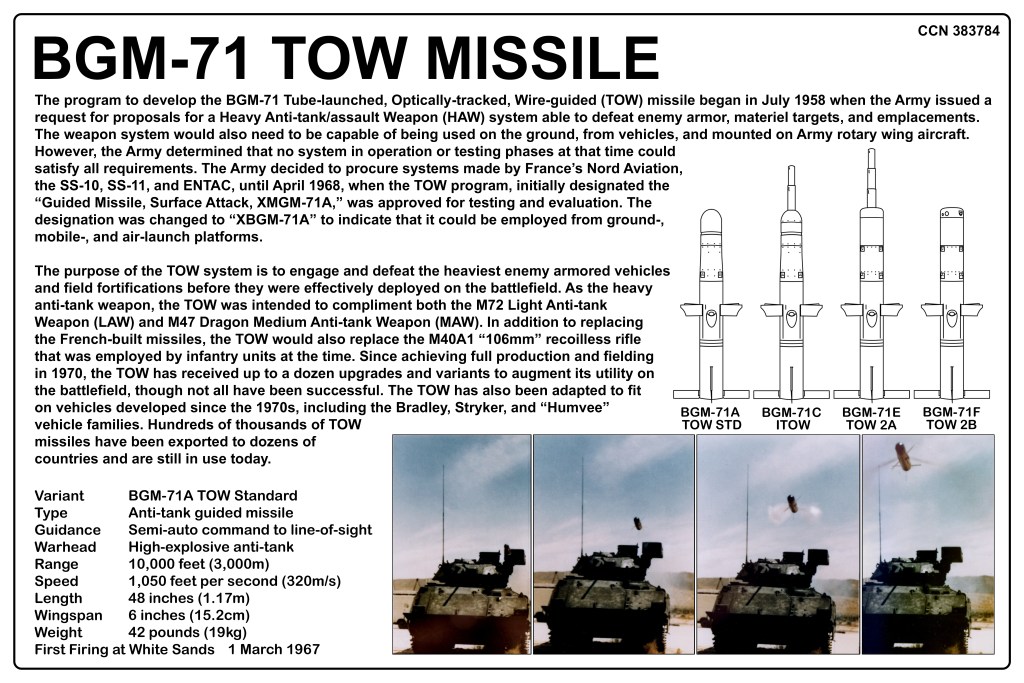
BGM-71 Tube-Launched Optically-Tracked Wire-Guided (TOW) Missile
| Variant: | BGM-71A TOW Standard |
| Type: | Anti-tank guided missile |
| Guidance: | Semi-auto command to line-of-sight |
| Warhead: | High-explosive anti-tank |
| Propellant: | Dual motor solid propellant |
| Range: | 10,000 feet (3,000m) |
| Speed: | 1,050 feet per second (320m/s) |
| Length: | 48 inches (1.17m) |
| Diameter: | 6 inches (15.2cm) |
| Weight: | 42 pounds (19kg) |
| First Firing at White Sands: | 1 March 1967 |
From the start, the TOW was produced as a heavy anti-tank weapon system with the infantryman in mind. The program to develop the BGM-71 Tube-launched, Optically-tracked, Wire-guided (TOW) missile began in July 1958 when the Army issued a request for proposals for a Heavy Anti-tank/assault Weapon (HAW) system able to defeat enemy armor, materiel targets, and emplacements. The weapon system would also need to be capable of being used on the ground, from vehicles, and mounted on Army rotary wing aircraft. However, the Army determined that no system in operation or testing phases at that time could satisfy all requirements. The Army decided to procure systems made by France’s Nord Aviation, the SS-10, SS-11, and ENTAC, until April 1968, when the TOW program, initially designated that “Guided Missile, Surface Attack, XMGM-71A,” was approved for testing and evaluation. The designation was changed to “XBGM-71A” to indicate that it could be employed from ground-, mobile-, and air-launch platforms.
The purpose of the TOW system is to engage and defeat the heaviest enemy armored vehicles and field fortifications before they were effectively deployed on the battlefield. As the heavy anti-tank weapon, the TOW was intended to compliment both the M72 Light Anti-tank Weapon (LAW) and M47 Dragon Medium Anti-tank Weapon (MAW). In addition to replacing the French-built missiles, the TOW would also replace the M40A1 “106mm) recoilless rifle that was employed by infantry units at the time. Since achieving full production and fielding in 1970, the TOW has received up to a dozen upgrades and variants to augment its utility on the battlefield, though not all have been successful.
The system can be broken down into three units for easy handling: the optical sight, the traversing unit, and the missile guidance set. The TOW launcher, weighing around 171 pounds, can be carried by ground troops, fired from ground emplacements, or mounted on a variety of vehicles. TOW launchers have been mounted on Army jeeps, the M113 Armored Personnel Carrier, Humvees, Bradley Infantry Fighting Vehicles, and Stryker Armored Fighting Vehicles. A dedicated system based on the M113 APC, the M901 Improved TOW Vehicle (ITV), was used during the Persian Gulf War and Iraq War, but has since been retired from active Army service.
In operation, the gunner obtains a telescopic sight picture of a target, then launches the missile, which follows his line of sight. For moving targets, the gunner tracks the target with his sight, which generates signals to correct the missile’s course while still in flight. The TOW carries two coils of wires in its tail that carries these signals from the gunner to the missile. The wire is automatically cut after the missile travels three kilometers, but this range has been extended in more recent models.
TOW uses two solid propellant motors. One ejects the missile from the launcher, which ensures the safety of the gunner. The missile coasts for a short period until its back blast is past the operating team. Then, the second rocket motor fires and carries the missile to the target.
A helicopter-adapted variant of the TOW missile consists of modular launchers, which carry two missiles each. Four launchers can be attached, which permits the helicopter to carry and fire a total of eight missiles. A stabilized sight was developed for the helicopter-borne missile which permits the gunner to hold a bead on the target, even while the pilot maneuvers to avoid ground fire. The launch system components are not interchangeable with the infantry TOW launcher.
TOW is a combat-proven system against armored vehicles, ground fortifications, bunkers, and has been in regular use in conflicts since the Vietnam War.