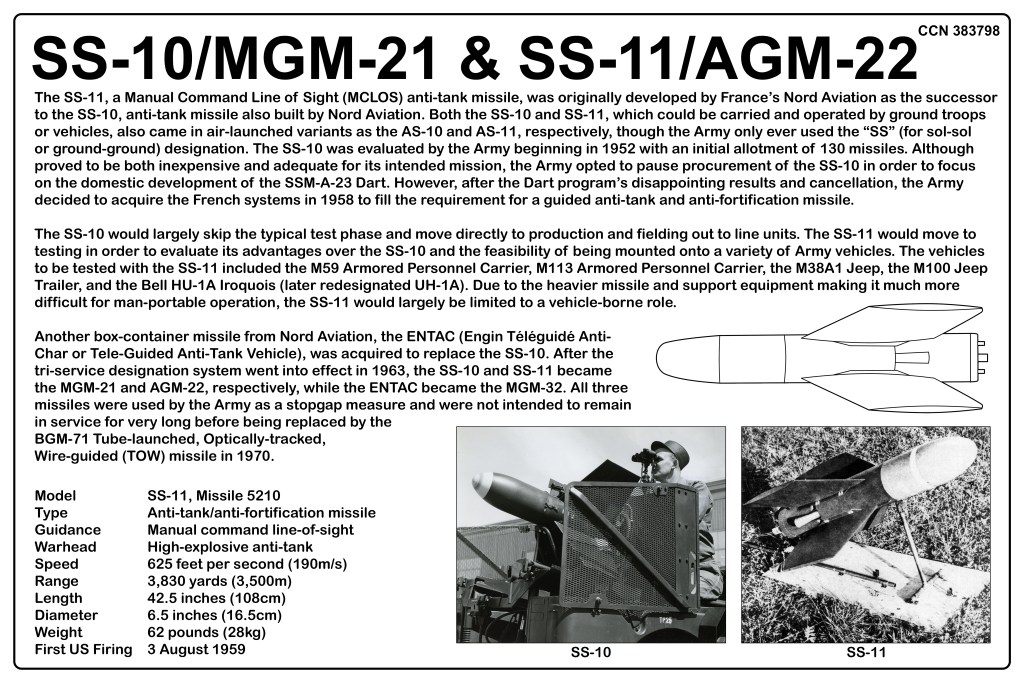
SS-10/MGM-21 & SS-11/AGM-22
| Model: | SS-11, Missile 5210 |
| Type: | Anti-tank/anti-fortification missile |
| Guidance: | Manual command line-of-sight |
| Warhead: | High-explosive anti-tank |
| Speed | 625 miles per hour (190m/s) |
| Range: | 3,830 yards (3,500m) |
| Length: | 42.5 inches (108cm) |
| Diameter: | 6.5 inches (16.5cm) |
| Weight: | 62 pounds (28kg) |
| First US Firing: | 3 August 1959 |
The SS-11, a Manual Command Line of Sight (MCLOS) anti-tank missile, was originally developed by France’s Nord Aviation as the successor to the SS-10, anti-tank missile also built by Nord Aviation. Both the SS-10 and SS-11, which could be carried and operated by ground troops or vehicles, also came in air-launched variants as the AS-10 and AS-11, respectively, though the Army only ever used the “SS” (for sol-sol or ground-ground) designation. The SS-10 was evaluated by the Army beginning in 1952 with an initial allotment of 130 missiles. Although proved to be both inexpensive and adequate for its intended mission, the Army opted to pause procurement of the SS-10 in order to focus on the domestic development of the SSM-A-23 Dart. However, after the Dart program’s disappointing results and cancellation, the Army decided to acquire the French systems in 1958 to fill the requirement for a guided anti-tank and anti fortification missile.
The SS-10 would largely skip the typical test phase and move directly to production and fielding out to line units. Procurement of the SS-10 and SS-11 anti-tank guided missiles and associated equipment was announced by the Army on 12 April 1959. They were touted as multi-role systems that could be man-handled, dropped by parachute, operated by a single soldier, and launched from the ground, a vehicle, or a helicopter. The SS-11, originally intended to complement the SS-10, soon outshone its predecessor by having twice the range and greater speed. The SS-11 would move to testing in order to evaluate its advantages over the SS-10 and the feasibility of being mounted onto a variety of Army vehicles. The vehicles to be tested with the SS-11 included the M59 Armored Personnel Carrier, M113 Armored Personnel Carrier, the M38A1 Jeep, the M100 Jeep Trailer, and the Bell HU-1A Iroquois (later redesignated UH-1A). Due to the heavier missile and support equipment making it much more difficult for man-portable operation, the SS-11 would largely be limited to a vehicle-borne role while in United States service.
Another box-container missile from Nord Aviation, the ENTAC (Engin Téléguidé Anti-Char or Tele-Guided Anti-Tank Vehicle), was acquired to replace the SS-10. After the tri-service designation system went into effect in 1963, the SS-10 and SS-11 became the MGM-21 and AGM-22, respectively, while the ENTAC became the MGM-32. All three missiles were used by the Army as a stopgap measure and were not intended to remain in service for very long before being replaced by the BGM-71 Tube-launched, Optically-tracked, Wire-guided (TOW) missile in 1970.