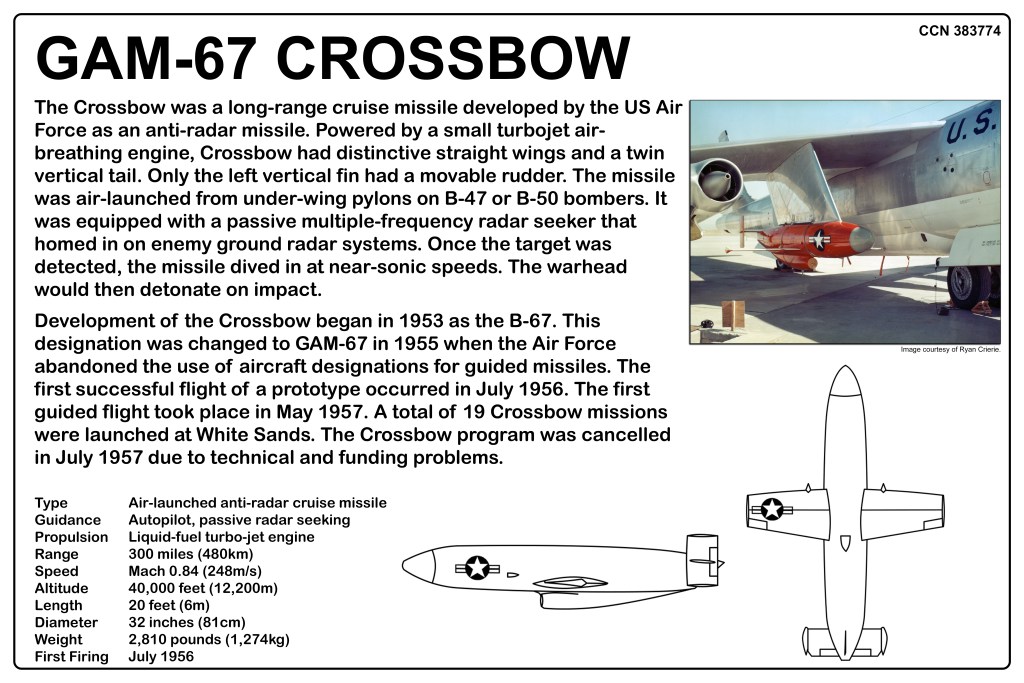
GAM-67 Crossbow
| Type: | Air-launched anti-radar cruise missile |
| Guidance: | Autopilot, passive radar homing |
| Propulsion: | Liquid-fuel turbo-jet engine |
| Range: | 300 miles (480km) |
| Speed: | Mach 0.84 (248m/s) |
| Altitude: | 40,000 feet (12,200m) |
| Length: | 20 feet (6m) |
| Diameter: | 32 inches (81cm) |
| Weight: | 2,810 pounds (1,274kg) |
| First firing: | July 1956 |
The Crossbow was a long-range cruise missile developed by the US Air Force as an anti-radar missile. Powered by a small turbojet air-breathing engine, Crossbow had distinctive straight wings and a twin vertical tail. Only the left vertical fin had a movable rudder. The missile was air-launched from under-wing pylons on B-47 or B-50 bombers. It was equipped with a passive multiple-frequency radar seeker that homed in on enemy ground radar systems. Once the target was detected, the missile dived in at near-sonic speeds. The warhead would then detonate on impact.
Development of the Crossbow began in 1953 as the B-67. This designation was changed to GAM-67 in 1955 when the Air Force abandoned the use of aircraft designations for guided missiles. The first successful flight of a prototype occurred in July 1956. The first guided flight took place in May 1957. A total of 19 Crossbow missions were launched at White Sands. The Crossbow program was cancelled in July 1957 due to technical and funding problems.