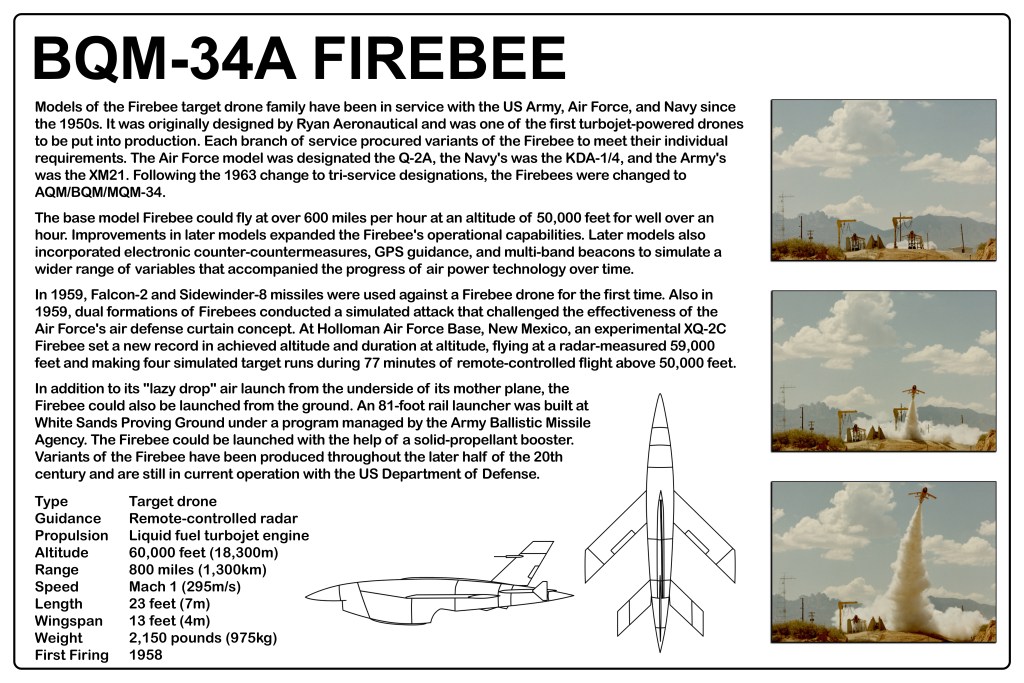
BQM-34A Firebee
| Type: | Target drone |
| Guidance: | Remote-controlled radar |
| Propellant: | Liquid fuel turbojet engine |
| Altitude: | 60,000 feet (18,300m) |
| Range: | 800 miles (1,300km) |
| Speed: | Mach 1 (295m/s) |
| Length: | 23 feet (7m) |
| Wingspan: | 13 feet (4m) |
| Weight: | 2,150 pounds (975kg) |
| First firing*: | 1958 |
Models of the Firebee target drone family have been in service with the US Army, Air Force, and Navy since the 1950s. It was originally designed by Ryan Aeronautical and was one of the first turbojet-powered drones to be put into production. Each branch of service procured variants of the Firebee to meet their individual requirements. The Air Force model was designated the Q-2A, the Navy’s was the KDA-1/4, and the Army’s was the XM21. Following the 1963 change to tri-service designations, the Firebees were changed to AQM/BQM/MQM-34.
The base model Firebee could fly at over 600 miles per hour at an altitude of 50,000 feet for well over an hour. Improvements in later models expanded the Firebee’s operational capabilities. Later models also incorporated electronic counter-countermeasures, GPS guidance, and multi-band beacons to simulate a wider range of variables that accompanied the progress of air power technology over time.
In 1959, Falcon-2 and Sidewinder-8 missiles were used against a Firebee drone for the first time. Also in 1959, dual formations of Firebees conducted a simulated attack that challenged the effectiveness of the Air Force’s air defense curtain concept. At Holloman Air Force Base, New Mexico, an experimental XQ-2C Firebee set a new record in achieved altitude and duration at altitude, flying at a radar-measured 59,000 feet and making four simulated target runs during 77 minutes of remote-controlled flight above 50,000 feet.
In addition to its “lazy drop” air launch from the underside of its mother plane, the Firebee could also be launched from the ground. An 81-foot rail launcher was built at White Sands Proving Ground under a program managed by the Army Ballistic Missile Agency. The Firebee could be launched with the help of a solid-propellant booster.
Variants of the Firebee have been produced throughout the later half of the 20th century and are still in current operation with the US Department of Defense. Firebees have also been exported for use by other countries such as Canada and Japan.