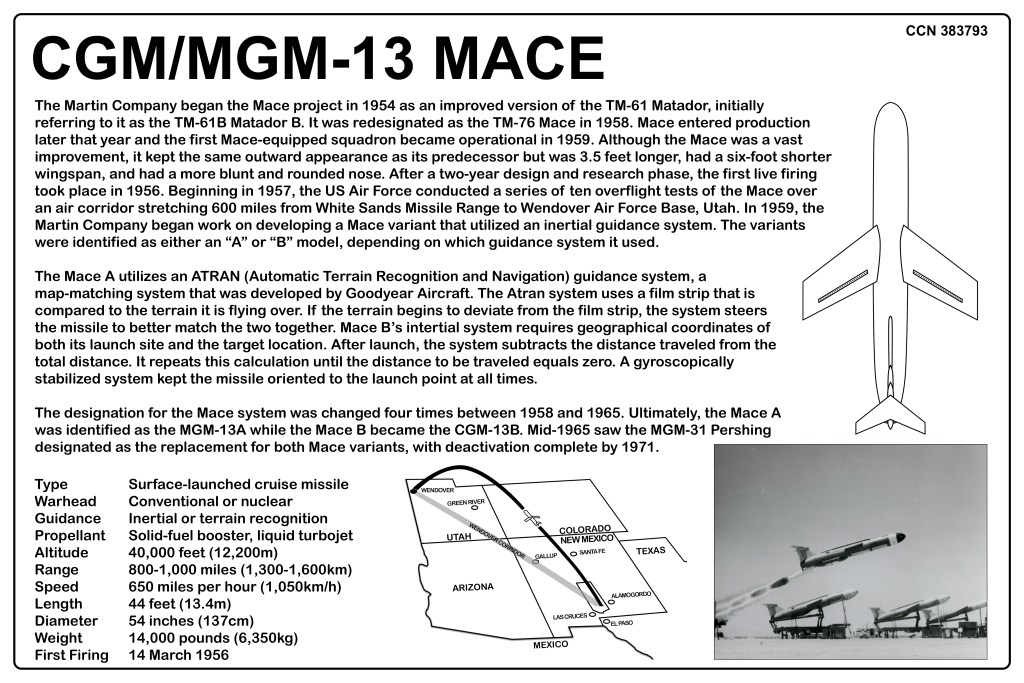
MGM-1 Matador / MGM-13 Mace
| Type: | Surface-launched cruise missile |
| Guidance: | Electronic radar guidance |
| Warhead: | Conventional or nuclear |
| Propellant: | Solid-fuel booster, liquid turbojet |
| Range: | 500-600 miles (800-965km) |
| Speed: | 650 miles per hour (1,050km/h) |
| Altitude: | 35,000 feet (10,650m) |
| Length: | 40 feet (12.2m) |
| Diameter: | 54 inches (137cm) |
| Weight: | 12,000 pounds (5,440kg) |
| First Launch: | 19 January 1949 |
| Type: | Surface-launched cruise missile |
| Guidance: | Inertial or terrain recognition |
| Warhead: | Conventional or nuclear |
| Propellant: | Solid-fuel booster, liquid turbojet |
| Range: | 800-1,000 miles (1,300-1,600km) |
| Speed: | 650 miles per hour (1,050km/h) |
| Altitude: | 40,000 feet (12,200m) |
| Length: | 44 feet (13.4m) |
| Diameter: | 54 inches (137cm) |
| Weight: | 14,000 pounds (6,350kg) |
| First Launch: | 14 March 1956 |
MGM-1 Matador
The Matador is the predecessor of the Mace missile and is essentially a tactical “bomber” missile designed as an improved version of the JB-2 Loon. The Matador’s development project began in 1946 and made its first flight from Holloman Air Force Base on 19 January 1949. Full-scale production of the Matador began in January 1951.
On 1 October 1951, the Air Force activated the First Pilotless Bomber Squadron (Light) at the Missile Test Center. A few months later on 10 January 1952, the USAF activated the 69th Pilotless Bomber Squadron (Light). The squadron was supervised in its initial round of training by an already established training unit, the 6555th Guided Missile Wing, which itself was part of the USAF Air Research and Development Command. On 15 January 1954, the squadron was transferred to the Tactical Air Command to be made combat-ready and, on 9 March 1954, the First Pilotless Bomber Squadron, equipped with its load out of Matadors, departed for Germany. The 69th was also transferred to TAC on 15 January 1954 and was also stationed overseas. In addition to its deployment to Europe, a Matador squadron was sent to Korea and Taiwan, then known as Formosa.
The Matador’s unit cost was $100,000 in the 1960s. The missile was launched from a special trailer platform by a Thiokol solid propellant rocket booster producing 52,000 pounds of thrust. A single Allison J-33-A-37 turbojet served as the Matador’s cruising engine and produced around 4,600 pounds of thrust. It was controlled electronically in flight via a radar guidance system, which necessitated maintaining a continuous line of sight. The Matador began to be replaced by the Mace in the 1960s.
MGM-13 Mace
The Mace was originally designated as the TM-76 and came in two variants, “A” or “B,” which differed in their guidance systems. Both were produced by the Martin Company. First tests of the Mace began in 1956 and production began in 1958.
The A model used the Atran guidance system, which was a map-matching system developed by Goodyear Aircraft. Atran systems relate a film strip to the terrain over which the Mace is flying. If there is any deviation from the programmed route, the missile’s flight was adjusted to rematch the terrain with the film. This enabled the Mace to fly at extremely low altitudes, complicating enemy radar’s ability to detect, track, and destroy it. To add another variable, the Mace could weave up and down to different altitudes, invalidating the enemy’s unguided fire solutions as soon as they were calculated.
The B model used inertial guidance, which is a form of “memory navigation.” The geographic location of both launch and target points had to be known and set into the missile system prior to launch. The missile then “knows” the exact distance to be traveled. Once launched and flying towards its target, the system is aware at any given instant exactly how far it had traveled. It then subtracted this distance from the “remembered” total distance and knows how much farther it was from the target. This process was constantly repeated until the distance to target became zero, at which point the Mace would explode in an air burst or upon direct impact. The inertial system was gyroscopically stabilized so that it maintained its reference to its launch point at all times, regardless of the missile’s altitude. The system was able to sense any off-course motion and immediately provided the autopilot with the necessary data to move the missile back onto its course.