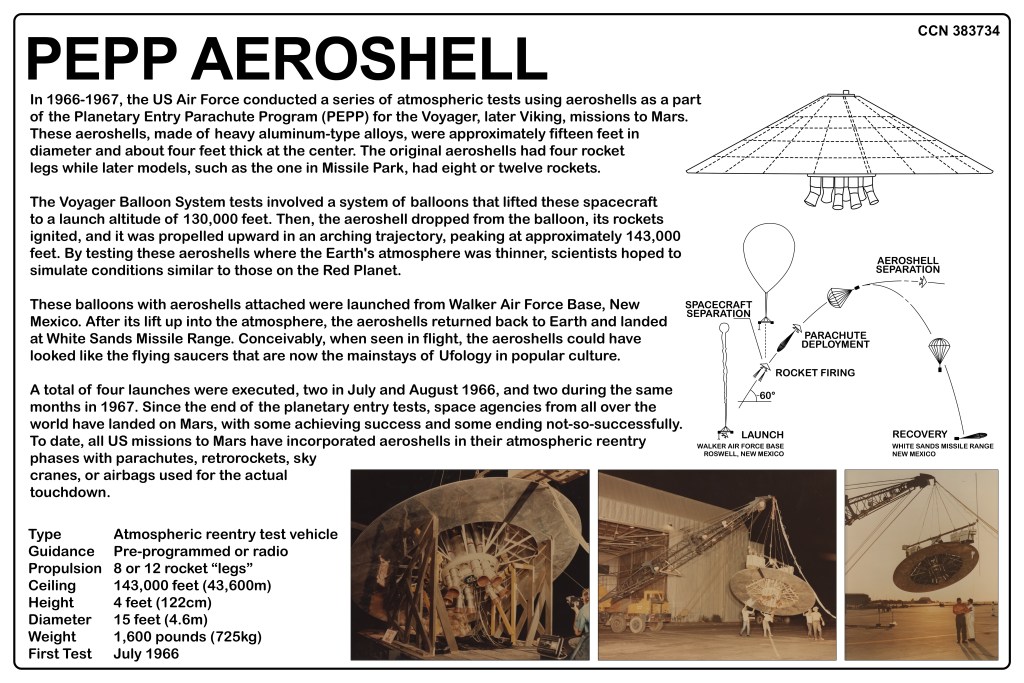
Planetary Entry Parachute Program (PEPP) Aeroshell
| Type: | Atmospheric reentry test vehicle |
| Guidance: | Pre-programmed, radio |
| Propulsion: | 4/8/12 rocket “legs” |
| Ceiling: | 143,000 feet (43,600m) |
| Height: | 48 inches (122cm) |
| Diameter: | 15 feet (4.6m) |
| Weight: | 1,600 pounds (725kg) |
| First test: | July 1966 |
Resting in the Missile Park at White Sands Missile Range, along with rockets and missiles developed by the Army, Navy, and Air Force, is a flying saucer, believed to be one of only two “in captivity.”
The conical disk, atop a cluster of short stubby rocket “legs” bears a marked resemblance to photographs and artists sketches of Unidentified Flying Objects reportedly seen across the nation since the sensational Roswell Incident in July 1947. However, WSMR’s flying saucer is hardly large enough to carry beings, terrestrial or extraterrestrial, larger than three feet tall. To top it all off, the vessel’s true purpose and history is rather undramatic.
Back in 1966-1967, the US Air Force conducted a series of atmospheric tests using aeroshells as a part of the Voyager Balloon System for the Viking I and II missions to Mars. The Voyager Program was renamed to Viking following a significant reorganization of the program’s administration and mission. The name “Voyager” was later reused for the unrelated program to send probes into the outer solar system. These aeroshells, made of heavy aluminum-type alloys, were approximately fifteen feet in diameter and about four feet thick at the center. The original aeroshell had four rocket engines, while later models, such as the one in Missile Park, had eight or twelve rockets.
The Voyager Balloon System tests involved a system of balloons that lifted these spacecraft to a launch altitude of 130,000 feet (39,625m). Then, the aeroshell dropped from the balloon, its rockets ignited, and it was propelled upward in an arching trajectory, peaking at approximately 143,000 feet (43,585m). The aeroshell, designed by NASA, was intended to reach the altitude of the rarefied atmosphere that most closely resembled that of Mars. By testing these aeroshells where the Earth’s atmosphere was thinner, scientists hoped to simulate the conditions that would be present if we tried to land a similar craft on the Red Planet.
These balloons with aeroshells attached were launched from Walker Air Force Base, near Roswell, New Mexico. After its lift up into the atmosphere, the aeroshells returned back to Earth and landed at White Sands Missile Range. Conceivably, when seen in flight, these bright and shiny aeroshells could have looked like the flying saucers that are now the mainstays of Ufology in popular culture.
A total of five launches were planned, two in July and August 1966, and three during the same months in 1967. The last test was never carried out to save time and resources. The aeroshell in the Missile Park is one of those that impacted on the range and was retrieved.
Since the end of the planetary entry tests, space agencies from all over the world have landed on Mars, with some achieving success and some ending not-so-successfully. To date, all US missions to Mars have incorporated aeroshells in their atmospheric reentry phases, with parachutes, retrorockets, sky cranes, or airbags used for the actual touchdown.