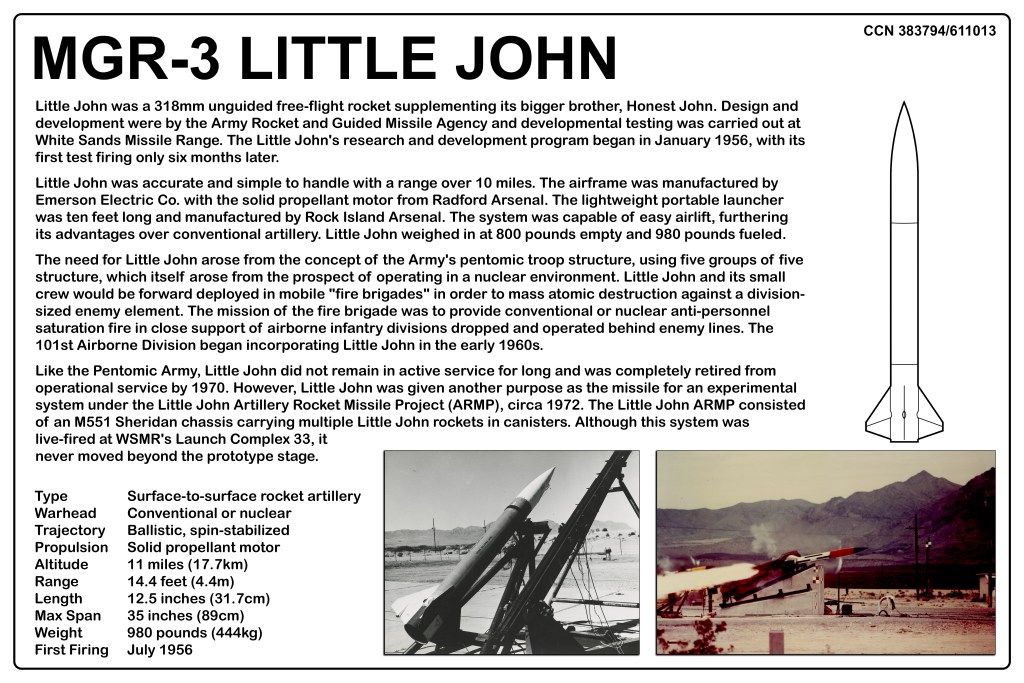
MGR-3 Little John
| Type: | Surface-to-surface rocket artillery |
| Warhead: | Conventional or nuclear |
| Trajectory: | Ballistic, spin-stabilized |
| Propulsion: | Solid propellant motor |
| Range: | 11 miles (17.7km) |
| Length: | 14.4 feet (4.4m) |
| Diameter: | 12.5 inches (31.7cm) |
| Weight: | 980 pounds (444kg) |
| First firing: | July 1956 |
Little John was a 318mm unguided free-flight rocket supplementing its bigger brother, Honest John. Design and development were by the Army Rocket and Guided Missile Agency and developmental testing was carried out at White Sands Missile Range. The Little John’s research and development program began in January 1956, with its first test firing only six months later.
Little John was accurate and simple to handle with a range over 10 miles. The airframe was manufactured by Emerson Electric Co. with the solid propellant motor from Radford Arsenal. The lightweight portable launcher was ten feet long and manufactured by Rock Island Arsenal. The system was capable of easy airlift, furthering its advantages over conventional artillery. Little John weighed in at 800 pounds empty and 980 pounds fueled.
The need for Little John arose from the concept of the Army’s pentomic troop structure, using five groups of five structure, which itself arose from the prospect of operating in a nuclear environment. Little John and its small crew would be forward deployed in mobile “fire brigades” in order to mass atomic destruction against a division- sized enemy element. The mission of the fire brigade was to provide conventional or nuclear anti-personnel saturation fire in close support of airborne infantry divisions dropped and operated behind enemy lines. The 101st Airborne Division began incorporating Little John in the early 1960s.
Like the Pentomic Army, Little John did not remain in active service for long and was completely retired from operational service by 1970. However, Little John was given another purpose as the missile for an experimental system under the Little John Artillery Rocket Missile Project (ARMP), circa 1972. The Little John ARMP consisted of an M551 Sheridan chassis carrying multiple Little John rockets in canisters. Although this system was live-fired at WSMR’s Launch Complex 33, it never moved beyond the prototype stage.