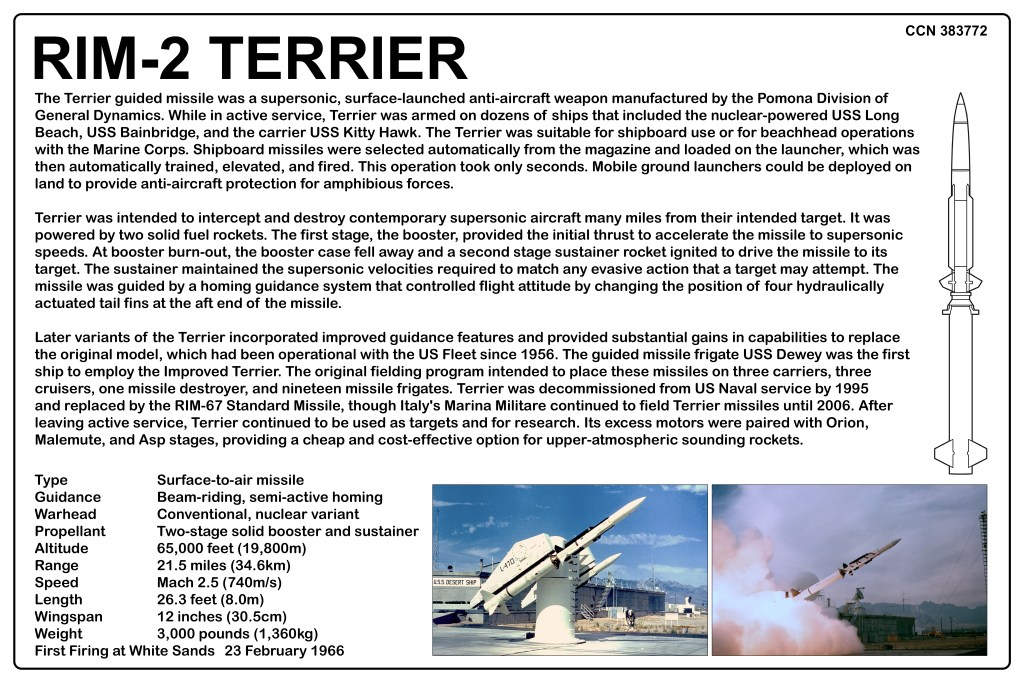
RIM-2 Terrier
| Type: | Surface-to-air missile |
| Guidance: | Beam-riding, semi-active homing |
| Warhead: | Conventional with nuclear-armed variant |
| Propellant: | Two-stage solid booster and sustainer |
| Altitude: | 65,000 feet (19,800m) |
| Range: | 21.5 miles (34.6km) |
| Speed: | Mach 2.5 (740m/s) |
| Length: | 26.3 feet (8.0m) |
| Diameter: | 12 inches (30.5cm) |
| Weight: | 3,000 pounds (1,360kg) |
| First Firing at White Sands: | 23 February 1966 |
The Terrier guided missile was a supersonic, surface-launched antiaircraft weapon manufactured by the Pomona Division of General Dynamics. While in active service, Terrier was armed on dozens of ships that included the nuclear-powered USS Long Beach, USS Bainbridge, and the carrier USS Kitty Hawk.
Terrier was intended to intercept and destroy contemporary supersonic aircraft many miles from their intended target. It was powered by two solid fuel rockets. The first stage, the booster, provided the initial thrust to accelerate the missile to supersonic speeds. At booster burn-out, the booster case fell away and a second stage sustainer rocket ignited to drive the missile to its target. The sustainer maintains the supersonic velocities required to match any evasive action that a target may attempt. The missile was guided by a homing guidance system that controlled flight attitude by changing the position of four hydraulically actuated tail fins at the aft end of the missile.
The Terrier was suitable for shipboard use or for beachhead operations with the Marine Corps. Shipboard missiles were selected automatically from the magazine and loaded on the launcher, which was then automatically trained, elevated, and fired. This operation took only seconds. Mobile ground launchers could be deployed on land to provide antiaircraft protection for amphibious forces.
A later model of the Terrier, incorporating improved guidance features and providing substantial improvements in coverage was put into production to replace the original model, which had been operational with the US Fleet since 1956. The guided missile frigate USS Dewey was the first ship to employ the Improved Terrier. The original fielding program for the Improved Terrier intended to place these missiles on three carriers, three cruisers, one guided missile destroyer, and nineteen guided missile frigates.
Terrier was decommissioned from US Naval service in 1995 and replaced by the RIM-67 Standard missile, though Italy’s Marina Militare continued to field Terrier missiles until 2006. Even after leaving active service, Terrier continued to be used as a research rocket, with excess Terrier motors being paired with Orion, Malemute, and Asp stages to provide a cheap and cost-effective option for upper-atmospheric sounding rockets.