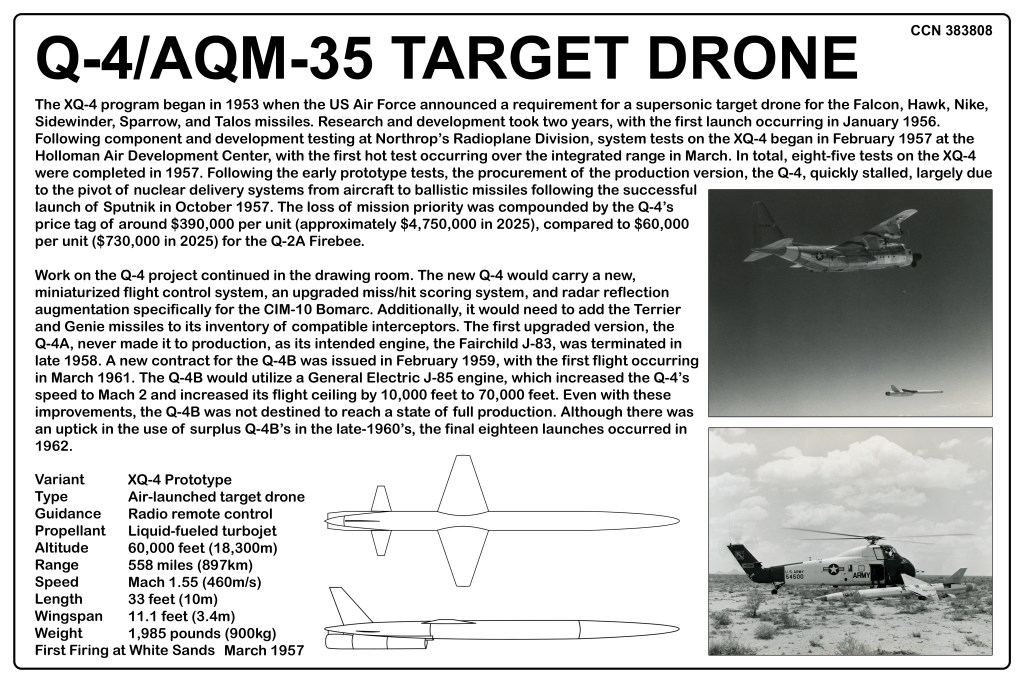
XQ-4 Target Drone
| Type: | Air-launched target drone |
| Guidance: | Radar control |
| Propellant: | Liquid-fueled turbojet |
| Altitude: | 70,000 feet (21,330m) |
| Speed: | Mach 2 (590m/s) |
| Length: | 33 feet (10m) |
| Wingspan: | 11.1 feet (3.3m) |
| Weight: | 1,985 pounds (900kg) |
| First Firing at White Sands: | March 1957 |
As threat vehicles developed the capability to fly higher than most propeller-driven aircraft and faster than the speed of sound, it became necessary to provide supersonic targets for the testing of US missiles. This air-launched target was developed by the Air Force to provide a realistic testing scenario to fully prove new missile systems and demonstrate their capabilities.
The XQ-4 program began in 1953 when the US Air Force announced a requirement for a supersonic target drone for the Falcon, Hawk, Nike, Sidewinder, Sparrow, and Talos missiles. Research and development took two years, with the first launch occurring in January 1956. Following component and development testing at Northrop’s Radioplane Division, system tests on the XQ-4 began in February 1957 at the Holloman Air Development Center, with the first hot test occurring over the integrated range in March. In total, eight-five tests on the XQ-4 were completed in 1957. Following the early prototype tests, the procurement of the production version, the Q-4, quickly stalled, largely due to the pivot of nuclear delivery systems from aircraft to ballistic missiles following the successful launch of Sputnik in October 1957. The loss of mission priority was compounded by the Q-4’s price tag of around $390,000 per unit (approximately $4,750,000 in 2025), compared to $60,000 per unit ($730,000 in 2025) for the Q-2A Firebee.
Work on the Q-4 project continued in the drawing room. The new Q-4 would carry a new, miniaturized flight control system, an upgraded miss/hit scoring system, and radar reflection augmentation specifically for the CIM-10 Bomarc. Additionally, it would need to add the Terrier and Genie missiles to its inventory of compatible interceptors. The first upgraded version, the Q-4A, never made it to production, as its intended engine, the Fairchild J-83, was terminated in late 1958. A new contract for the Q-4B was issued in February 1959, with the first flight occurring in March 1961. The Q-4B would utilize a General Electric J-85 engine, which increased the Q-4’s speed to Mach 2 and increased its flight ceiling by 10,000 feet to 70,000 feet. Even with these improvements, the Q-4B was not destined to reach a state of full production. Although there was an uptick in the use of surplus Q-4B’s in the late-1960’s, the final eighteen launches occurred in 1962.