PGM-11 Redstone
| Type: | Short-range ballistic missile |
| Guidance: | Inertial guidance, gyroscopic |
| Warhead: | Conventional, nuclear-capable |
| Propellant: | Single stage liquid |
| Range: | 200 miles (320km) |
| Length: | 69 feet (21m) |
| Diameter: | 70 inches (177cm) |
| Weight: | 61,200 pounds (27,760kg) |
| First firing: | 20 August 1953 |
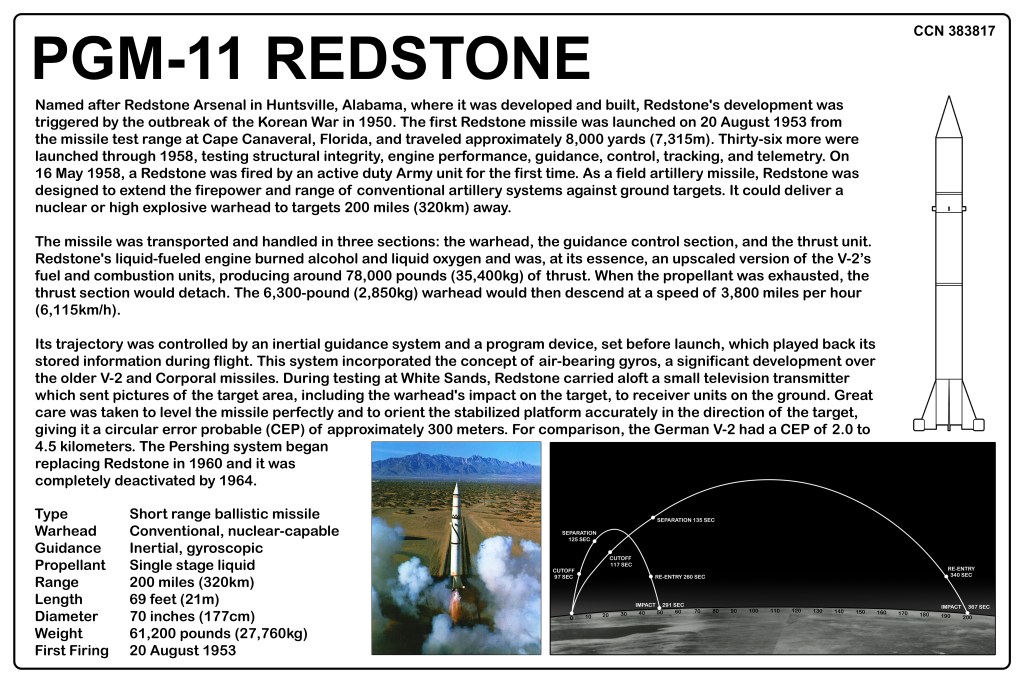
Named after Redstone Arsenal in Huntsville, Alabama, where it was developed and built, Redstone’s development was triggered by the outbreak of the Korean War in 1950. The first Redstone missile was launched on 20 August 1953 from the missile test range at Cape Canaveral, Florida, and traveled approximately 8,000 yards. Thirty-six more were launched through 1958, testing structural integrity, engine performance, guidance, control, tracking, and telemetry. On 16 May 1958, the first Redstone was fired by an active duty Army unit. It was deployed to Germany in June.
As a field artillery missile, Redstone was designed to extend the firepower and range of conventional artillery systems against ground targets. It could deliver a nuclear or high explosive warhead to targets 200 miles away. Because Redstone was a truly ballistic missile, its initial trajectory and guidance was provided by the launcher. Great care was taken to level the missile perfectly and to orient the stabilized platform accurately in the direction of the target.
The missile was transported and handled in three sections: the warhead, the guidance control section, and the thrust unit, the latter of which would detach and drop away after burnout. Redstone’s liquid-fueled engine burned alcohol and liquid oxygen, producing around 75,000 pounds of thrust. At burnout, or when the propellant was exhausted, the warhead would be moving at a speed of 3,800 miles per hour.
Its trajectory was controlled by an inertial guidance system and a program device, set before launch, which played back its stored information during flight. This system incorporated the concept of air-bearing gyros, a significant development over the older V-2 and Corporal missiles. During testing at White Sands, Redstone carried aloft a small television transmitter which sent pictures of the target area, including the warhead’s impact on the target, to receiver units on the ground.
At the time, the Redstone was considered to be a mobile and easily transportable system. However, when on the move, a Redstone battalion of 600 men needed a convoy of 200 vehicles carrying approximately 10,000 individual parts and subassemblies. The Redstone itself was carried on three trucks, one for each section, to be assembled in the field.
A solid-fuel fourth stage was added to the Redstone and became known as the Jupiter-C. On 31 January 1958, a Jupiter-C lifted America’s first orbiting satellite, Explorer I, into space. Starting in 1959, Redstone rockets were modified for use in NASA’s Mercury program. Propellant tanks were elongated by 96 inches, adding 20 seconds of burn time. The warhead section was replaced by the Mercury capsule and escape tower. The first of these Mercury-Redstone rockets was tested at Cape Canaveral on 19 December 1960. On 05 May 1961, astronaut Alan Shepard became the first American in space when he was launched on a suborbital flight in a Mercury capsule lifted by a modified Redstone.
Between 1958 and 1962, eighteen Redstone missiles were fired at White Sands Missile Range. The Pershing system replaced Redstone beginning in 1960.