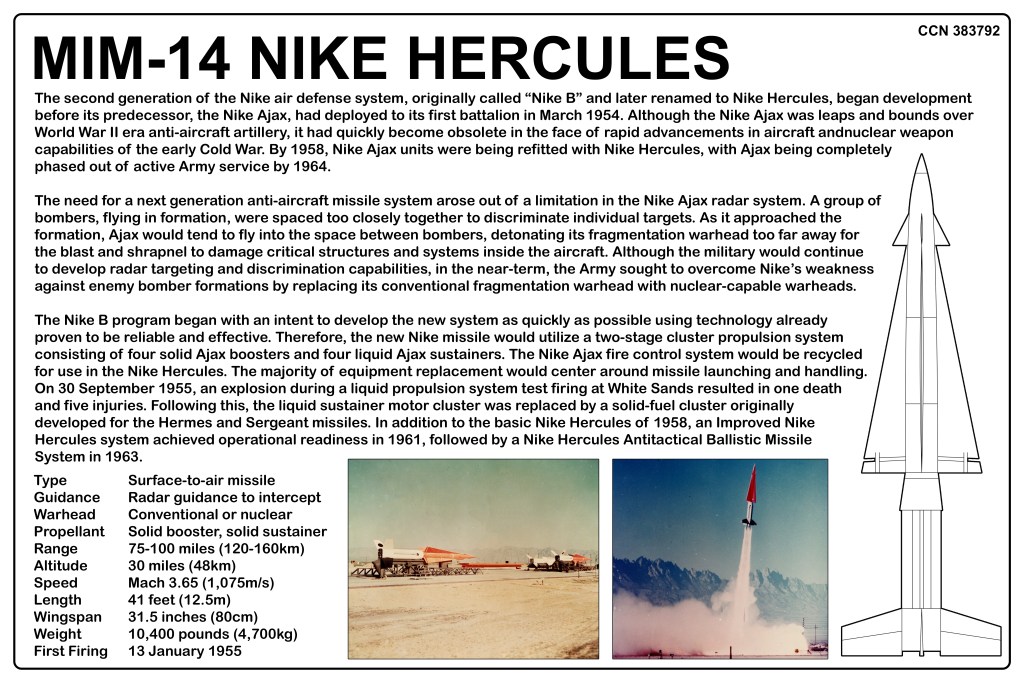
MIM-14 Nike Hercules
| Type: | Surface-to-air missile |
| Warhead: | Conventional or nuclear |
| Guidance: | Radar guidance to intercept |
| Propellant: | Solid booster, liquid*/solid sustainer |
| Speed: | Mach 3.65 (1,075m/s) |
| Range: | 75-100 miles (120-160km) |
| Ceiling: | 30 miles (48km) |
| Length: | 41 feet (12.5m) |
| Diameter: | 31.5 inches (80cm) |
| Weight: | 10,400 pounds (4,700kg) |
| First firing: | 13 January 1955 |
The Nike Hercules was the second generation of the Nike family. In addition to its primary role as a surface-to-air missile, Hercules had a secondary capability as a surface-to-surface missile. Its primary mission was to provide air defense against enemy bomber formations and missiles.
Developed as a replacement for the Nike Ajax, Nike Hercules was essentially an Ajax with four of each component: a cluster of four solid-fuel rocket boosters launched and accelerated the missile, while four liquid-propellant engines carried the warhead to its target. Eventually, the liquid propellant was changed to solid fuel for the four sustainer motors.
Hercules development began in the early 1950s when the Army became concerned that Nike Ajax was incapable of stopping a massed Soviet air attack. First, the Army explored the possibility of equipping Nike Ajax with a nuclear warhead, an idea that quickly proved impractical. In July 1953, the Army authorized the start of the Nike B program to design a missile that could intercept aircraft flying at 1,000 miles per hour (447m/s), at an altitude of 60,000 feet (18,300m), and a horizontal range of 150,000 feet (45.7km). Nike B was renamed Nike Hercules in December 1956.
System testing began in 1955 at White Sands Proving Ground. Tragedy struck on 30 September 1955, when a liquid-fueled Nike Hercules engine undergoing static test firing exploded with enough force to collapse a nearby protective bunker. Five people were injured and one person was killed, the only missile-testing death in the history of White Sands Missile Range. Because of this incident, fuel for the Nike Hercules sustainer motor was changed from liquid to solid propellant.
The first production Nike Hercules missiles were delivered in 1958 and quickly began replacing the older Nike Ajax systems guarding US targets.
The Nike Hercules was designed to use the supporting components of the Nike Ajax system, although the increased capability that Hercules provided necessitated some additions to ground support equipment.
Hercules ground equipment included a low power and high power acquisition radar, a target tracking radar, a missile tracking radar, electronic and data processing equipment, and remote controlled launchers. The acquisition radars searched the sky in a 360 degree sweep. When a target was detected, its location was relayed to the target tracking radar, which pinpoints it for intercept. The missile track radar issued guidance and detonation orders to the missile.
Hercules system operators were located in a battery control trailer, a tracking radar control trailer, and a launcher control trailer. Each Hercules battery could operate as part of a defense network or as an autonomous unit, capable of detecting, tracking, and engaging targets. If needed, Hercules units were capable of operating in an electronic countermeasures environment.
Launch is from a single rail elevated at 85 degrees to the horizontal plane and guidance is by command. Target tracking and missile tracking radars provided data to a ground-stationed computer which would relay guidance commands to the missile. Demonstrations of Hercules’ capabilities in tests at White Sands Missile Range include “kill” intercepts of a target missile approaching at an altitude of 14 miles (22.5km) and a speed of 2,200 miles per hour (3,540km/h). It also successfully engaged a parachute-borne target at an altitude of 20 miles (32km). Tests at Eglin Air Force Base, Florida, demonstrated Hercules’ transportability and its capability to select any single aircraft flying in a group formation.
In June 1961, Army Air Defense Command (ARADCOM) began phasing in the Improved Hercules, which incorporated improvements in ground system radars to take advantage of the Hercules’ greater performance. The High-Power Acquisition Radar (HIPAR), Target Tracking Radar (TTR), and the Target Ranging Radar (TRR) were all improved and made more compact for increased mobility.
During the Cold War, the Army established 145 Nike Hercules sites in the continental US to protect population centers and Strategic Air Command (SAC) bomber bases. They remained strategically deployed in the continental US until 1974, though Nike Hercules continued to see service abroad into the early 1990s. More than 25,000 Nike Hercules missiles were manufactured during its decades-long lifecycle.