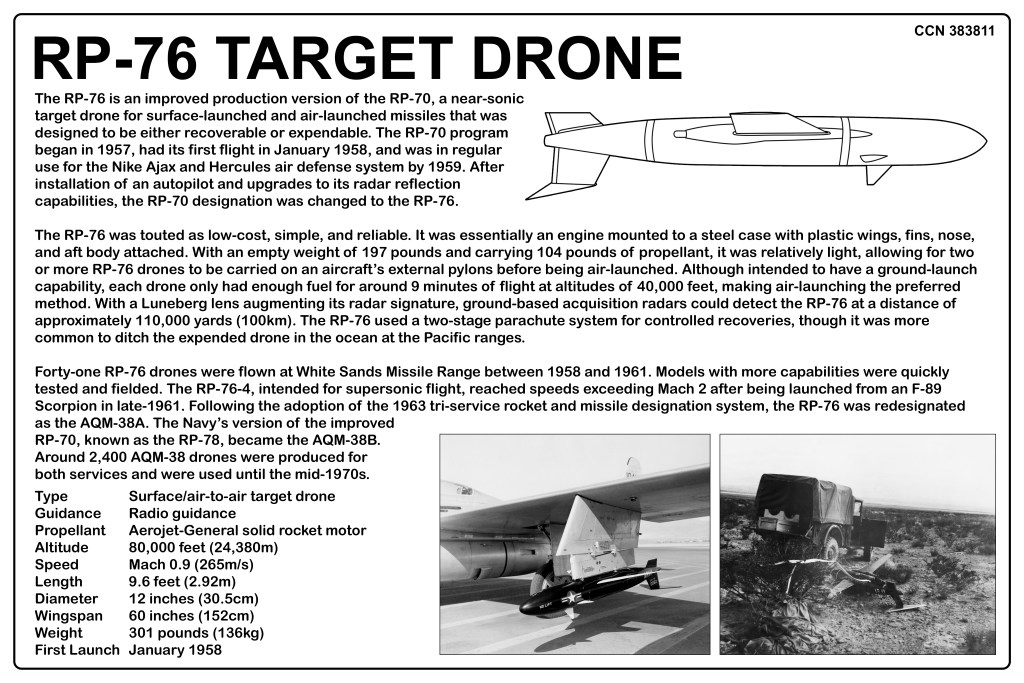
RP-76 / AQM-38A Target Drone
| Type: | Surface/air-to-air target drone |
| Guidance: | Radio guidance |
| Propellant: | Aerojet-General solid rocket motor |
| Altitude: | 80,000 feet (24,380m) |
| Speed: | Mach 0.9 (265m/s) |
| Length: | 9.6 feet (2.92m) |
| Diameter: | 12 inches (30.5cm) |
| Wingspan: | 60 inches (152cm) |
| Weight: | 301 pounds (136kg) |
| First Launch: | January 1958 |
The RP-76 is an improved production version of the RP-70, a near-sonic target drone for surface-launched and air-launched missiles that was designed to be either recoverable or expendable. The RP-70 program began in 1957, had its first flight in January 1958, and was in regular use for the Nike Ajax and Hercules air defense system by 1959. After installation of an autopilot and upgrades to its radar reflection capabilities, the RP-70 designation was changed to the RP-76.
The RP-76 was touted as low-cost, simple, and reliable. It was essentially an engine mounted to a steel case with plastic wings, fins, nose, and aft body attached. With an empty weight of 197 pounds and carrying 104 pounds of propellant, it was relatively light, allowing for two or more RP-76 drones to be carried on an aircraft’s external pylons before being air-launched. Although intended to have a ground-launch capability, each drone only had enough fuel for around 9 minutes of flight at altitudes of 40,000 feet, making air-launching the preferred method. With a Luneberg lens augmenting its radar signature, ground-based acquisition radars could detect the RP-76 at a distance of approximately 110,000 yards (100km). The RP-76 used a two-stage parachute system for controlled recoveries, though it was more common to ditch the expended drone in the ocean at the Pacific ranges.
Forty-one RP-76 drones were flown at White Sands Missile Range between 1958 and 1961. Models with more capabilities were quickly tested and fielded. The RP-76-4, intended for supersonic flight, reached speeds exceeding Mach 2 after being launched from an F-89 Scorpion in late-1961. Following the adoption of the 1963 tri-service rocket and missile designation system, the RP-76 was redesignated as the AQM-38A. The Navy’s version of the improved RP-70, known as the RP-78, became the AQM-38B. Around 2,400 AQM-38 drones were produced for both services and were used until the mid-1970s.