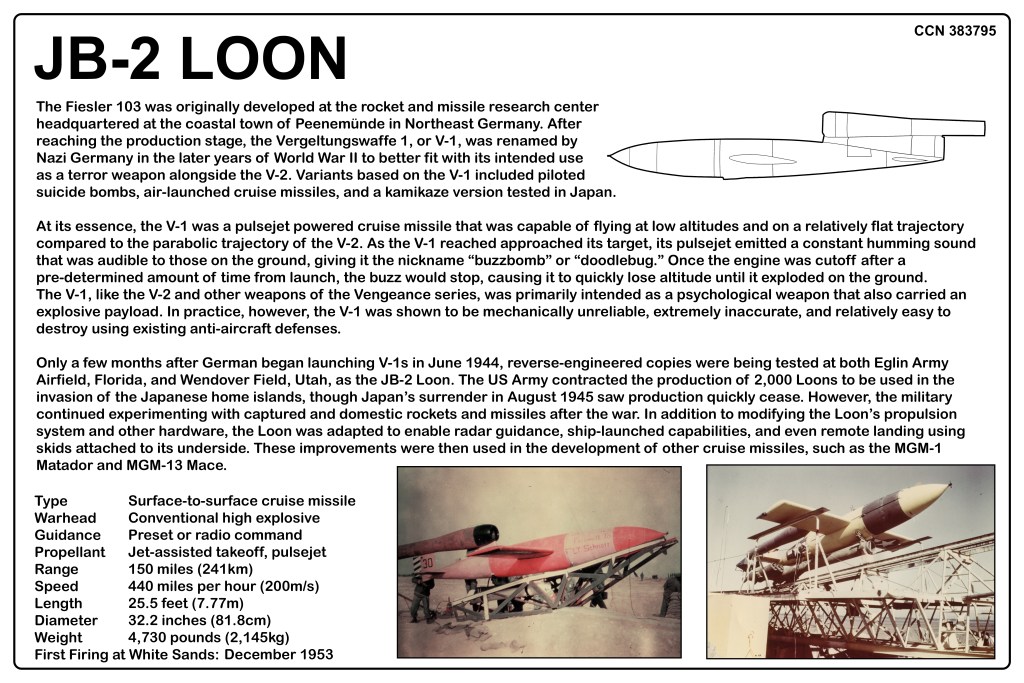
LTV-N-2 Loon
| Type: | Surface-to-surface cruise missile |
| Guidance: | Preset or radio command |
| Warhead: | Conventional high explosive |
| Propellant: | Jet-assisted takeoff (JATO), pulsejet |
| Range: | 150 miles (241km) |
| Speed: | 440 miles per hour (200m/s) |
| Length: | 25.5 feet (7.77m) |
| Diameter: | 32.2 inches (81.8cm) |
| Weight: | 4,730 pounds (2,145kg) |
| First Firing at White Sands: | December 1953 |
The Fiesler 103 was originally developed at the rocket and missile research center headquartered at the coastal town of Peenemünde in Northeast Germany. After reaching the production stage, the Vergeltungswaffe 1, or V-1, was renamed by Nazi Germany in the later years of World War II to better fit with its intended use as a terror weapon alongside the V-2. Variants based on the V-1 included piloted suicide bombs, air-launched cruise missiles, and a kamikaze version tested in Japan.
At its essence, the V-1 was a pulsejet powered cruise missile that was capable of flying at low altitudes and on a relatively flat trajectory compared to the parabolic trajectory of the V-2. As the V-1 reached approached its target, its pulsejet emitted a constant humming sound that was audible to those on the ground, giving it the nickname “buzzbomb” or “doodlebug.” Once the engine was cutoff after a pre-determined amount of time from launch, the buzz would stop, causing it to quickly lose altitude until it exploded on the ground. The V-1, like the V-2 and other weapons of the Vengeance series, was primarily intended as a psychological weapon that also carried an explosive payload. In practice, however, the V-1 was shown to be mechanically unreliable, extremely inaccurate, and relatively easy to destroy using existing anti-aircraft defenses.
Only a few months after German began launching V-1s in June 1944, reverse-engineered copies were being tested at both Eglin Army Airfield, Florida, and Wendover Field, Utah, as the JB-2 Loon. The US Army contracted the production of 2,000 Loons to be used in the invasion of the Japanese home islands, though Japan’s surrender in August 1945 saw production quickly cease. However, the military continued experimenting with captured and domestic rockets and missiles after the war. In addition to modifying the Loon’s propulsion system and other hardware, the Loon was adapted to enable radar guidance, ship-launched capabilities, and even remote landing using skids attached to its underside. These improvements were then used in the development of other cruise missiles, such as the MGM-1 Matador and MGM-13 Mace.