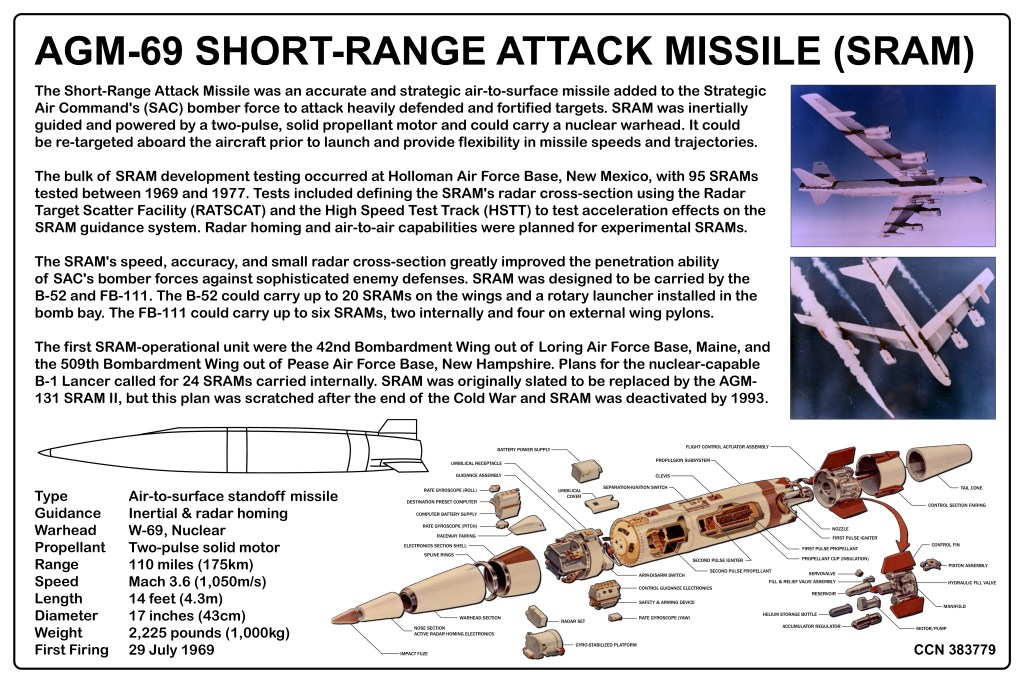
AGM-69 Short-Range Attack Missile (SRAM)
| Type: | Air-to-surface standoff missile |
| Guidance: | Inertial & radar homing |
| Warhead: | W-69, 200 kiloton yield |
| Propellant: | Two-pulse solid fuel motor |
| Range: | 110 miles (175km) |
| Speed: | Mach 3.6 (1,050m/s) |
| Length: | 14 feet (4.3m) |
| Diameter: | 17 inches (43cm) |
| Weight: | 2,225 pounds (1,000kg) |
| First firing: | 29 July 1969 |
The Short-Range Attack Missile was an accurate and strategic air-to-surface missile added to the Strategic Air Command’s (SAC) bomber force to attack heavily defended and fortified targets. Designated the AGM-69A, the SRAM is inertially guided and powered by a two-pulse, solid propellant rocket motor and can carry a nuclear warhead. It could be re-targeted aboard the aircraft prior to launch and provides flexibility in missile speeds and trajectories.
The bulk of SRAM development testing occurred at the USAF Missile Development Center on Holloman Air Force Base, New Mexico, with 95 being tested between 1969 and 1977. Tests included defining the SRAM’s radar cross-section using the Radar Target Scatter Facility (RATSCAT) and using the High Speed Test Track (HSTT) to test acceleration effects on the SRAM guidance system. Radar homing and air-to-air capabilities were planned for experimental SRAMs, but these upgrades were never implemented in the operational SRAM inventory.
The SRAM’s speed, accuracy, and small radar cross-section greatly improved the penetration ability of SAC’s bomber forces against sophisticated enemy defenses. SRAM was designed to be carried by the B-52 and FB-111. The B-52 could carry up to 20 SRAMs on wing pylons and a rotary launcher installed in the bomb bay. The FB-111 could carry up to six SRAMs, two internally and four on external wing pylons.
The first SRAM-operational unit were the B-52s of the 42nd Bombardment Wing out of Loring Air Force Base, Maine, and the FB-111s of the 509th Bombardment Wing out of Pease Air Force Base, New Hampshire. Plans for the nuclear-capable B-1 Lancer called for 24 SRAMs carried between its three internal bomb bays. The SRAM was originally slated to be replaced by the AGM-131 SRAM II, but this plan was scratched after the end of the Cold War. The SRAM was deactivated in 1993.