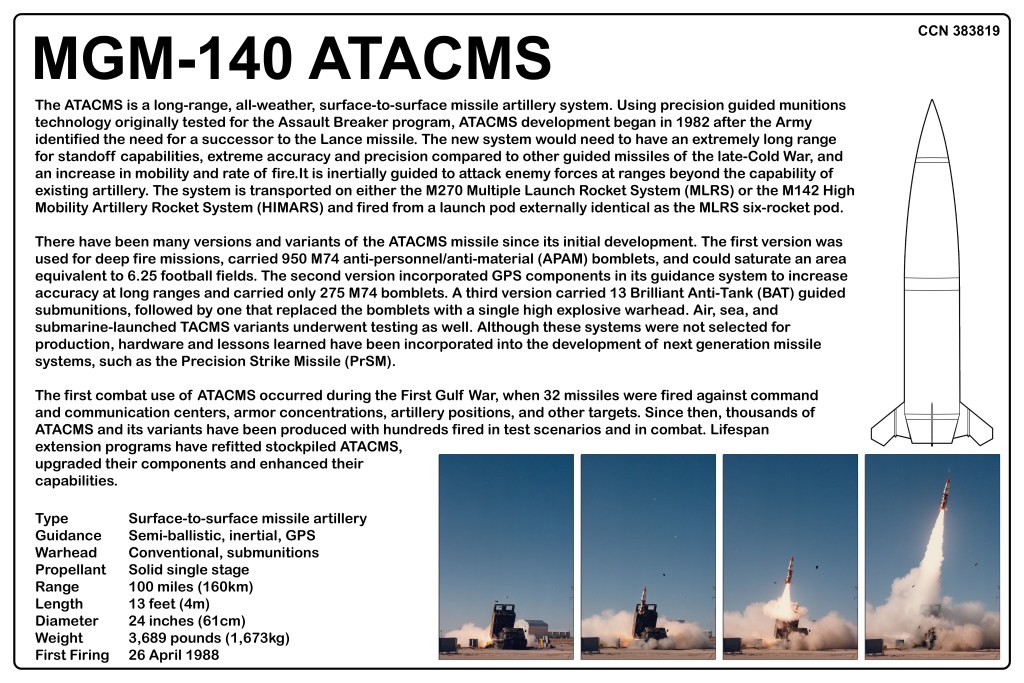
MGM-140 ATACMS
| Type: | Surface-to-surface missile artillery |
| Guidance: | Semi-ballistic, inertial, GPS |
| Warhead: | Conventional, submunitions |
| Propellant: | Solid single stage |
| Range: | 180 miles (290km) |
| Length: | 13 feet (4m) |
| Diameter: | 24 inches (61cm) |
| Weight: | 3,689 pounds (1,673kg) |
| First firing: | 26 April 1988 |
The Army Tactical Missile System (ATACMS) is a long-range, all-weather, surface-to-surface missile artillery system. Using precision guided munitions technology originally tested for the Assault Breaker program, ATACMS development began in 1982 after the Army identified the need for a successor to the Lance missile. The new system would need to have an extremely long range for standoff capabilities, extreme accuracy and precision compared to other guided missiles of the late-Cold War, and an increase in mobility and rate of fire.It is inertially guided to attack enemy forces at ranges beyond the capability of existing artillery. The system is transported on either the M270 Multiple Launch Rocket System (MLRS) or the M142 High Mobility Artillery Rocket System (HIMARS) and fired from a launch pod externally identical as the MLRS six-rocket pod.
There have been many versions and variants of the ATACMS missile since its initial development. The first version was used for deep fire missions, carried 950 M74 anti-personnel/anti-material (APAM) bomblets, and could saturate an area equivalent to 6.25 football fields. The second version incorporated GPS components in its guidance system to increase accuracy at long ranges and carried only 275 M74 bomblets. A third version carried 13 Brilliant Anti-Tank (BAT) guided submunitions, followed by one that replaced the bomblets with a single high explosive warhead. Air, sea, and submarine-launched TACMS variants underwent testing as well. Although these systems were not selected for production, hardware and lessons learned have been incorporated into the development of next generation missile systems, such as the Precision Strike Missile (PrSM).
The first combat use of ATACMS occurred during the First Gulf War, when 32 missiles were fired against command and communication centers, armor concentrations, artillery positions, and other targets. Since then, thousands of ATACMS and its variants have been produced with hundreds fired in test scenarios and in combat. Lifespan extension programs have refitted stockpiled ATACMS, upgraded their components and enhanced their capabilities.