
AIM-9 Sidewinder
AIM-9A/B Sidewinder
| Type: | Short-range air-to-air missile |
| Guidance: | Infrared target seeking |
| Warhead: | Blast fragmentation |
| Range: | 3 miles (4.8km) |
| Speed: | Mach 1.8 (530m/s) |
| Length: | 9.3 feet (2.83m) |
| Diameter: | 5 inches (12.7cm) |
| Weight: | 155 pounds (70kg) |
| First Firing at White Sands: | August 1955 |
The AIM-9 Sidewinder, a supersonic, short-range, air-to-air missile carried by fighter aircraft, is one of the oldest and most successful missiles in the US weapons inventory. In service since the 1950s, the Sidewinder has had dozens of upgrades and variants in development. Development began in 1949 at the US Naval Weapons Center (NWC) at China Lake, California. The NWC needed a simple heat-seeking air-to-air missile for naval interceptor aircraft. With the increasing use of jet-powered aircraft, existing aircraft-mounted machine guns and cannons were quickly being outpaced, similar to the continuing obsolescence of conventional antiaircraft artillery. The result was a compact, lightweight, cruciform canard weapon, aptly named for the Sidewinder (Crotalus cerastes), a desert rattlesnake which uses heat-sensing pit organs to detect an animal’s thermal presence.
The missile’s four main components are: the infrared homing guidance section, an optical target detector, a high-explosive warhead and a single-stage, solid-propellant rocket motor. The infrared guidance section enables the missile to home in on the engine exhaust of target aircraft. Infrared systems can be used day or night in all weather conditions. The infrared seeker also allows the pilot to launch the missile and then leave the area while the missile guides itself to the target. Later models and variants enabled Sidewinder to attack from different angles. Present-day models have “all-aspect” capabilities, allowing it to attack from any direction and angle at any part of the enemy aircraft.
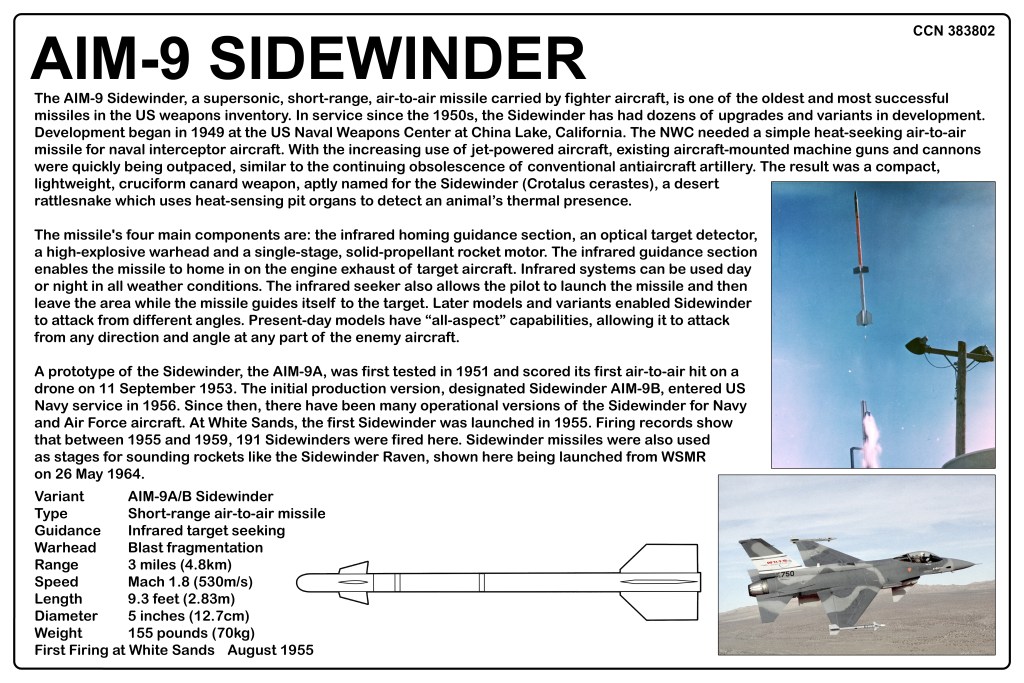
A prototype of the Sidewinder, the AIM-9A, was first tested in 1951 and scored its first air-to-air hit on a drone on 11 September 1953. The initial production version, designated Sidewinder AIM-9B, entered US Navy service in 1956. Since then, there have been many operational versions of the Sidewinder for Navy and Air Force aircraft. At White Sands, the first Sidewinder was launched in 1955. Firing records show that between 1955 and 1959, 191 Sidewinders were fired here. Sidewinder missiles were also used as stages for sounding rockets like the Sidewinder Raven.
Later Sidewinder Models
Sidewinders are of modular design with four main component sections: guidance control, warhead, target detection device, and the rocket motor. Outwardly, the missile did not change in appearance as upgrades were added and component changes were made. Missile length ranged from 9.3 to 10 feet and launch weight from 155 to 195 pounds. Its distinctive forward canards, its aft wings, and rollerons on a pencil-thin body have made the Sidewinder one of the easiest to recognize missiles in NATO’s inventory.
Starting with the AIM-9B, all Sidewinders through the AIM-9J used lead sulfide as the detector material. Uncooled in the AIM-9B, the lead sulfide infrared detector was cooled in later versions by using coolant tanks, either in the missile itself or as part of the launcher system, and thermo-electric devices. Among other differences were rocket motors of improved designs increasing the flight range; updating of 1950s vacuum tube technology to all-solid state electronics, as in the AIM-9H version; and modifications and improvements to the optics, servo, and proximity fuse.