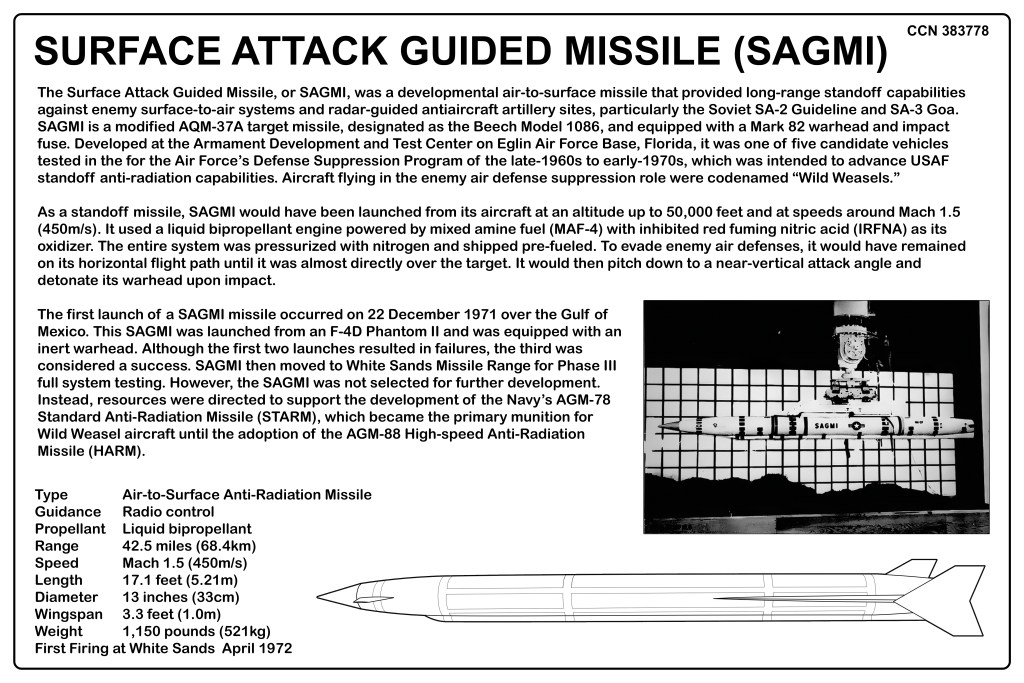
Surface Attack Guided Missile (SAGMI)
| Type: | Air-to-surface anti-radiation missile |
| Guidance: | Radio control |
| Propellant: | Liquid bipropellant |
| Range: | 42.5 miles (68.4km) |
| Speed: | Mach 1.5 (450m/s) |
| Length: | 17.1 feet (5.21m) |
| Diameter: | 13 inches (33cm) |
| Wingspan: | 3.3 feet (1.0m) |
| Weight: | 1,150 pounds (521kg) |
| First Firing at White Sands: | April 1972 |
The Surface Attack Guided Missile, or SAGMI, was a developmental air-to-surface missile that provided long-range standoff capabilities against enemy surface-to-air systems and radar-guided antiaircraft artillery sites, particularly the Soviet SA-2 Guideline and SA-3 Goa. SAGMI is a modified AQM-37A target missile, designated as the Beech Model 1086, and equipped with a Mark 82 warhead and impact fuse. Developed at the Armament Development and Test Center on Eglin Air Force Base, Florida, it was one of five candidate vehicles tested in the for the Air Force’s Defense Suppression Program of the late-1960s to early-1970s, which was intended to advance USAF standoff anti-radiation capabilities. Aircraft flying in the enemy air defense suppression role were codenamed “Wild Weasels.”
As a standoff missile, SAGMI would have been launched from its aircraft at an altitude up to 50,000 feet and at speeds around Mach 1.5 (450m/s). It used a liquid bipropellant engine powered by mixed amine fuel (MAF-4) with inhibited red fuming nitric acid (IRFNA) as its oxidizer. The entire system was pressurized with nitrogen and shipped pre-fueled. To evade enemy air defenses, it would have remained on its horizontal flight path until it was almost directly over the target. It would then pitch down to a near vertical attack angle and detonate its warhead upon impact.
The first launch of a SAGMI missile occurred on 22 December 1971 over the Gulf of Mexico. This SAGMI was launched from an F-4D Phantom II and was equipped with an inert warhead. Although the first two launches resulted in failures, the third was considered a success. SAGMI then moved to White Sands Missile Range for Phase III full system testing. However, the SAGMI was not selected for further development. Instead, resources were directed to support the development of the Navy’s AGM-78 Standard Anti-Radiation Missile (STARM), which became the primary munition for Wild Weasel aircraft until the adoption of the AGM-88 High-speed Anti-Radiation Missile (HARM).