Aerobee
| Aerobee 100 | Aerobee 150 | Aerobee 170 | Aerobee 200 | Aerobee 350 | Aerobee Hi | |
| Maximum Altitude | 102 miles | 189 miles | 210 miles | 290 miles | 348 miles | 170 miles |
| Acceleration | 15.2 G | 10.3 G | 12.4 G | 12.4 G | 15.2 G | 10.3 G |
| Weight Without Payload | 1,470 pounds | 1,941 pounds | 1,850 pounds | 2,027 pounds | 6,800 pounds | 2,050 pounds |
| Maximum Payload Capability | 200 pounds | 500 pounds | 550 pounds | 550 pounds | 900 pounds | 150 pounds |
| Length | 25.75 feet | 29.67 feet | 31 feet | 32 feet | 57 feet | 31 feet |
| Diameter | 15 inches | 15 inches | 15 inches | 15 inches | 22 inches | 15 inches |
The Aerobee rocket family was one of the oldest rocket firing programs at White Sands Missile Range and was officially introduced into service on 24 November 1947. Hundreds of Aerobees were launched to varying heights over White Sands in research projects designed to gather upper-atmospheric solar and stellar data.
Aerobee was designed as an expendable ballistic rocket capable of transporting a scientific payload to high altitudes. It was a boosted vehicle using a solid propellant booster and a liquid fuel sustainer. The liquid propellants were Red Fuming Nitric Acid as an oxidizer and Furfuryl Alcohol Aniline as fuel. The fluids were forced into the sustainer thrust chamber by 3,450 pounds per square inch of helium gas pressure, where they combust rapidly. Both the sustainer and the booster burned simultaneously at lift-off and were position-mated by nothing more than the overriding thrust of the booster.
The Aerobee had no guidance system. The fins were preset to give a slight spin that could be seen as the rocket left the tower. Spin was induced to furnish aerodynamic stability during flight.
The payloads or experiments are many varied. Each rocket may carry as many as six different experiments, each independent of the other. Cameras, vacuum bottles, mirrors, grids, sensing devices, lenses, and many other mechanical units have been carried aloft and returned to Earth. Most of the data collected is transmitted by telemetry from the rocket to ground receiving stations during flight and is recorded simultaneously with event occurrence.
An interesting feature of the Aerobee is that the rocket does not fly like an arrow but continues up until the zenith is reached and then falls tail first until the denser atmosphere is reached. The rocket then inverts and continues its descent in a normal ballistic trajectory. After separation of the nose cone from the sustainer, but prior to parachute deployment, the nose cone either tumbles or goes into a flat spin, depending on what has been programmed.
Impact predictions are based on the wind velocity and direction at launch time and are accomplished by tilting the launch tower in a compensating direction. The tower sits on a tripod which has one leg hinged. The other two are hydraulically powered for extension or retraction.
The entire nose cone, with exposed film, can be recovered in excellent condition through the use of a parachute. Some of the nose cones were flown a dozen times with only a minimal amount of servicing between each flight.
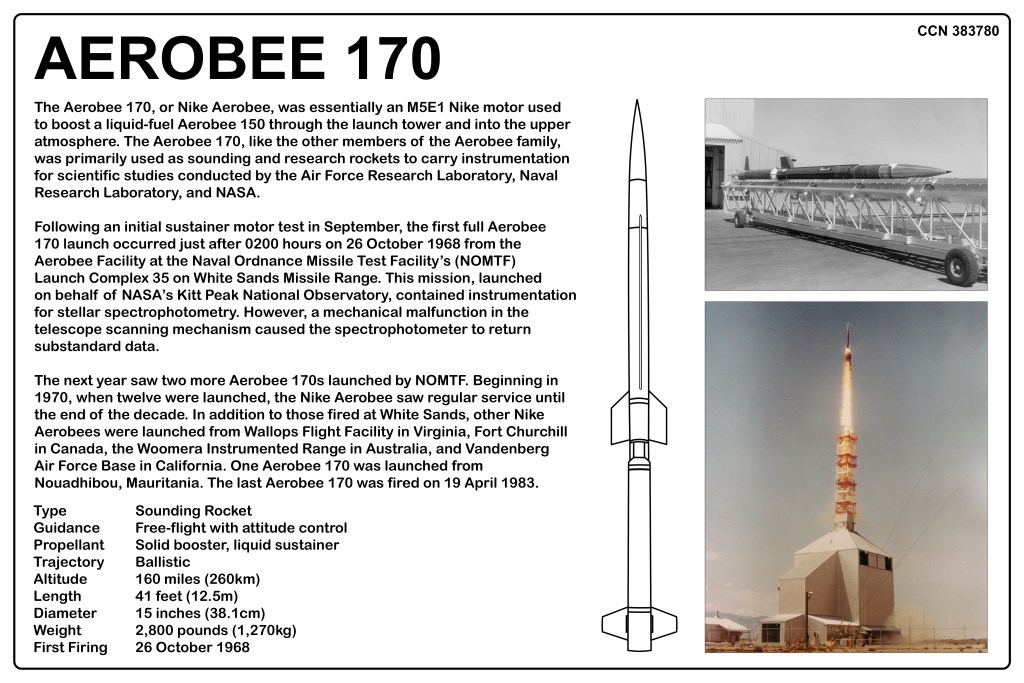
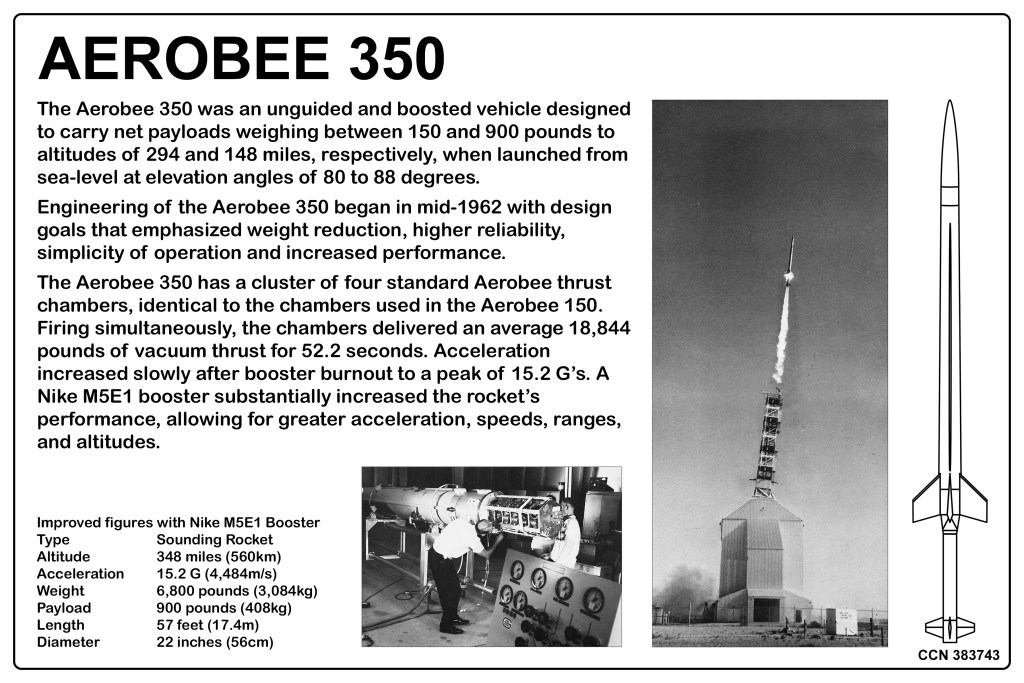
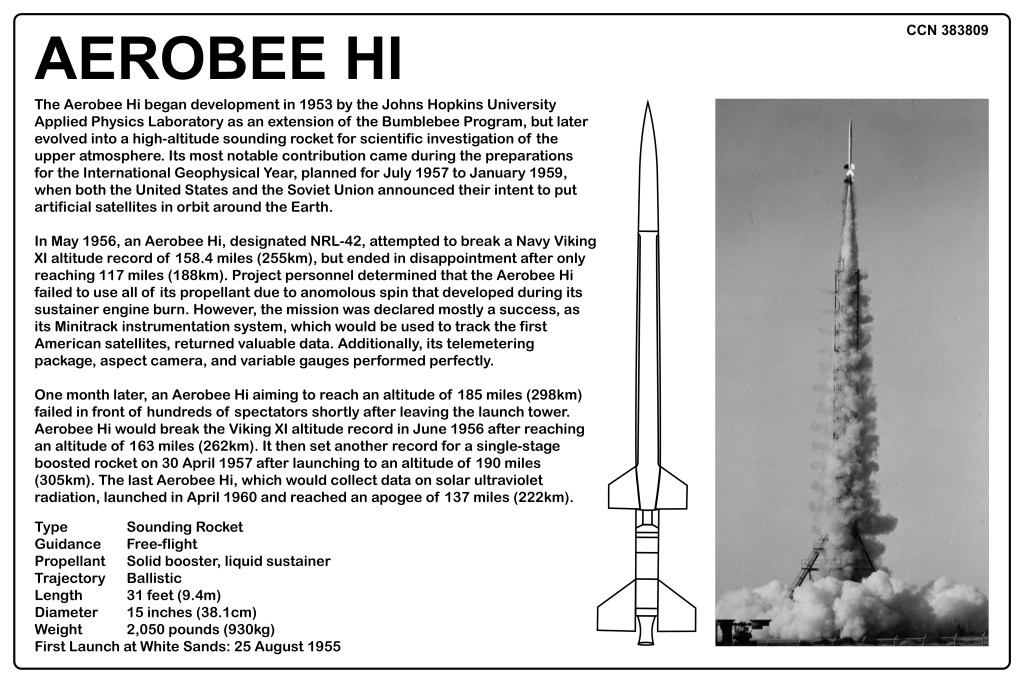
The Aerobee family of rockets were designated by their capable altitude in miles and included: Aerobee 100, Aerobee 150, Aerobee 170, Aerobee 200, Aerobee 350, and Aerobee Hi. The Aerobees were built primarily by Aerojet’s Space General Company and were tested at White Sands by the Naval Ordnance Missile Test Facility.