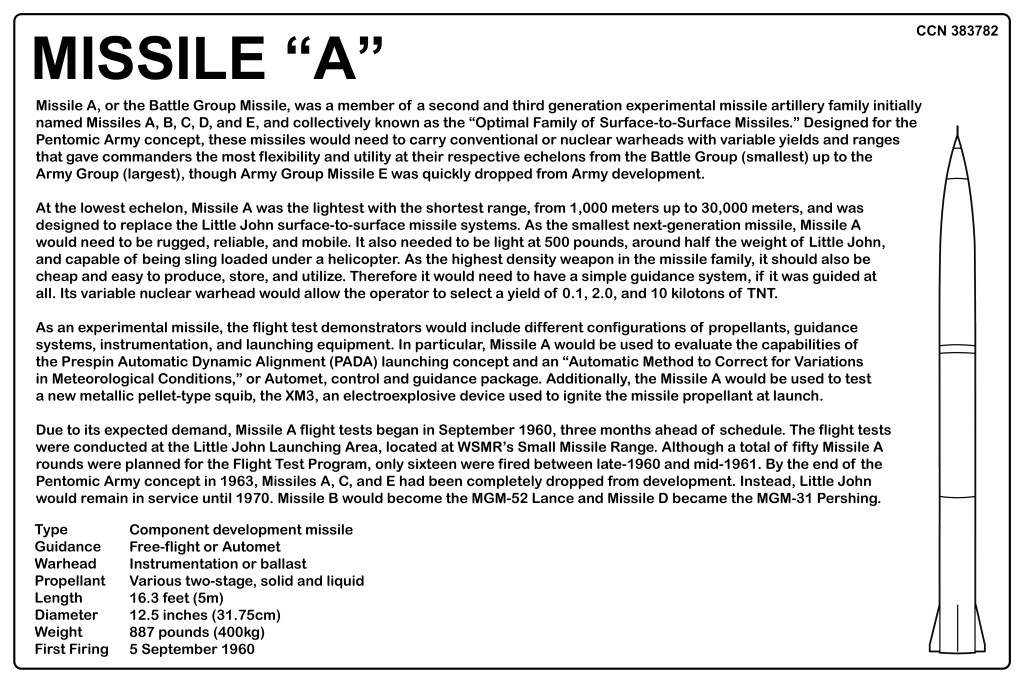
Missile “A”
| Type: | Component development missile |
| Guidance: | Free-flight or Automet |
| Warhead: | Instrumental or ballast |
| Propellant: | Various two-stage, solid and liquid |
| Length: | 16.3 feet (5m) |
| Diameter: | 12.5 inches (31.75cm) |
| Weight: | 887 pounds (400kg) |
| First firing: | 5 September 1960 |
Missile A, or the Battle Group Missile, was a member of a second and third generation experimental missile artillery family initially named Missiles A, B, C, D, and E, and collectively known as the “Optimal Family of Surface-to-Surface Missiles.” Designed for the Pentomic Army concept, these missiles would need to carry conventional or nuclear warheads with variable yields and ranges that gave commanders the most flexibility and utility at their respective echelons from the Battle Group (smallest) up to the Army Group (largest), though Army Group Missile E was quickly dropped from Army development.
At the lowest echelon, Missile A was the lightest with the shortest range, from 1,000 meters up to 30,000 meters, and was designed to replace the Little John surface-to-surface missile systems. As the smallest next-generation missile, Missile A would need to be rugged, reliable, and mobile. It also needed to be light at 500 pounds, around half the weight of Little John, and capable of being sling loaded under a helicopter. As the highest density weapon in the missile family, it should also be cheap and easy to produce, store, and utilize. Therefore it would need to have a simple guidance system, if it was guided at all. Its variable nuclear warhead would allow the operator to select a yield of 0.1, 2.0, and 10 kilotons of TNT.
As an experimental missile, the flight test demonstrators would include different configurations of propellants, guidance systems, instrumentation, and launching equipment. In particular, Missile A would be used to evaluate the capabilities of the Prespin Automatic Dynamic Alignment (PADA) launching concept and an “Automatic Method to Correct for Variations in Meteorological Conditions,” or Automet, control and guidance package. Additionally, the Missile A would be used to test a new metallic pellet-type squib, the XM3, an electroexplosive device used to ignite the missile propellant at launch.
Due to its expected demand, Missile A flight tests began in September 1960, three months ahead of schedule. The flight tests were conducted at the Little John Launching Area, located at WSMR’s Small Missile Range. Although a total of fifty Missile A rounds were planned for the Flight Test Program, only sixteen were fired between late-1960 and mid-1961. By the end of the Pentomic Army concept in 1963, Missiles A, C, and E had been completely dropped from development. Instead, Little John would remain in service until 1970. Missile B would become the MGM-52 Lance and Missile D became the MGM-31 Pershing.