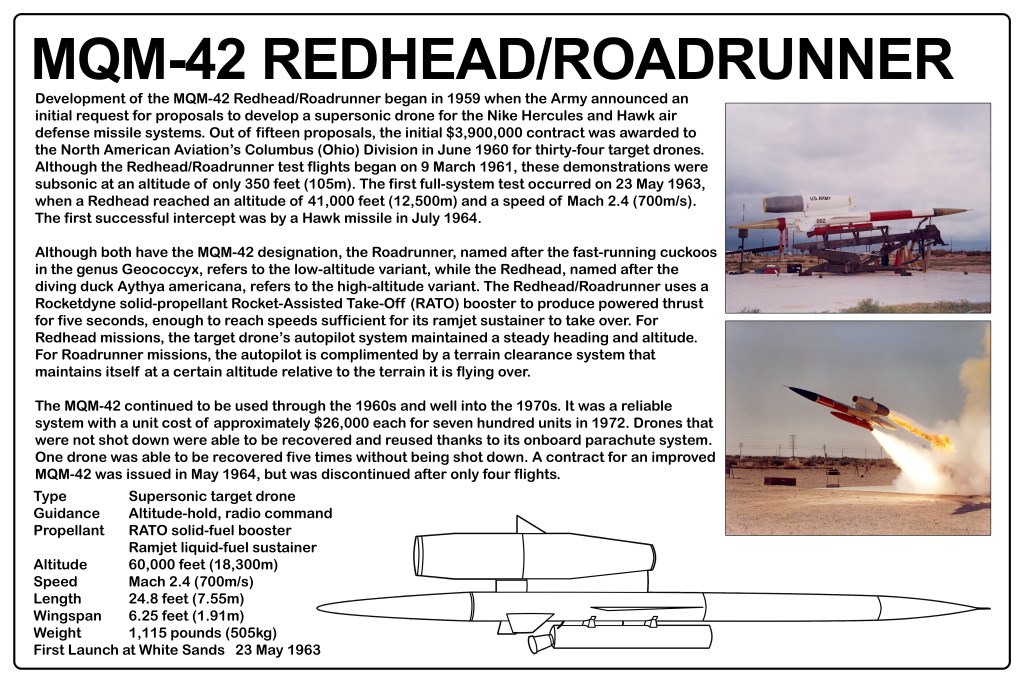
MQM-42 Redhead/Roadrunner
| Type: | Supersonic target drone |
| Guidance: | Altitude-hold, radio command |
| Propellant: | RATO solid-fuel booster Ramjet liquid-fuel sustainer |
| Altitude: | 60,000 feet (18,300m) |
| Speed: | Mach 2.4 (700m/s) |
| Length: | 24.8 feet (7.55m) |
| Wingspan: | 6.25 feet (1.91m) |
| Weight: | 1,115 pounds (505kg) |
| First firing at White Sands: | 23 May 1963 |
Development of the MQM-42 Redhead/Roadrunner began in 1959 when the Army announced an initial request for proposals to develop a supersonic drone for the Nike Hercules and Hawk air defense missile systems. Out of fifteen proposals, the initial $3,900,000 contract was awarded to the North American Aviation’s Columbus (Ohio) Division in June 1960 for thirty-four target drones. Although the Redhead/Roadrunner test flights began on 9 March 1961, these demonstrations were subsonic at an altitude of only 350 feet (105m). The first full-system test occurred on 23 May 1963, when a Redhead reached an altitude of 41,000 feet (12,500m) and a speed of Mach 2.4 (700m/s). The first successful intercept was by a Hawk missile in July 1964.
Although both have the MQM-42 designation, the Roadrunner, named after the fast-running cuckoos in the genus Geococcyx, refers to the low-altitude variant, while the Redhead, named after the diving duck Aythya americana, refers to the high-altitude variant. The Redhead/Roadrunner uses a Rocketdyne solid-propellant Rocket-Assisted Take-Off (RATO) booster to produce powered thrust for five seconds, enough to reach speeds sufficient for its ramjet sustainer to take over. For Redhead missions, the target drone’s autopilot system maintained a steady heading and altitude. For Roadrunner missions, the autopilot is complimented by a terrain clearance system that maintains itself at a certain altitude relative to the terrain it is flying over.
The MQM-42 continued to be used through the 1960s and well into the 1970s. It was a reliable system with a unit cost of approximately $26,000 each for seven hundred units in 1972. Drones that were not shot down were able to be recovered and reused thanks to its onboard parachute system. One drone was able to be recovered five times without being shot down. A contract for an improved MQM-42 was issued in May 1964, but was discontinued after only four flights.