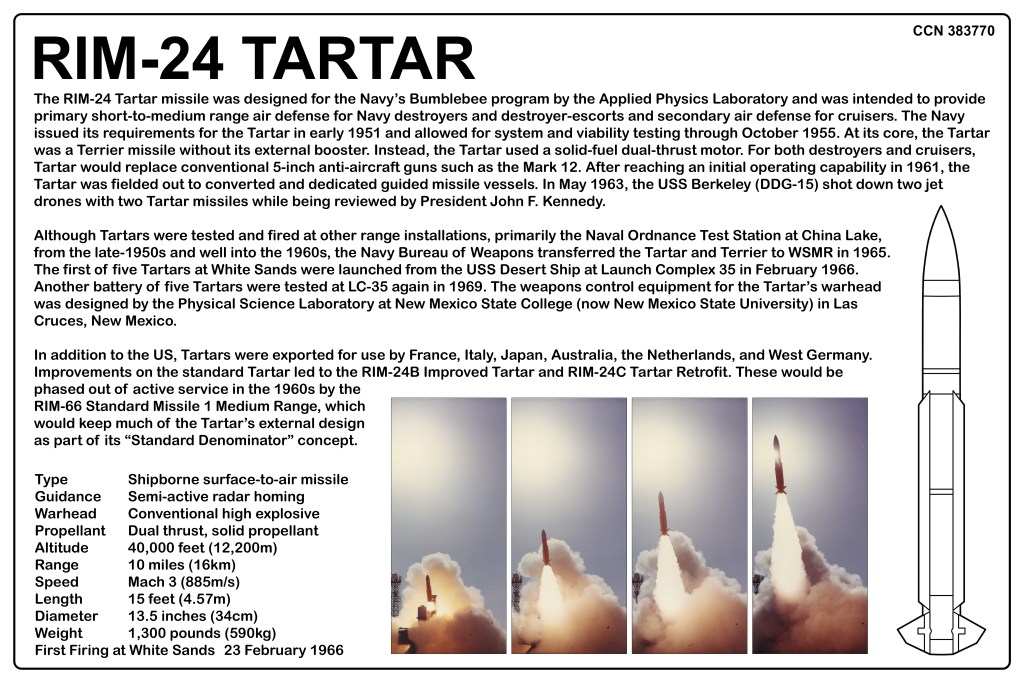
RIM-24 Tartar
| Type: | Shipborne surface-to-air missile |
| Guidance: | Semi-active radar homing |
| Warhead: | Conventional high explosive |
| Propellant: | Dual thrust, solid propellant |
| Altitude: | 40,000 feet (12,200m) |
| Range: | 10 miles (16km) |
| Speed: | Mach 3 (885m/s) |
| Length: | 15 feet (4.57m) |
| Diameter: | 13.5 inches (34cm) |
| Weight: | 1,300 pounds (590kg) |
| First Firing at White Sands: | 23 February 1966 |
The RIM-24 Tartar missile was designed for the Navy’s Bumblebee program by the Applied Physics Laboratory and was intended to provide primary short-to-medium range air defense for Navy destroyers and destroyer-escorts and secondary air defense for cruisers. The Navy issued its requirements for the Tartar in early 1951 and allowed for system and viability testing through October 1955. At its core, the Tartar was a Terrier missile without its external booster. Instead, the Tartar used a solid-fuel dual-thrust motor. For both destroyers and cruisers, Tartar would replace conventional 5-inch anti-aircraft guns such as the Mark 12. After reaching an initial operating capability in 1961, the Tartar was fielded out to converted and dedicated guided missile vessels. In May 1963, the USS Berkeley (DDG-15) shot down two jet drones with two Tartar missiles while being reviewed by President John F. Kennedy.
Although Tartars were tested and fired at other range installations, primarily the Naval Ordnance Test Station at China Lake, from the late-1950s and well into the 1960s, the Navy Bureau of Weapons transferred the Tartar and Terrier to WSMR in 1965. The first of five Tartars at White Sands were launched from the USS Desert Ship at Launch Complex 35 in February 1966. Another battery of five Tartars were tested at LC-35 again in 1969. The weapons control equipment for the Tartar’s warhead was designed by the Physical Science Laboratory at New Mexico State College (now New Mexico State University) in Las Cruces, New Mexico.
In addition to the US, Tartars were exported for use by France, Italy, Japan, Australia, the Netherlands, and West Germany. Improvements on the standard Tartar led to the RIM-24B Improved Tartar and RIM-24C Tartar Retrofit. These would be phased out of active service in the 1960s by the RIM-66 Standard Missile 1 Medium Range, which would keep much of the Tartar’s external design as part of its “Standard Denominator” concept.